India News
Sushma Swaraj leaves for Saudi Arabia as Guest of Honour


[vc_row][vc_column][vc_column_text]Will participate in a landmark cultural festival in Riyadh
External Affairs Minister Sushma Swaraj has left on her first official visit to Saudi Arabia on Tuesday. During her two day sojourn she will meet with the Saudi leadership and discuss bilateral, regional and global issues of mutual interest.
Minister of External Affairs will participate in the inauguration of the Janadriyah national and cultural festival in Riyadh on Wednesday. India is participating in the most popular and prestigious festival as Guest of Honour country for the first time.
Raveesh Kumar, spokesperson of Ministry of External Affairs announced her departure by his twitter post.[/vc_column_text][/vc_column][/vc_row][vc_row][vc_column][vc_raw_html]JTNDYmxvY2txdW90ZSUyMGNsYXNzJTNEJTIydHdpdHRlci10d2VldCUyMiUyMGRhdGEtbGFuZyUzRCUyMmVuJTIyJTNFJTNDcCUyMGxhbmclM0QlMjJlbiUyMiUyMGRpciUzRCUyMmx0ciUyMiUzRUVBTSUyMCUzQ2ElMjBocmVmJTNEJTIyaHR0cHMlM0ElMkYlMkZ0d2l0dGVyLmNvbSUyRlN1c2htYVN3YXJhaiUzRnJlZl9zcmMlM0R0d3NyYyUyNTVFdGZ3JTIyJTNFJTQwU3VzaG1hU3dhcmFqJTNDJTJGYSUzRSUyMGVtcGxhbmVzJTIwb24lMjBoZXIlMjBmaXJzdC1ldmVyJTIwdmlzaXQlMjB0byUyMFNhdWRpJTIwQXJhYmlhLiUyMER1cmluZyUyMHRoZSUyMHZpc2l0JTJDJTIwc2hlJTIwd2lsbCUyMG1lZXQlMjB3aXRoJTIwdGhlJTIwU2F1ZGklMjBsZWFkZXJzaGlwJTIwYW5kJTIwcGFydGljaXBhdGUlMjBhdCUyMHRoZSUyMGluYXVndXJhdGlvbiUyMG9mJTIwdGhlJTIwcHJlc3RpZ2lvdXMlMjAlRTIlODAlOThKYW5hZHJpeWFoJUUyJTgwJTk5JTIwZmVzdGl2YWwlMjBiZWluZyUyMGhlbGQlMjBpbiUyMFNhdWRpJTIwQXJhYmlhJTJDJTIwYXQlMjB3aGljaCUyMEluZGlhJTIwaXMlMjB0aGUlMjBndWVzdCUyMG9mJTIwaG9ub3VyJTIwY291bnRyeS4lMjAlM0NhJTIwaHJlZiUzRCUyMmh0dHBzJTNBJTJGJTJGdC5jbyUyRlNOVGxsUFY0bkglMjIlM0VwaWMudHdpdHRlci5jb20lMkZTTlRsbFBWNG5IJTNDJTJGYSUzRSUzQyUyRnAlM0UlMjZtZGFzaCUzQiUyMFJhdmVlc2glMjBLdW1hciUyMCUyOCU0ME1FQUluZGlhJTI5JTIwJTNDYSUyMGhyZWYlM0QlMjJodHRwcyUzQSUyRiUyRnR3aXR0ZXIuY29tJTJGTUVBSW5kaWElMkZzdGF0dXMlMkY5NjA3Njg3NjUyNTUzOTczNzclM0ZyZWZfc3JjJTNEdHdzcmMlMjU1RXRmdyUyMiUzRUZlYnJ1YXJ5JTIwNiUyQyUyMDIwMTglM0MlMkZhJTNFJTNDJTJGYmxvY2txdW90ZSUzRSUwQSUzQ3NjcmlwdCUyMGFzeW5jJTIwc3JjJTNEJTIyaHR0cHMlM0ElMkYlMkZwbGF0Zm9ybS50d2l0dGVyLmNvbSUyRndpZGdldHMuanMlMjIlMjBjaGFyc2V0JTNEJTIydXRmLTglMjIlM0UlM0MlMkZzY3JpcHQlM0UlMEE=[/vc_raw_html][/vc_column][/vc_row][vc_row][vc_column][vc_column_text]In April 2016, Prime Minister Narendra Modi had a landmark visit to Saudi Arabia, which gave a strong impetus to the mutually beneficial strategic ties. Saudi Arabia conferred its highest civilian honour King Abdulaziz award to Prime Minister.
Saudi Arabia is the fourth largest trading partner for India with bilateral trade exceeding USD 25 billion in 2016-17. Being the largest supplier of crude oil, Saudi Arabia accounts for about 20 percent of India’s total annual imports.
On Sunday, Minister of State for External Affairs Gen V. K. Singh addressed a joint press conference with Prince Khalid bin Abdul Aziz, the Saudi Minister of National Guard Prince on India’s participation in Janadriyah festival in Riyadh.
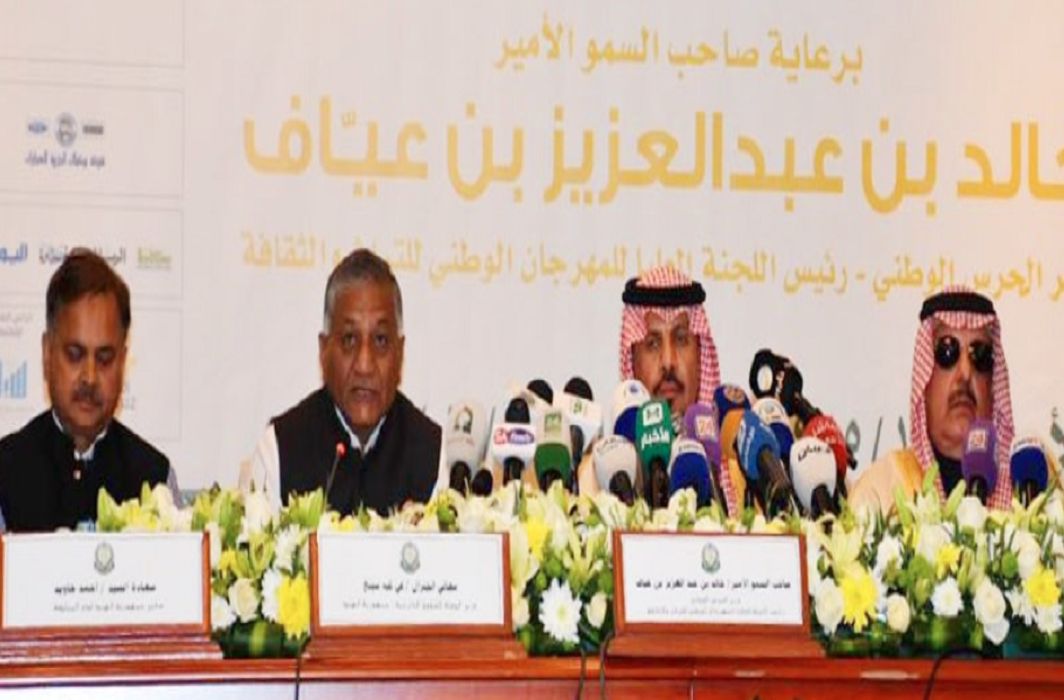 During interaction with media persons, Gen V. K. Singh had reportedly said “we greatly value our close and deep rooted civilizational and strategic relationship with the Kingdom of Saudi Arabia”.
Indian pavilion in the festival will project a number of themes and projects comprising glimpses of traditional and modern India. There will be displays and representations by various Ministries and Departments including Ordnance Factories Board, ISRO, Ministry of AYUSH, India Tourism Board, Ministries of Shipping, Textiles and Food Processing Industries. Moreover, Handicraft Promotion Council, Skill Development, Digital India and Make in India will also be introduced during the festival.
A number of Indian companies, including L & T, Tata Motors, Lulu Group, TCIL, Al Abeer Medical Group, ITL Group, Jet Airways and several others are putting up their stalls in the Indian pavilion. Nine Indian cultural troupes will present their performances during the festival.
Saudi Arabia hosts 3.2 million strong Indian community. Their positive and well-appreciated contribution in the development of the Kingdom’s economy has been an important element in the bilateral relations.[/vc_column_text][/vc_column][/vc_row]











India News
Journalist files police complaint against Rahul Gandhi over push allegation
Journalist Richa Parashar has filed a criminal complaint against Rahul Gandhi and others, alleging that she was pushed while covering the Opposition’s march to the Supreme Court. The Congress has denied the allegation.

India News
Delhi court orders release of CJP founder Abhijeet Dipke
A Delhi court on Saturday ordered the conditional release of Cockroach Janta Party founder Abhijeet Dipke, who was detained and subsequently arrested ahead of a planned protest march at Connaught Place.
India News
Anirudh Ravichander to marry Kavya Maran in November, reception on November 21
Anirudh Ravichander and Kavya Maran are set to marry in November, with their Chennai wedding reception scheduled for November 21.


Anirudh Ravichander to marry Kavya Maran in November, reception on November 21

Journalist files police complaint against Rahul Gandhi over push allegation

Delhi court orders release of CJP founder Abhijeet Dipke
Journalist files police complaint against Rahul Gandhi over push allegation
Delhi court orders release of CJP founder Abhijeet Dipke
Anirudh Ravichander to marry Kavya Maran in November, reception on November 21

ED summons Pinarayi Vijayan in money laundering case

LK Advani, 98, hospitalised in Delhi with chest infection

Afghan Men Try To Hang With The Jet Engine Of The Aircraft in Kabul- Afghanistan News – Kabul News
Trending Top 10 News: 10000 Crore Fine on Flipkart, Apple to Launch Unique Feature, Hdfc Bank Job Ad

Trending Top 10 News: Nokia 6310, Apple sales, Bachpan ka Pyar Video Kid, Dainik Bhaskar IT Raid

Trending Top 10 News: Canada bans Indian flights, Rain in Delhi NCR, AIMIM Twitter hacked, Raj Kundra case