English हिन्दी
Connect with us

Latest business news

Pitching for foreign investments, PM Modi says India will soon be 5th largest economy

Published

on

Pitching for foreign investments, PM Modi says India will soon be 5th largest economy

Making a strong pitch for foreign investments, Prime Minister Narendra Modi on Tuesday said his government has worked towards creating a stable business environment and removed arbitrariness in decision-making.

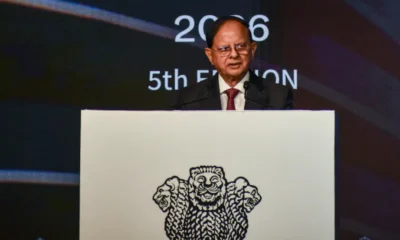
Speaking at the India-Korea Business Summit, he said India is one of the most open economies in the world and is ready to do business with the world.

“We seek positivity in day-to-day transactions. We are widening areas of trust rather than digging into doubts. This represents a complete change of the government’s mindset,” he said.

India, he said, is already the third-largest economy in terms of purchasing power. “Very soon, we will become the world’s fifth-largest economy by nominal GDP. We are also the fastest-growing major economy in the world today,” he said.

“We are also a country with the one of the largest start-up eco-system,” he added.

Stating that the government is on a de-regulation and de-licensing drive, Modi said validity period of industrial licences has been increased from three years to fifteen years and more. He said the Industrial licensing regime for defence production has been liberalized greatly. Nearly 65 percent to 70 percent of the items previously under licensing can now be produced without a license.

In FDI, India is one of the most open countries now and most of the sectors of its economy are open for FDI. “More than 90 percent approvals have been put on automatic route. There is practically no requirement of Government approval for investments in manufacturing sector except for Defence sector. Incorporating a company along with allotment of statutory numbers is now just a one day affair,” said Modi.

“If you see around the globe, there are very few countries where you have three important factors of the economy together. They are democracy, demography, and demand. In India, we have all the three together,” he said.

To the Korean businessmen, he said India is now ready for business and promised to do whatever is required to “promote and protect” their investment.

He noted that India’s trade with South Korea crossed 20 billion dollars last year, for the first time in six years. “Over 500 Korean companies are operating in India too. In fact, many of your products are house-hold names in India. However, South Korea ranks only 16th in FDI Equity inflows to India,” he said, adding, “India offers a lot of potential for the Korean Investors with its huge market and enabling policy environment.”

He listed the steps taken towards this, mentioning GST as one ‘historic’ step in this direction.

He said with unique ID and mobile phone penetration, India is fast moving towards becoming a Digital Economy.

“On the global platform. India has climbed 42 places in the World Bank’s Ease of Doing Business Index in the last three years. We moved up 19 places on the Logistics Performance Index of 2016 of World Bank. We have improved 31 places in last two years in the Global Competitiveness Index of the World Economic Forum. We have also moved up twenty one places on the Global Innovation Index of WIPO in two years. We are among the top 10 FDI destinations listed by UNCTAD,” said Modi.

“Our vision is to create a globally competitive industry and services base equipped with skill, speed and scale. Therefore, we are continuously working to improve our investment climate,” said Modi.

He laid stress on investments to promote the manufacturing sector “in a big way to create jobs for our youth”.

“For this purpose, we have launched a campaign called “Make in India”. This includes bringing our industrial infrastructure, policies and practices to best global standards and to convert India into a global manufacturing hub. This initiative has been well supplemented by programmes like ‘Digital India’ and ‘Skill India’. Cleaner and greener development and Zero defect Zero effect manufacturing is another commitment,” said the PM.

He spoke of the huge potential for cooperation in sectors like IT, car manufacturing, ship-building, housing, smart cities, railway stations, water, transportation, railways, sea ports, energy including renewables, IT infrastructure and services, electronics, to say “are all very promising sectors in my country”.

“Our partnership has immense potential to promote regional growth, development, stability and prosperity in Asia,” said Modi.

Pointing out that India a huge and emerging market, Modi said, “It can also be a bridge for Korean business to penetrate the Middle East and African markets.”

He said that after his Korea visit, a dedicated team was established for Korean Investments in India – “Korea Plus” was formed in June 2016. Envisaged as the first reference point for Korean Investors in India, Korea Plus has facilitated more than 100 Korean Investors in a short span of about two years, said Modi, concluding, “This shows our commitment towards welcoming Korean people and companies; ideas and investments.”

India News

Modi says right time to invest in Indian shipping sector; meets global CEOs

Published

on

Prime Minister Narendra Modi on Wednesday exhorted global investors to take bets on the Indian shipping sector, pointing out that this is the “right time” for such a move.

The Prime Minister also met a select chief executives of global majors, including DP World and APM, at a specially convened meeting on the sidelines of the India Maritime Week 2025 held here.

“For all of you hailing from different countries, this is the right time to work in the Indian shipping sector and also expand (your presence),” Modi said during a public address before the closed-door meeting with CEOs.

Modi listed several targets being chased by India in the maritime sector over the next few years, and underlined the importance of the global community in the same.

“You all are an important partner who will help us achieve all our aims. We welcome your ideas, innovations and investments,” Modi said.

He said that India allows 100 per cent foreign direct investment in the shipping and ports sector, and also provides incentives under the “Make In India, and Make For The World” vision.

Addressing an audience, including leaders of various companies, the Prime Minister affirmed India’s commitment to strengthening the supply chain resilience at a global level.

He also said that India is engaged in creating world-class mega ports, and cited the work undertaken on the Vadhavan Port to the north of the financial capital, which entered the top-10 firms in the world on the first day.

The government is also looking to grow the capacity at 12 major ports by four times and increase India’s share in containerised cargo at the global level.

Later, Modi held a meeting with top CEOs of shipping sector companies from across the world.

As per people in the know, he met AP Moller-Maersk Chairman Robert Maersk Uggla, DP World Group Chairman Sultan Ahmed bin Sulayem, Mediterranean Shipping Company Chief Executive Soren Toft, Adani Ports and SEZ Managing Director Karan Adani and French company CMA-CGM’s Senior Vice President Ludovic Renou.

The participation from over 85 countries in the IMW sends a strong message, Modi said, noting the presence of CEOs of major shipping giants, startups, policymakers, and innovators at the event.

The Prime Minister also thanked Port of Singapore (PSA) for the nearly Rs 8,000 crore investment in the Jawaharlal Nehru Port Authority’s fourth terminal, pointing out that this is also the largest FDI in the port sector in India.

Modi said more than 150 new initiatives have been launched under the ‘Maritime India Vision’, resulting in nearly doubling the capacity of major ports, a substantial reduction in turnaround time, and a new momentum in cruise tourism.

—PTI

Continue Reading

Economy news

ITR filing last date today: What taxpayers must know about penalties and delays

The deadline for ITR filing ends today, September 15. Missing it may lead to penalties, interest charges, refund delays, and loss of tax benefits.

Published

on

Income Tax Return

The deadline to file Income Tax Returns (ITR) for most taxpayers, including salaried individuals, pensioners, and small businesses not requiring audit, ends today, September 15. Those who miss the due date face penalties, interest charges, and loss of certain tax benefits.

Penalties for late filing

If the return is not filed by the deadline, taxpayers can still file a belated return until December 31. However, under Section 234F of the Income Tax Act, late filing attracts penalties.

  • For income up to Rs5 lakh: penalty is capped at Rs1,000.
  • For income above Rs5 lakh: penalty increases to Rs5,000.

Additionally, if any tax remains unpaid, Section 234A imposes an interest of 1% per month (or part thereof) until the return is filed.

Consequences of missing deadline

  • Loss of certain tax benefits: Belated filers cannot carry forward specific losses such as business or capital losses.
  • Restrictions on tax regime change: Taxpayers lose the option to switch between old and new tax regimes after the deadline.
  • Refund delays: Those eligible for refunds will face delays compared to timely filers.

Steps to file before time runs out

  • Gather documents: Form 16, Form 26AS, Annual Information Statement (AIS), bank interest certificates, and proofs of investments or deductions.
  • Use the e-filing portal: File immediately to avoid last-minute portal congestion.
  • Verify your return: Ensure the ITR is verified electronically or physically for it to be considered valid.

Continue Reading

Economy news

India’s GDP surges 7.8% in Q1, outpaces estimates and China

India’s GDP surged 7.8% in Q1 2025-26, the highest in five quarters, driven by strong services and agriculture sector growth, according to NSO data.

Published

on

GDP Growth

India’s economy recorded a sharp growth of 7.8% in the April-June quarter (Q1) of 2025-26, surpassing the earlier estimate of 6.5% and outpacing China’s 5.2% growth in the same period. The figure also marks a notable rise from the 6.5% growth in the corresponding quarter last year, making it the fastest expansion in the last five quarters.

Strong performance across key sectors

According to data released by the National Statistical Office (NSO), the surge was driven primarily by the services sector, which expanded 9.3% compared to 6.8% a year ago, and the agriculture sector, which rose 3.7% against 1.5% last year.

The construction sector, however, witnessed a slowdown, growing 7.6% compared to 10.1% in the same quarter of the previous fiscal.

RBI’s earlier forecast

Earlier this month, the Reserve Bank of India (RBI) had projected a more modest Q1 growth of 6.5%, with overall real GDP growth for 2025-26 expected at 6.5%. RBI Governor Sanjay Malhotra attributed the positive outlook to favorable conditions, including a good monsoon, lower inflation, and strong government capital expenditure.

He said, “The above normal southwest monsoon, lower inflation, rising capacity utilisation and congenial financial conditions continue to support domestic economic activity. The supportive monetary, regulatory and fiscal policies, including robust government capital expenditure, should also boost demand. The services sector is expected to remain buoyant, with sustained growth in construction and trade in the coming months.”

India remains fastest-growing major economy

With China reporting 5.2% growth in April-June, India has retained its position as the world’s fastest-growing major economy. The latest figures highlight resilience in the face of external pressures, including recent US tariffs on Indian imports.

Continue Reading

Trending

© Copyright 2022 APNLIVE.com