
Latest world news
Iran kills three Pakistan origin terrorists on border


Tehran loses two IRGC and one border guard personnel in gun-battle
Iranian forces have claimed of thwarting an attempt by Pakistan-based terrorists to storm and seize a security watchtower in its south-eastern border region, killing three terrorists in the operation. Three Iranian security personnel have also been killed.
According to Press TV, Islamic Revolution Guards Corps (IRGC) said in a statement that the “terrorist team from inside Pakistan” attacked the border guard watch-tower at 01:30 a.m. local time on Tuesday in the town of Mirjaveh in Sistan-and-Baluchestan province. However, the raid was met with “strong resistance” by the guards deployed at the watchtower.
Official IRNA news agency said, “At 0130 this morning (2100 GMT Monday], a terrorist group from Pakistan attacked” a police post in the border area of Mirjaveh, around 75 kilometres southeast of Zahedan, the capital of Sistan-Baluchistan province. The guards and terrorists exchanged gunfire for two hours.
Iranian media said that the terrorists failed to achieve their “ominous objective” as reinforcements were swiftly sent to help the guards. The ensuing clashes left three terrorists dead and several others injured. Two IRGC personnel and one border guard also lost their lives.
Over the past years, Iranian border guards have repeatedly come under attack by terror groups active on Pakistani soil. In April last year, 10 Iranian border guards were killed by militants in Mirjaveh.
Read More: Pakistan receives seven bodies from Afghanistan, Iran
According to Arab News, Iran has criticized Pakistan in the past for supporting the Jaish Al-Adl jihadist group, which it accuses of ties to Al-Qaeda and carrying out numerous attacks in Sistan-Baluchistan.
From 2005 to 2010, Sistan-Baluchistan suffered a prolonged insurgency by the Balochi-Sunni jihadist group Jundallah, meaning “soldiers of Allah,” although violence was largely curbed after the killing of its leader in mid-2010.
A hard-line separatist Sunni group called Jundullah, also known as People’s Resistance Movement of Iran (PRMI) is based in Sistan and Baluchistan, a south-eastern region of Iran.
The group founded by Abdolmalek Rigi, who was dramatically extracted from a passenger jet on his way from Dubai to Kyrgyzstan forcing pilots to land at Bandar Abbas on 23 February 2010, claims to be fighting for “equal rights of Sunnis”. Iranian agencies forced pilot of the passenger aircraft while flying over its airspace. Rigi was executed after a few month court proceedings in Iran. Iran alleges that Pakistani hard-line Sunnis, who were being supported and funded by CIA and Saudi Arabia have been supporting their Iranian counterparts.
Earlier on Monday, Iranian authorities handed over dead bodies of two civilians and five arrested persons to Pakistan’s Federal Investigative Agency (FIA). They were reportedly trying to sneak into Iran without travel documents. Iranian security forces had claimed of confiscating a large number of weapons and ammunition from militants in the area.






Latest world news
Magnitude 7 earthquake strikes Tibet after floods
A magnitude 7 earthquake struck northern Tibet on Thursday, October 22. The tremor came weeks after deadly flash floods and landslides hit the mountainous region near the Nepal-China border. Initial reports did not confirm casualties or damage from the earthquake.


Latest world news
Macron rejects Trump’s immigration claims over France riots
French President Emmanuel Macron criticised Donald Trump and other foreign leaders over their comments on France’s recent unrest. Macron rejected claims that the country was being overrun by migrants and Islamists, calling such assertions false.

Latest world news
Marco Rubio says India and US share extraordinary alignment on key issues
US Secretary of State Marco Rubio said India and the United States share an extraordinary alignment on core issues, even though disagreements between the two countries may arise.


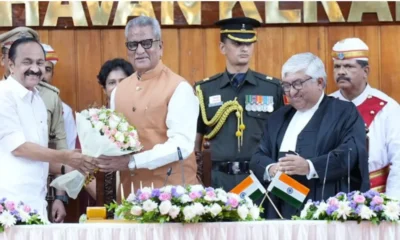
Om Prakash Mathur sworn in as Keralam Governor

PM Modi to inaugurate Rs 169-crore RBI data centre in Odisha on October 25

MEA responds after ITBP chief flags ongoing face-offs with China in Arunachal

Delhi High Court rejects Neha Bora’s plea against peace bond notice

Thousands bang utensils, beat drums in Manipur protest over continued killings

Congress seeks 175-200 seats in UP, Samajwadi Party stresses on winnability
Thousands bang utensils, beat drums in Manipur protest over continued killings
MEA responds after ITBP chief flags ongoing face-offs with China in Arunachal
Delhi High Court rejects Neha Bora’s plea against peace bond notice
PM Modi to inaugurate Rs 169-crore RBI data centre in Odisha on October 25

Afghan Men Try To Hang With The Jet Engine Of The Aircraft in Kabul- Afghanistan News – Kabul News
Trending Top 10 News: 10000 Crore Fine on Flipkart, Apple to Launch Unique Feature, Hdfc Bank Job Ad

Trending Top 10 News: Nokia 6310, Apple sales, Bachpan ka Pyar Video Kid, Dainik Bhaskar IT Raid

Trending Top 10 News: Canada bans Indian flights, Rain in Delhi NCR, AIMIM Twitter hacked, Raj Kundra case

Trending Top 10 News: Shein India, Apple New Service, Pocket Oxygen, Oppo Launched New Phone
-
 India News18 hours ago
Om Prakash Mathur sworn in as Keralam Governor
-
 India News18 hours ago
PM Modi to inaugurate Rs 169-crore RBI data centre in Odisha on October 25
-
 India News16 hours ago
MEA responds after ITBP chief flags ongoing face-offs with China in Arunachal
-
 India News17 hours ago
Delhi High Court rejects Neha Bora’s plea against peace bond notice
-
 India News4 hours ago
Thousands bang utensils, beat drums in Manipur protest over continued killings
-
 India News3 hours ago
Congress seeks 175-200 seats in UP, Samajwadi Party stresses on winnability
