English हिन्दी
Connect with us

Top Stories

India reports 5,880 fresh Covid-19 cases, 14 fatalities, check statewise list

The spike in Covid-19 cases is raising concern for the fourth wave in the country.

Published

on

Covid-19

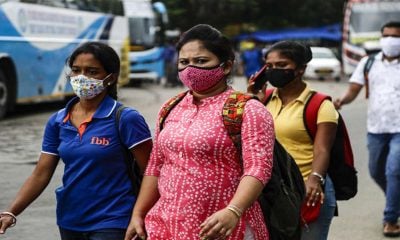
The spike in Covid-19 cases is raising concern for the fourth wave in the country. The Covid-19 cases in the country don’t seem to come down anytime soon. In the last 24 hours, India reported 5,880 fresh Covid-19 cases, compared to the previous day which recorded 5,357 cases.

With the addition of Sunday’s Covid-19 cases, the active cases stand at 35,199, comprising 0.07 percent of total infections. According to the Union Ministry of Health and Family Affairs, the daily positivity rate is 6.91 percent while the weekly positivity rate is 3.67 percent.

India also logged 14 new fatalities in the last 24 hours, taking the death toll to 5,30,979. The fatality rate stands at 1.19 percent.

With 859 fresh Covid-19 cases, Kerala recorded the highest number of cases in the last 24 hours, followed by Haryana with 283 cases, Delhi with 228 cases, Maharashtra with 227 cases, and Uttar Pradesh with 167 cases.

Read Also: Bajrang Dal leader who masterminded Bihar Ram Navami violence surrenders, riots were planned on WhatsApp group: Police

Check statewise active Covid-19 cases!

S. No.Name of State/UTActive Cases
1Andaman and Nicobar Islands0
2Andhra Pradesh160
3Arunachal Pradesh1
4Assam2
5Bihar146
6Chandigarh168
7Chhattisgarh466
8Dadra and Nagar Haveli and Daman and Diu1
9Delhi2460
10Goa776
11Gujarat2013
12Haryana1842
13Himachal Pradesh1764
14Jammu and Kashmir392
15Jharkhand63
16Karnataka1830
17Kerala12433
18Ladakh43
19Lakshadweep0
20Madhya Pradesh170
21Maharashtra4587
22Manipur10
23Meghalaya4
24Mizoram1
25Nagaland0
26Odisha629
27Puducherry271
28Punjab636
29Rajasthan651
30Sikkim47
31Tamil Nadu1900
32Telangana165
33Tripura0
34Uttarakhand81
35Uttar Pradesh1192
36West Bengal295

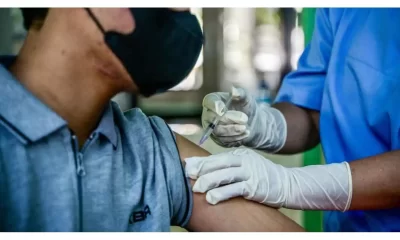
According to the ministry’s website, 220.66 crore doses of the Covid-19 vaccine have been administered so far under the nationwide inoculation drive.

Union Minister Bisheswar Tudu says officers appointed through UPSC are dacoits

Clashes in Jharkhand’s Jamshedpur after Ram Navami flag desecrated, Section 144 imposed

India News

Meerut murder: Muskaan Rastogi and Sahil Shukla get death sentence

A Meerut court has sentenced Muskaan Rastogi and Sahil Shukla to death in the blue drum murder case involving the killing of merchant navy officer Saurabh Rajput in March 2025.

Published

on

A court in Meerut has sentenced Muskaan Rastogi and Sahil Shukla to death for the murder of Saurabh Rajput, Muskaan’s husband and a former Merchant Navy officer. The sentencing was pronounced on Wednesday, October 14, 2026, after the court convicted the two in the case widely known as the Meerut blue drum murder.

The case involved the killing of Rajput in March 2025 and the concealment of his dismembered remains inside a blue plastic drum sealed with cement and sand.

The two were convicted on September 30. The prosecution had sought the death penalty, arguing for the maximum punishment in the case.

Court verdict follows 126 hearings

The trial involved 126 hearings and statements from 22 prosecution witnesses. District Judge Arvind Kumar Mishra delivered the sentence after the court considered the evidence presented during the proceedings.

The investigation and prosecution relied on a combination of circumstantial, technical and physical evidence. This included forensic findings, witness testimony and material recovered during the investigation.

The case drew attention after police discovered Rajput’s remains inside the cement-filled drum at the couple’s residence in Meerut.

How Saurabh Rajput was killed

According to the prosecution’s account of the case, Rajput was killed in March 2025 after he returned to Meerut from London. Investigators alleged that Muskaan and Sahil had planned the murder.

The prosecution said Rajput was given food laced with sleeping medication before he was attacked. His body was subsequently dismembered, and the remains were placed inside a blue plastic drum.

The drum was filled with a mixture containing cement and sand and sealed. Investigators later recovered the remains from inside it.

Evidence presented during the investigation

Investigators built the case using several strands of evidence. Shopkeepers provided testimony about the purchase of materials, including a blue drum, cement, sand and cutting implements, before the murder.

Call detail records and mobile tower information were also cited to establish Sahil’s presence at the residence around the time of the crime. The prosecution further relied on post-mortem findings that confirmed Rajput had died from stab injuries.

The investigation also traced the movements of Muskaan and Sahil during their trip to Himachal Pradesh following the killing. Investigators said photographs and activity linked to Rajput’s phone were used to create the impression that he was still alive.

The case came to light in March 2025

The murder came to light after questions arose over Rajput’s whereabouts. According to the investigation, the couple’s attempt to move the heavy drum eventually raised suspicion.

Rajput’s family approached the police, leading to an investigation that uncovered the remains. Muskaan and Sahil were arrested in March 2025.

The sentencing on October 14 marks a major development in the case, which had proceeded from the discovery of Rajput’s remains to a trial involving dozens of witness statements and more than a hundred hearings.

Continue Reading

India News

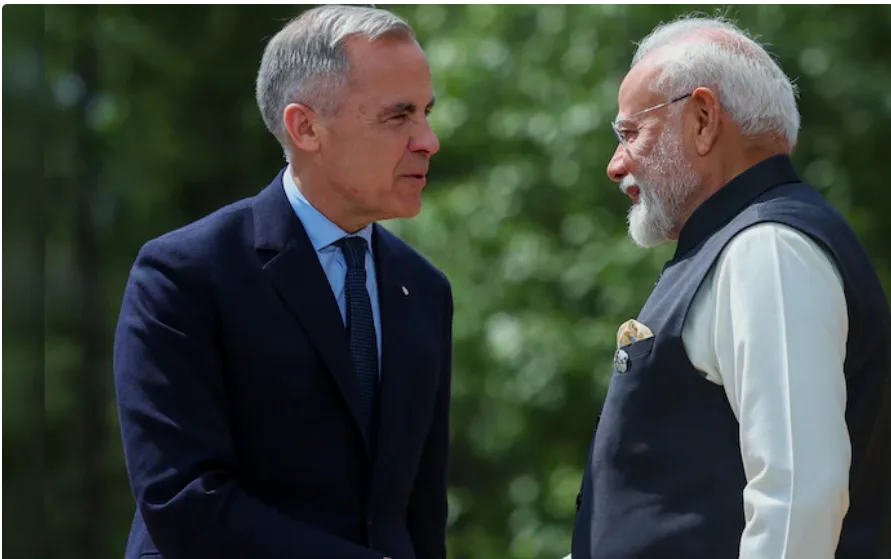
PM Modi speaks to Mark Carney as India and Canada push to strengthen ties

Prime Minister Narendra Modi held a telephone conversation with Canadian Prime Minister Mark Carney on October 13, with both leaders agreeing to strengthen India-Canada ties and pursue concrete outcomes across key areas of their strategic partnership.
Published

on

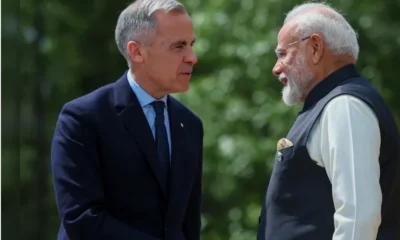
Prime Minister Narendra Modi held a telephone conversation with Canadian Prime Minister Mark Carney on Tuesday, October 13, as the two countries seek to strengthen bilateral relations and translate renewed diplomatic engagement into concrete outcomes.

Following the conversation, Modi said both leaders had agreed to build on the positive momentum in India-Canada ties and work towards progress across key areas of their strategic partnership.

In a post on X, the prime minister described the conversation as “warm and productive”. He identified trade, energy, technology, security and people-to-people ties as important areas for further cooperation.

Modi also said India and Canada were contributing towards a more stable and prosperous world.

India and Canada focus on trade and strategic cooperation

The latest conversation comes amid increased engagement between New Delhi and Ottawa across economic, security and diplomatic matters.

According to the Canadian Prime Minister’s Office, the two leaders welcomed the expansion of engagement over the past year, including cooperation in finance, defence and security, people-to-people ties and artificial intelligence.

The two leaders reaffirmed their commitment to concluding negotiations on a Comprehensive Economic Partnership Agreement (CEPA) at the earliest opportunity. The proposed agreement is intended to support efforts to double two-way trade between India and Canada by 2030.

The leaders welcomed the ongoing Team Canada Trade Mission in India, led by Canadian International Trade Minister Maninder Sidhu, along with the visit of Canadian Foreign Minister Anita Anand to New Delhi.

The engagements are aimed at advancing shared priorities, including trade, energy and people-to-people ties.

Security cooperation remains on the agenda

The conversation followed a bilateral security dialogue held in India the previous week as part of ongoing engagement between the two countries on security and law enforcement.

The Canadian Prime Minister’s Office said the two leaders welcomed the bilateral security dialogue held in India the previous week as part of ongoing security and law enforcement engagement at the National Security Advisor level. They also agreed to remain in close contact ahead of Modi’s planned visit to Canada in December.

The Canadian readout also said the two prime ministers discussed the effects of geopolitical instability on the Indo-Pacific region and the need for trusted partners in energy and agriculture.

Carney thanked Modi for his leadership in seeking a peaceful resolution to Russia’s war against Ukraine.

India-Canada relations seek to move beyond diplomatic tensions

Relations between India and Canada deteriorated sharply in 2023 after then Canadian Prime Minister Justin Trudeau alleged a potential Indian link to the killing of Khalistan separatist Hardeep Singh Nijjar in Canada.

India rejected the accusation as absurd. In October 2024, India recalled its high commissioner and five other diplomats after Ottawa attempted to link them to the Nijjar case. New Delhi also expelled an equal number of Canadian diplomats.

Relations have since shown signs of improvement through renewed diplomatic engagement and cooperation in several areas. Both countries now have high commissioners posted in each other’s capitals.

Canadian Prime Minister Carney’s visit to India in March 2026 also contributed to renewed efforts to strengthen bilateral ties.

The latest conversation between Modi and Carney reflects the two governments’ stated intention to build on this progress, with trade negotiations, security cooperation and other shared priorities remaining central to their engagement.

Modi’s planned visit to Canada in December is expected to provide another opportunity for the two sides to advance their bilateral agenda.

Continue Reading

Latest world news

S Jaishankar says India is a natural option for Russia amid Europe tensions

External Affairs Minister S Jaishankar said India remained a natural option for Russia as Moscow increasingly turned towards Asia amid strained relations with Europe. He highlighted the continuity of India-Russia ties and their significance for the balance of power in Asia.

Published

on

External Affairs Minister S Jaishankar has described India as a natural option for Russia as Moscow increasingly looks towards Asia amid deteriorating relations with Europe. He said India’s longstanding relationship with Russia had remained steady despite significant changes in the international strategic landscape.

Jaishankar made the remarks during a conversation with John Micklethwait, editor-in-chief of the Bloomberg New Economy Forum. He discussed how the Russia-Ukraine war had affected Moscow’s relationship with Europe and contributed to Russia’s growing focus on Asia.

Jaishankar highlights Russia’s shift towards Asia

Jaishankar said Russia’s relationship with Europe had become deeply strained following the Ukraine war. He noted that Russia had historically viewed itself as a European country and placed considerable importance on its relations with Europe and the United States.

However, the conflict had pushed Moscow to look increasingly towards Asia,with much of that shift directed towards China.

The minister said it was in India’s interest, as well as the wider world’s interest, for Russia to maintain multiple relationships in Asia rather than having its options concentrated in one direction.

Against this backdrop, he described India as a natural partner for Russia, pointing to the longstanding nature of the relationship between the two countries.

India-Russia ties remain steady despite global changes

Jaishankar said India and Russia had maintained a consistent relationship over several decades. He emphasised that New Delhi continued to engage with Moscow even as the global order and Russia’s strategic calculations evolved.

According to the minister, India was reassuring Russia that the relationship built over nearly eight decades remained steady despite the changes in Moscow’s relations with Europe and the wider West.

He stressed that India was not passing a value judgment on those changes but was continuing its bilateral engagement with Russia.

Jaishankar said the relationship had benefited both countries and contributed to the balance of power and the broader status quo in Asia. 

Why the relationship matters for Asia

Jaishankar’s remarks highlighted India’s position in Russia’s changing regional outlook. As Moscow increasingly turns towards Asia, India continues to maintain its longstanding ties with Russia while navigating a changing international environment.

The minister’s comments underscored the importance he placed on preserving India-Russia ties and ensuring that Russia maintained multiple relationships in Asia. 

His assessment came against the backdrop of strained Russia-Europe relations following the war in Ukraine, which has reshaped Moscow’s engagement with Western countries and increased its focus on Asian partners.

Continue Reading

Trending

© Copyright 2022 APNLIVE.com