English हिन्दी
Connect with us

India News

PM Modi pays tribute to VD Savarkar on death anniversary, says India will remember his valiant spirit

Veer Sawarkar passed away in 1966 on February 26.

Published

on

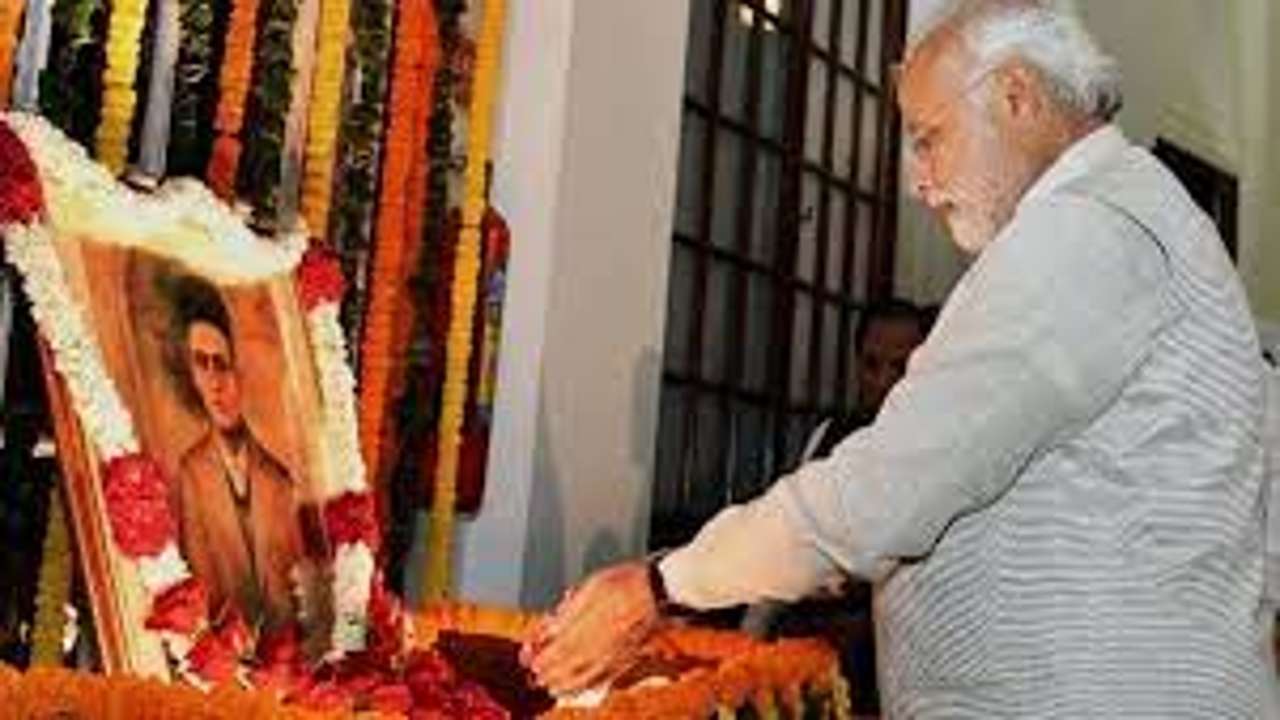
Prime Minister Narendra Modi today paid tribute to Hindutva icon Vinayak Damodar Savarkar and said that India will never forget his unwavering dedication to the country’s freedom and unity.

Born at Bhagur on May 28, 1883, Vinayak Damodar Savarkar, often known as Veer Savarkar, was raised there. Savarkar, an esteemed advocate of the Hindutva ideology, passed away in 1966.

Tributes to Veer Savarkar on his Punya Tithi, PM Modi wrote in a post on X. He also said, India will forever remember his valiant spirit and unwavering dedication to our nation’s freedom and integrity. His achievements motivate us to work toward our nation’s growth and prosperity, rhe PM added.

The national president of the BJP JP Nadda, on his officia X handle said, he pays his tribute to Swatantryaveer Vinayak Damodar Savarkar, the great hero of the Indian freedom struggle, the founder of cultural nationalism, an embodiment of unparalleled sacrifice and bravery, on his death anniversary. He also said, millions of his compatriots will always find inspiration in his commitment to securing Mother India’s freedom and fostering cultural awareness in the community.

Meanwhile, following his graduation from Pune College in 1906, Savarkar pursued legal studies in the United Kingdom. He founded the Free India Society that same year.

Savarkar was certain that national education should be given, a revolutionary spirit should be fostered, and the principles of Swadeshi and a boycott of foreign products should all be part of the fight for the freedom of the Motherland.

He was detained in London in 1909 on suspicion of organizing an armed uprising against the Morley-Minto reform. After that, he was given two life terms in the Andaman cellular jail. Savarkar was freed from prison in 1924, but only if he would stay out of politics for five years. He did, however, keep pushing for other social reforms, such as the abolition of untouchability.

India News

Ukraine envoy meets Ajit Doval, S Jaishankar to discuss path to peace

Ukraine’s Rustem Umerov met Ajit Doval and S Jaishankar in New Delhi to discuss the conflict and efforts towards a peaceful resolution.

Published

on

Ukraine envoy meets Ajit Doval

A senior Ukrainian official held high-level meetings with India’s top leadership in New Delhi, focusing on efforts to find a peaceful resolution to the ongoing conflict in Ukraine.

Rustem Umerov, a top aide to Volodymyr Zelensky, met separately with Ajit Doval and S. Jaishankar during his visit.

In his meeting with Ajit Doval, discussions focused on the evolving situation along the frontline in Ukraine, along with broader security developments related to the conflict.

Talks with External Affairs Minister S. Jaishankar covered the ongoing war as well as bilateral ties between India and Ukraine. Both sides exchanged views on diplomatic efforts aimed at ending the conflict.

India reiterated its consistent position that the crisis should be resolved through dialogue and diplomacy, emphasising the need for continued engagement between all parties.

Umerov noted that the discussions also touched on the progress of negotiations and the prospects for achieving a “just, lasting and sustainable peace” in Ukraine. He described the interactions as constructive and highlighted ongoing cooperation between the two countries following earlier high-level engagements.

Continue Reading

India News

Women’s quota bill fails in Lok Sabha as it falls short of two-thirds majority

Women’s reservation proposal failed in Lok Sabha after securing 298 votes, below the required two-thirds majority

Published

on

Parliament

Government secures 298 votes in favour, 230 against; proposal does not pass constitutional threshold

The proposed amendment related to women’s reservation failed to pass in the Lok Sabha on Friday after the government could not secure the required two-thirds majority.

The bill received 298 votes in favour and 230 against, falling short of the constitutional threshold needed for passage. As a constitutional amendment, it required the support of at least two-thirds of members present and voting.

Despite securing a simple majority, the government was unable to gather sufficient support to meet this requirement.

Debate continues over two days

The discussion on the bill extended late into Thursday and continued on Friday, with members from both sides participating in the debate on women’s representation in legislative bodies.

Prime Minister Narendra Modi urged members to support the proposal, calling for wider consensus on the issue.

Implications of the outcome

The failure of the bill underscores the challenges in securing broad political agreement on constitutional amendments, especially those related to representation and electoral reforms.

The proposal was aimed at advancing women’s representation in the Lok Sabha and state assemblies, an issue that has remained under discussion for several years.

Continue Reading

India News

Rahul Gandhi faces FIR order as Allahabad High Court acts on dual citizenship plea

High Court allows plea in Rahul Gandhi citizenship case, paving the way for further legal process.

Published

on

Rahul Gandhi

The Lucknow bench of the Allahabad High Court has allowed a petition seeking legal action in connection with allegations related to Congress leader Rahul Gandhi’s citizenship status, marking a fresh development in the case.

The petition was filed by a political worker, who had approached the court seeking directions for registration of a case over claims that Gandhi may have held foreign citizenship. The High Court, while hearing the matter, passed directions for further proceedings in accordance with law.

The development comes after a special MP/MLA court in Lucknow had earlier declined to order registration of an FIR, reportedly observing that it lacked jurisdiction in matters concerning citizenship.

Background

The case is linked to allegations that Rahul Gandhi may have held British citizenship. Under Indian law, dual citizenship is not permitted. However, these claims remain part of the petitioner’s submissions and have not been established by any court.

During earlier hearings, the High Court had sought records and considered material presented by the parties involved.

What happens next

With the High Court allowing the plea, the matter is expected to proceed as per due legal process. This may involve examination by the appropriate authority and further judicial review at subsequent stages.

The case carries both legal and political significance given Rahul Gandhi’s role as Leader of the Opposition in the Lok Sabha.

Continue Reading

Trending

© Copyright 2022 APNLIVE.com