English हिन्दी
Connect with us

India News

Doctors’ strike hits healthcare across India, Calcutta HC orders CBI probe

Published

on

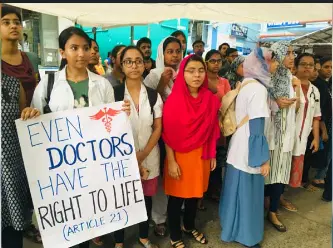
The all-India doctors’ strike on Tuesday in protest against the rape and murder of 31-year-old junior doctor in Kolkata has hit health services across the country.

The protesting doctors had announced that out-patient department services would be hit during the strike. AIIMS Delhi which sees thousands of OPD patients a day saw a fall though marginal. The worst hit cities are Kolkata, Delhi, Pune, Lucknow and Jaipur where doctors in state hospitals have joined protests.

The strike is near total in Kokata with the transfer and appointment of the RG Kar Medical College and Hospital to another hospital galvanising the angry doctors, who are demanding justice for the victim who was found dead inside a hospital seminar hall on August 9, Friday.

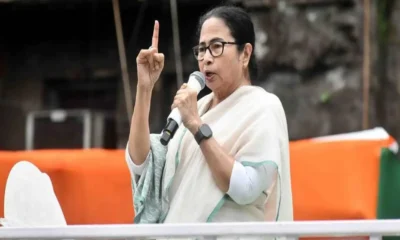
Yesterday, West Bengal Chief Minister Mamata Banerjee had promised to transfer the case to the CBI if the Kolkata Police failed to wrap the case by August 18, Sunday.

Doctors who are working in states such as Uttarakhand are going about their day with a black arm band. In Rajasthan, doctors didn’t turn up for work for two hours.  

The Calcutta High Court, meanwhile, has ordered a CBI probe into the issue. Chief Justice TS Sivagnanam and other judges on the division bench wondered why a murder case was not registered by the principal or the hospital superintendent since the body of the victim was found in college premises.

Though a civic volunteer was arrested on Saturday last, the police in Kokata are questioning several people including four doctors who had dinner with the victim.

 The protesting doctors in Kolkata have stuck to their guns and have said they will not call off their stir until their demands are met. The demands include a magisterial probe into the killing and the sacking of senior officials of the hospital involved. They are also pushing for the police investigation to be completed  by August 14, Wednesday.

India News

Amit Shah says Centre will amend NDPS Act to tighten crackdown on drug syndicates

Amit Shah said the Centre is relooking the NDPS Act to plug loopholes exploited by narco syndicates and strengthen anti-drug enforcement across India.

Published

on

Union Home Minister Amit Shah on Friday said the Centre is preparing amendments to the Narcotic Drugs and Psychotropic Substances (NDPS) Act to close loopholes allegedly exploited by drug trafficking networks and strengthen India’s anti-narcotics framework.

Addressing the 10th apex-level meeting of the Narco-Coordination Centre (NCORD) in New Delhi, Shah said the government is re-examining the existing law and invited states to submit suggestions for the proposed changes. The amendments are being worked on by the Ministry of Finance to make the legislation more effective in tackling organised drug syndicates.

Centre seeks stronger legal framework against narcotics

Shah stressed the need for a tougher approach towards drug traffickers and peddlers, while advocating a compassionate stance towards victims of addiction. He outlined a three-pronged strategy against drug trafficking — “detect, disrupt and destroy” — and urged all stakeholders to intensify efforts against the narcotics menace.

The Home Minister also asked state governments to share suggestions on strengthening the NDPS Act. Directors General of Police have been asked to forward recommendations to the Ministry of Home Affairs, while Chief Secretaries can submit their inputs to the Department of Revenue under the Ministry of Finance.

Seizures of synthetic drugs rise over past decade

Highlighting the government’s anti-drug campaign, Shah said that between 2004 and 2014, around 26 lakh kilograms of synthetic drugs were seized across the country. In comparison, agencies confiscated approximately 1.18 crore kilograms of synthetic drugs between 2014 and 2026.

He further said the estimated value of drugs seized during 2014-2026 stood at around Rs 1.84 lakh crore, significantly higher than the nearly Rs 40,000 crore worth of narcotics seized during the previous decade. According to Shah, these figures reflect the expanded scale and effectiveness of anti-drug enforcement efforts.

The minister also called for real-time information sharing among states through digital platforms developed by the Narcotics Control Bureau and urged authorities to ensure NCORD meetings deliver measurable outcomes. He unveiled the “Vision Document on Drug Control (2026-2029)”, which aims to provide a roadmap for reducing drug demand, curbing supply and minimising harm caused by substance abuse.

Continue Reading

India News

If passport does not establish citizenship, then what does: Shashi Tharoor asks amid row

Shashi Tharoor has questioned the Centre’s stance that passports are not proof of citizenship and urged legislative changes to recognise passports and Aadhaar as conclusive citizenship documents.

Published

on

Congress MP Shashi Tharoor on Friday questioned the existing legal framework governing proof of Indian citizenship, asking what document citizens should rely on if a passport itself is not considered conclusive evidence of citizenship.

The remarks came a day after the Centre clarified that an Indian passport is primarily a travel document and has never been treated as definitive proof of citizenship under existing laws. The government maintained that this position is not new and has remained unchanged for years.

Reacting to the clarification, Tharoor described the situation as an “absurd legal paradox” and argued that ordinary citizens have long regarded passports as the highest form of official identity because they are issued only after extensive verification procedures. He said it is difficult for people to understand how a document obtained after rigorous scrutiny does not conclusively establish citizenship.

In a detailed statement, the Thiruvananthapuram MP urged the government to undertake what he termed a “common-sense legislative overhaul” to end the controversy. He proposed amending the legal framework so that both passports and Aadhaar cards are recognised as valid and conclusive proof of Indian citizenship unless specifically cancelled or withdrawn by the government.

Tharoor, however, acknowledged a key challenge with Aadhaar. Since Aadhaar is currently issued on the basis of residence and is available to both citizens and certain non-citizen residents, he suggested that the Unique Identification Authority of India issue a visually distinct Aadhaar card for non-citizens. According to him, such a distinction would allow the government to designate standard Aadhaar cards and valid Indian passports as sufficient proof of citizenship.

The debate intensified after the Ministry of External Affairs stated during a recent briefing that an Indian passport should not be treated as conclusive proof of citizenship. The Centre subsequently reiterated that the Passports Act, 1967 permits passports to be issued to non-citizens in certain circumstances in the public interest, and therefore possession of a passport alone cannot legally establish citizenship.

Continue Reading

India News

Ayodhya Ram Mandir donation row: 8 arrested, Champat Rai resigns as Yogi Adityanath vows strict action

The Ayodhya Ram Mandir donation controversy intensified after all eight accused were arrested and trust official Champat Rai resigned on moral grounds.

Published

on

Ram Mandir

The alleged embezzlement of donations received at the Ram Mandir in Ayodhya has triggered major developments, with all eight accused named in the FIR now under arrest and senior temple trust officials resigning from their positions. Authorities have said the investigation will continue and anyone found guilty will face strict action.

The First Information Report was registered following recommendations made by a Special Investigation Team (SIT) constituted by the Uttar Pradesh government to probe allegations of irregularities in the handling of donations received at the temple. The complaint was lodged by a member of the Shri Ram Janmabhoomi Teerth Kshetra Trust.

According to officials, the eight accused were associated with the process of counting cash and valuables offered by devotees at the temple. Senior officials confirmed that all those named in the FIR have been arrested and are currently being questioned as part of the ongoing investigation.

Champat Rai and Anil Mishra step down

Amid the growing controversy, Shri Ram Janmabhoomi Teerth Kshetra Trust General Secretary Champat Rai resigned from his post on moral grounds. Trust member Anil Mishra also submitted his resignation, officials confirmed. Their resignations come as scrutiny over the alleged misappropriation of temple donations intensifies.

Yogi Adityanath says guilty will not be spared

Addressing a public meeting in Deoria, Uttar Pradesh Chief Minister Yogi Adityanath said action began immediately after the SIT submitted its report. He asserted that no individual involved in wrongdoing would be exempted from legal action.

The chief minister described Ayodhya as a symbol of faith and said that public sentiments attached to Lord Ram and Sanatan Dharma cannot be compromised. He assured that the government would ensure a fair probe and separate truth from falsehood.

The issue has also sparked political reactions, with opposition leaders questioning the investigation and demanding accountability, while BJP leaders have maintained that strict action will be taken against all those responsible.

Continue Reading

Trending

© Copyright 2022 APNLIVE.com