English हिन्दी
Connect with us

India News

At Nowshera rally, Amit Shah says no stone pelter, terrorist will be released in Jammu & Kashmir

“If they fire a bullet, we will respond with a shell,” he said.

Published

on

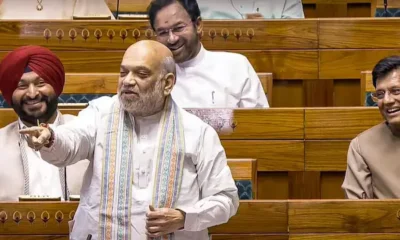
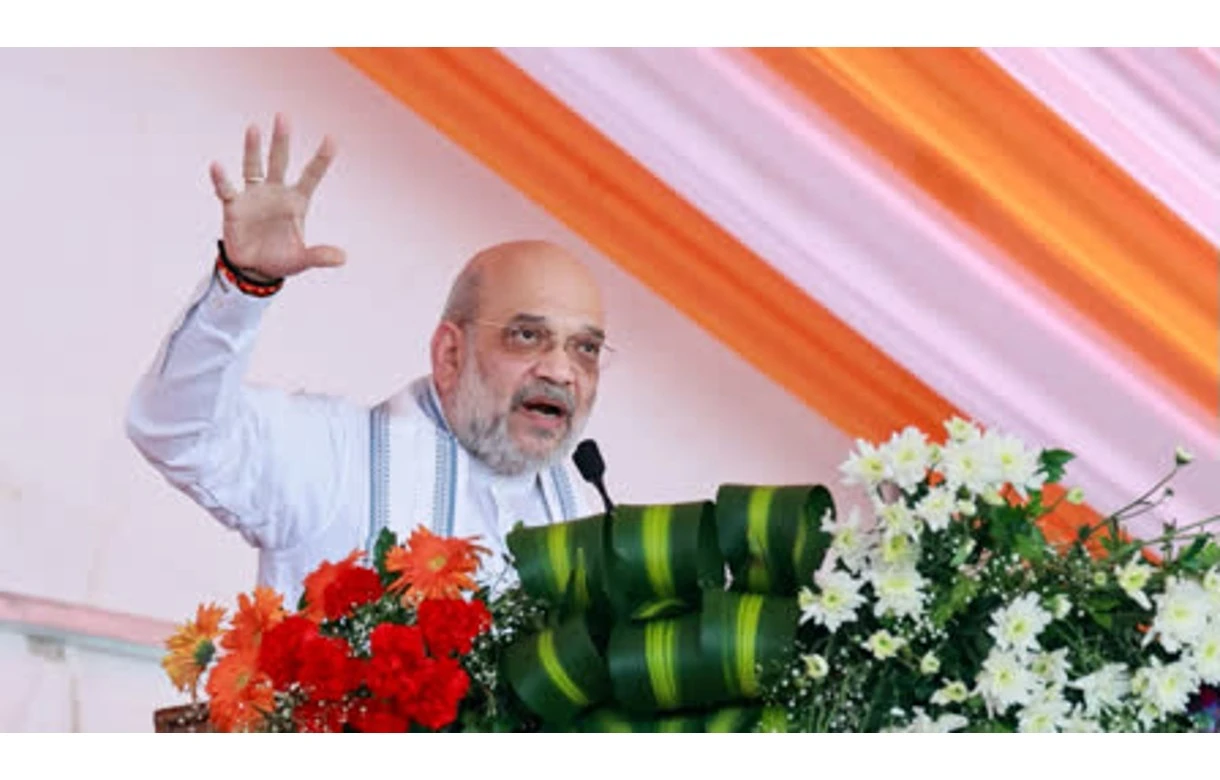
Home Minister Amit Shah on Sunday asserted that no stone pelter or terrorist will be released in Jammu and Kashmir and there will be no talks with Pakistan till terrorism is wiped out.

At an election rally in Nowshera in support of J-K BJP president Ravinder Raina, the Home Minister said he would like to talk to the youth of Jammu and Kashmir, whom he referred to as lions.

Shah alleged that allies National Conference and Congress want to release stone pelters and terrorists after forming their government as promised in their manifesto.

“Farooq Abdullah is talking about the revival of terrorism in Jammu hills but I want to tell them that this is Modi government and we will bury terrorism in patal’ (deep inside earth). No terrorist or stone pelter will be released,” he said.

Shah further accused the allies that NC and Congress are batting for talks with Pakistan.

“I want to tell Farooq Abdullah and Rahul Gandhi that there will be no dialogue with Pakistan till terrorism is wiped out. I will talk with my lions (youth of J-K) and not with Pakistan,” Shah said.

Referring to underground bunkers constructed by the government for the safety of border residents over the years, he said there would be no need for such structures as nobody has the power to open fire from across the border.

“If they fire a bullet, we will respond with a shell,” he said.
He also slammed the NC-Congress leaders’ remarks on the reservation and said nobody would be allowed to touch reservations given to deprived sections, including Paharis, Gujjars, Dalits, and other backward classes.

“Rahul Gandhi is saying in America that there is no need for reservation. I want to tell him that you will not be allowed to finish reservations for the deserving communities,” he said.

India News

Supreme Court raps Meta over WhatsApp privacy policy

The Supreme Court warned Meta that it would not tolerate any compromise of citizens’ privacy while hearing a case related to WhatsApp’s 2021 privacy policy and a CCI penalty.

Published

on

WhatsApp

The Supreme Court on Tuesday delivered strong observations against Meta, the parent company of WhatsApp, over the messaging platform’s 2021 privacy policy, warning that it would not tolerate any compromise of citizens’ privacy.

A bench led by Chief Justice Surya said the court would not allow the sharing of user data in a manner that exploits Indians, remarking that privacy protections under the Constitution must be followed. “You can’t play with privacy… we will not allow you to share a single digit of our data,” the Chief Justice said during the hearing.

The matter relates to a plea challenging the law tribunal’s decision that upheld a ₹213 crore penalty imposed by the Competition Commission of India (CCI) on WhatsApp, while also permitting certain data-sharing practices for advertising purposes.

Court questions accessibility of privacy policy

During the hearing, the court raised concerns about whether WhatsApp’s privacy policy could realistically be understood by large sections of the population, particularly those who are poor or not formally educated.

The bench questioned if users such as roadside vendors, rural residents, or people who do not speak English would be able to comprehend the policy’s terms. It also expressed scepticism about the effectiveness of opt-out clauses, stating that even legally trained individuals find such policies difficult to understand.

Describing the alleged data practices as potentially exploitative, the court said it would not allow private information to be taken without genuine and informed consent from users.

The Chief Justice also cited a personal example, suggesting that users often begin seeing advertisements shortly after exchanging sensitive messages on WhatsApp, such as medical conversations, raising questions about how user data is being utilised.

Arguments from government and Meta

Appearing for the government, Solicitor General Tushar Mehta criticised WhatsApp’s data-sharing practices, calling them exploitative and commercially driven. In response, the Chief Justice said that if companies cannot operate in line with constitutional values, they should not do business in India.

Senior advocates Mukul Rohatgi and Akhil Sibal, appearing for Meta and WhatsApp, countered the allegations by asserting that all WhatsApp messages are end-to-end encrypted and that the company cannot read message content.

Background of the case

In November 2024, the CCI ruled against WhatsApp over its 2021 privacy policy, holding that the company had abused its dominant market position by effectively forcing users to accept the updated terms.

The watchdog objected to WhatsApp making continued access to messaging services conditional on permitting data-sharing with other Meta platforms, leading to the imposition of a ₹213 crore fine. Meta has deposited the penalty.

In January 2025, Meta and WhatsApp challenged the CCI order. Later, in November 2025, the law tribunal lifted a five-year restriction on data-sharing while maintaining the financial penalty.

Continue Reading

India News

India welcomes US tariff cut as PM Modi thanks Trump for easing trade barriers

PM Modi has thanked US President Donald Trump after the US reduced tariffs on Indian goods to 18%, calling the move beneficial for bilateral trade.

Published

on

pm modi

Prime Minister Narendra Modi on Sunday welcomed US President Donald Trump’s decision to lower tariffs on Indian goods, describing the move as one that unlocks significant opportunities for cooperation between the two countries.

Minutes after President Trump announced the reduction on his social media platform, the Prime Minister took to X to express his appreciation, calling the development a boost for “Made in India” products entering the US market.

“Delighted that Made in India products will now have a reduced tariff of 18 per cent,” PM Modi said, thanking President Trump on behalf of India’s 1.4 billion people.

The Prime Minister said he had a “wonderful” conversation with President Trump and underlined the broader significance of the decision, noting that closer economic cooperation between the world’s two largest democracies benefits people on both sides.

PM Modi also said that when two major economies work together, it opens doors for mutually beneficial growth, adding that India supports President Trump’s efforts aimed at global peace, stability, and prosperity. He said he looked forward to strengthening the partnership further.

President Trump, while announcing the tariff reduction, described the move as a “trade deal” and referred to PM Modi as a close friend and a respected leader.

Trade signals positive momentum

The US India Strategic Partnership Forum described the tariff reduction as an important and positive first step in strengthening bilateral trade relations.

While the detailed terms of the agreement are yet to be finalised, the announcement reflects political intent on both sides to move towards a broader US-India bilateral trade agreement. Such an agreement is expected to address issues related to tariffs, market access, non-tariff barriers, and trade across multiple sectors.

How tariffs on Indian goods evolved

The latest decision comes after months of tariff fluctuations on Indian exports to the US.

Timeline of key developments

  • April 2, 2025: The US imposed a 26% reciprocal tariff on several Indian imports as part of global tariff actions.
  • April 10, 2025: The tariffs were paused for 90 days, with a 10% duty retained on all US imports.
  • July 31, 2025: A 25% tariff was announced on Indian goods, along with a warning linked to India’s purchase of Russian oil.
  • August 7, 2025: Tariffs were raised to 50%, the highest imposed on any US trade partner at the time.
  • February 2, 2026: The US announced a reduction in tariffs on Indian goods to 18%.

The latest rollback marks a significant easing of trade tensions and sets the stage for deeper engagement between India and the United States.

Continue Reading

India News

US-India trade deal to strengthen strategic partnership, says Amit Shah

Amit Shah says the US-India trade deal with reduced tariffs will elevate strategic partnership and pave the way for stronger trade ties and mutual growth.

Published

on

Amit Shah

Union Home Minister Amit Shah on Monday said the newly announced trade deal between India and the United States will elevate the strategic partnership between the two countries and pave the way for stronger trade ties and mutual growth.

In a post on social media platform X, Shah said the agreement marks a significant moment in India-US relations, with business between the two nations set to expand further. He noted that the deal, which includes a reduction in reciprocal tariffs, will benefit both countries and their people.

Calling it a “big day” for bilateral ties, Shah said the trade deal has been locked with a significantly reduced tariff of 18 per cent, creating fresh opportunities for economic cooperation. He also congratulated Prime Minister Narendra Modi and US President Donald Trump on what he described as a historic agreement.

According to Shah, the agreement will strengthen the strategic partnership between the two democracies and support growth on both sides. He added that trade and business activity between India and the US is expected to flourish in the coming period.

Modi welcomes reduced tariffs on Indian goods

Prime Minister Narendra Modi also welcomed the development, saying he was delighted that tariffs on “Made in India” products would now be reduced to 18 per cent. He thanked President Trump for the announcement and said the move would benefit the people of both nations.

Modi said cooperation between two large economies and the world’s largest democracies creates opportunities for mutually beneficial growth. He added that such collaboration helps unlock new possibilities for trade and development.

The prime minister also said he looked forward to working closely with the US president to take the bilateral partnership to unprecedented heights.

Trump outlines terms of the agreement

US President Donald Trump said the United States agreed to lower the reciprocal tariff on Indian goods from 25 per cent to 18 per cent following a phone conversation with Prime Minister Modi. He added that India would move forward to reduce tariffs and non-tariff barriers against the US.

Trump said New Delhi had also committed to purchasing American goods at a much higher level, including energy, technology, agricultural products, coal and other items. He mentioned that India would buy US energy worth more than USD 500 billion.

The US president said the relationship between the two countries would become even stronger going forward. He also noted that the two leaders discussed the ongoing war between Russia and Ukraine during their conversation.

Background to the trade talks

India and the US had agreed earlier to finalise the first tranche of a bilateral trade agreement, but negotiations had slowed after higher tariffs were imposed on Indian goods. The latest agreement follows several rounds of talks between the two sides.

Officials said India now faces lower tariffs compared to several competing export economies, which could provide an advantage to Indian exporters in the US market.

Continue Reading

Trending

© Copyright 2022 APNLIVE.com