
English हिन्दी
Connect with us

Latest world news

5 killed, several injured after bomb blast at Taliban religious school in Pakistan

The blast occurred in Akkora Khattak, a district in Khyber Pakhtunkhwa, as district police chief Abdul Rashid reported that authorities are currently investigating the incident, with casualties being transported to local hospitals.

Published

on

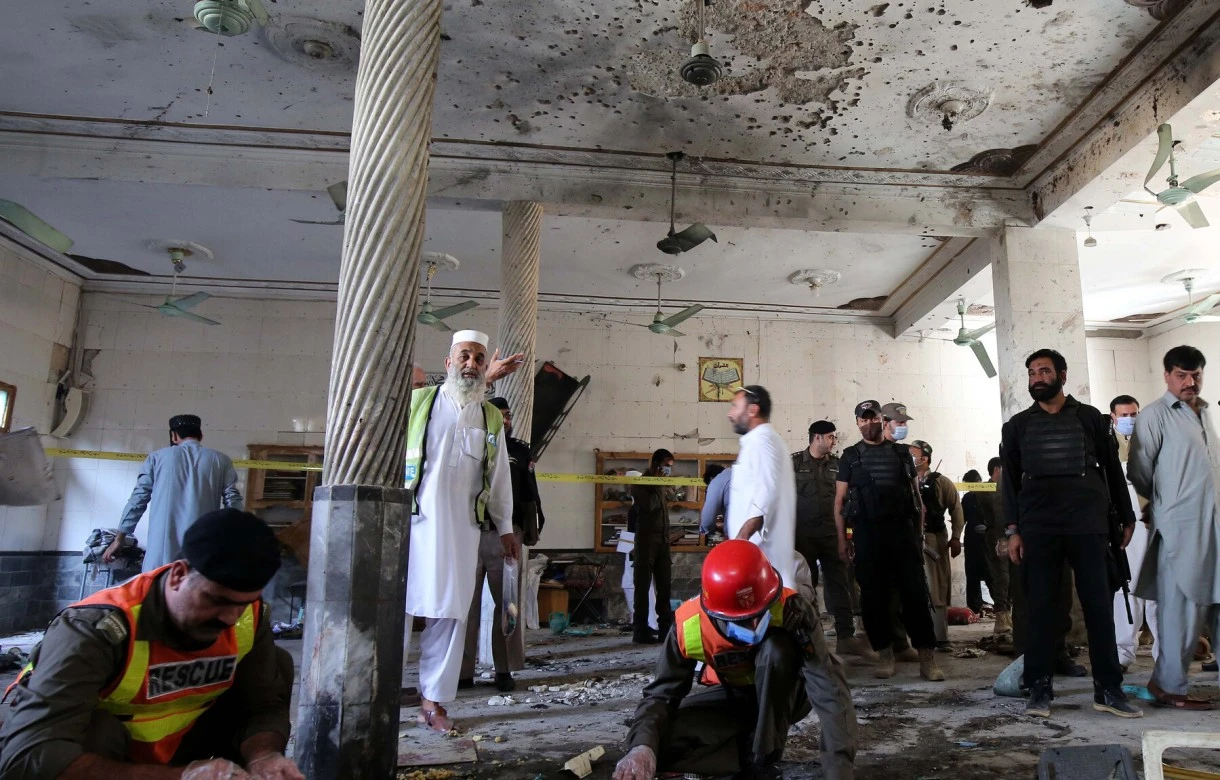
A devastating suicide bomb exploded at a mosque within a pro-Taliban seminary in Khyber Pakhtunkhwa province, northwestern Pakistan, on Friday, resulting in the deaths of at least five worshippers and injuring numerous others just ahead of the holy month of Ramadan, according to local law enforcement officials.

The blast occurred in Akkora Khattak, a district in Khyber Pakhtunkhwa, as district police chief Abdul Rashid reported that authorities are currently investigating the incident, with casualties being transported to local hospitals.

As of now, no group has taken responsibility for the attack at Jamia Haqqania, a seminary with known connections to the Afghan Taliban, according to reports.

The timing of the bombing is especially significant as Ramadan, the Muslim holy month, is anticipated to begin either this Saturday or Sunday, depending on the sighting of the Moon. Jamia Haqqania has been referred to as the “University of Jihad” due to its radical ideology and the number of militants it has produced. The institution provides free food, clothing, and education to approximately 4,000 students.

For many years, Pakistani madrassas have been breeding grounds for militancy, indoctrinating countless refugees who often have limited access to education, relying instead on hardline clerics’ teachings. Notably, the late Taliban founder Mullah Omar, who led an insurgency against U.S. and NATO forces in Afghanistan, and Jalaluddin Haqqani, the founder of the notorious Haqqani network, both graduated from this school.

The seminary has been at the center of regional militant violence for decades, educating both Pakistani and Afghan refugees, some of whom returned home to engage in conflict against the Russians and Americans or to advocate for jihad.

Since the Taliban regained control of Kabul in August 2021 following the withdrawal of foreign troops and the collapse of the previous government, militancy has surged in the border regions adjoining Afghanistan. Last year marked a particularly deadly period for Pakistan, with over 1,600 fatalities attributed to a spike in attacks, according to the Center for Research and Security Studies based in Islamabad.

Islamabad has accused the Taliban government of Afghanistan of failing to eliminate militants who operate from Afghan territory and plan attacks on Pakistan, an accusation the Taliban regime has denied.

In response to the bombing, Afghanistan’s Taliban administration condemned the attack, emphasizing their commitment to combatting such violence. Afghan interior ministry spokesman Abdul Mateen Qani referred to the attackers as “enemies of the religion” and suggested the involvement of the Islamic State group in this unclaimed assault.

Continue Reading

India News

India became Vishwaguru through service, not power, says Mohan Bhagwat

RSS chief Mohan Bhagwat said India became a Vishwaguru through selfless service and its tradition of respecting diversity, rather than through power.

Published

on

Mohan Bhagwat

RSS chief Mohan Bhagwat said India’s standing in the world was built through its tradition of selfless service and humanitarian assistance, rather than through military or imperial power.

Addressing the “Hindu Vishwa Bandhu – Embrace the World in Friendship” gathering in Toronto, Bhagwat said India became a “Vishwaguru” (world teacher) through its character and service to humanity, rather than as a “Mahashakti” (superpower).

Bhagwat recalls India’s humanitarian tradition

Bhagwat cited historical examples of India providing refuge to people fleeing persecution and war. He recalled how the Maharaja of Jamnagar provided shelter and protection to Polish refugees during the Second World War until they could return safely.

He also referred to more recent humanitarian operations, saying Indian military transport aircraft had rescued citizens of seven other countries along with Indians during evacuations from a conflict zone in the Middle East.

The RSS chief said India has historically provided peaceful refuge to people belonging to different faiths, including Muslims, Christians, Jews and Parsis.

‘India never conquered any country’

Bhagwat contrasted India’s civilisational outreach with imperial expansion, saying Indian traditions focused on sharing knowledge rather than conquering territories.

He said Indian travellers historically reached different parts of the world but did not conquer countries. Instead, he said, they shared knowledge in areas including astronomy, Ayurveda and civilisational values.

Calling this tradition the “DNA of Bharat”, Bhagwat said India has continued to help people in distress, including in situations where assistance was not specifically requested.

Bhagwat stresses diversity and unity

Bhagwat also spoke about his understanding of the word “Hindu”, saying it cannot be defined by a particular language, form of worship or lifestyle. He said Hindus “respect all” and “accept all”.

He emphasised the need to respect and embrace diversity, describing it as an expression of an underlying unity.

According to Bhagwat, India’s ancient ethos recognises diversity as natural while treating unity as the fundamental reality.

He further invoked the philosophy of “Vasudhaiva Kutumbakam”, or the belief that the entire world is one family.

Bhagwat said that despite differences in appearance and other forms of diversity, people are essentially one and therefore serving others is a duty.

Continue Reading

Latest world news

Nepal to bury unidentified flood victims, DNA tests to help identify them later

Nepal will bury unidentified flood victims after collecting DNA samples, assigning identification numbers and recording burial locations.

Published

on

Nepal will begin burying unidentified and unclaimed bodies recovered from this week’s devastating flash floods, as authorities struggle with the deteriorating condition of the remains and limited facilities to store them.

At least 675 bodies have been recovered so far. Chitwan district, which borders India, has reported the highest number, with 233 bodies recovered.

Authorities decided to proceed with burials after health experts warned that the decomposition of bodies kept in temporary facilities could increase the risk of infection. In Chitwan, officials had been using a house as a temporary cooling centre, but the facility eventually ran out of space.

DNA samples collected before burial

Nepalese authorities are collecting DNA samples from unidentified bodies before they are buried. Each body is also being assigned a unique identification or reference number, along with details of its location.

The system is intended to allow relatives to identify and recover the remains later if a DNA match is established.

More than 100 bodies had undergone DNA profiling by Saturday afternoon and were ready for burial.

Burial sites designed for future exhumation

The burial pits are being dug about 1.5 metres deep, with a 40-centimetre gap between individual bodies. This arrangement is intended to make it possible to retrieve a specific body if its identity is established later.

The bodies are being placed in bags marked with their identification numbers. Concrete platforms and signboards will also be installed at burial sites to display the corresponding numbers.

Authorities also plan to document the burial process through photographs and video and geo-tag the burial locations.

How families can identify missing relatives

People searching for missing family members will be required to provide DNA samples at designated hospitals across Nepal.

Once the DNA results are available, health authorities will compare them with samples collected from the unidentified bodies. If a match is found, the corresponding identification number will be used to locate the burial site.

The police will then use their records to determine where the body was buried. The remains can subsequently be exhumed and handed over to the family.

Nepal Police has also uploaded details of unidentified and unclaimed bodies online to help with the identification process.

According to officials, 2,426 people, including hundreds of foreigners, remain missing in Nepal.

Continue Reading

Latest world news

Nepal Flash Floods: Death toll rises to 676, nearly 3,000 missing

Nepal’s flash floods have killed 676 people and left nearly 3,000 missing as rescue teams continue operations in affected areas.

Published

on

Nepal’s death toll from the devastating flash floods along its border with Tibet has risen to 676, while nearly 3,000 people remain unaccounted for, as rescue operations continue for a fourth day.

The disaster struck on Wednesday after a glacier collapse triggered a massive surge of water and debris into the Bhote Koshi River in Rasuwa district, near the Tibet border. The flood swept through settlements and damaged roads, bridges and other infrastructure across the affected areas.

Rescue Operations Intensify

Nepal has intensified search and rescue efforts in the worst-hit areas, including operations to reach people trapped inside tunnels at hydropower projects.

An Indian rescue team has reached Trishuli and carried out an aerial reconnaissance of the Chilime and Langtang areas to assess the situation and plan rescue operations.

The Nepal government is also working to clear roads blocked by flood debris and landslides to restore access to affected communities.

The difficult terrain and continuing risk of flooding have complicated rescue efforts. Nepal has sought specialised international assistance for operations requiring technical expertise.

Hundreds Of Indians Unaccounted For

India has been closely coordinating efforts to trace its citizens affected by the disaster.

The Ministry of External Affairs said 320 Indian nationals remained missing, while around 400 others were stranded on the Chinese side following the floods. At least 153 Indians stranded in China had safely crossed into Nepal, while 63 Indian nationals working at the Trishuli-One hydropower project were rescued.

The MEA also said around 100 people of Indian origin holding other nationalities remained uncontactable. Many may have been travelling for the Kailash Mansarovar Yatra.

India has sent relief supplies, medical personnel and a specialised team to assist Nepal with rescue operations.

Reconstruction Bill Could Run Into Billions

The scale of destruction has raised concerns over the cost of rebuilding infrastructure in the affected areas.

Nepal’s Foreign Minister Shisir Khanal said the reconstruction and rehabilitation effort could cost “billions of dollars”.

The floods destroyed or severely damaged homes, roads, bridges and hydropower infrastructure, leaving several areas difficult to access.

As search teams continue to look for survivors and missing people, authorities are also working to provide relief to communities devastated by the floods.

Continue Reading

Trending

© Copyright 2022 APNLIVE.com













