English हिन्दी
Connect with us

India News

Pakistan Defence Minister Khawaja Asif says his country has been supporting terrorist organisations for US for three decades

“If India launches an all-out attack, it will lead to an all-out war with catastrophic consequences,” he said, emphasizing the dangers of a clash between two nuclear powers.

Published

on

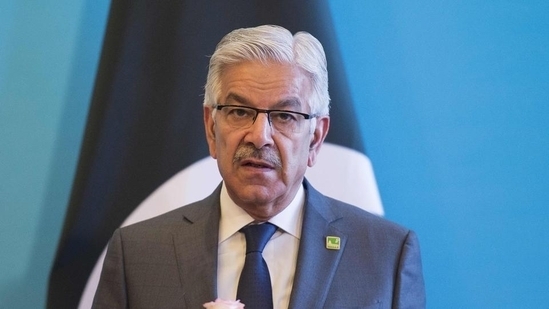
Pakistan Defence Minister Khawaja Asif sparked controversy by alleging that India “staged” the recent Pahalgam terror attack, which claimed 26 lives, while admitting that Pakistan has supported terrorist groups for decades at the behest of the US, Britain, and other Western nations.

In an interview with a British news channel, Asif warned that India’s response to the attack could precipitate an “all-out war” between the two nuclear-armed neighbours, urging the international community to be alarmed by the prospect of such a conflict.

Asif claimed that Pakistan’s military is “fully prepared” to counter any Indian aggression, promising a “measured response” to any provocation. “If India launches an all-out attack, it will lead to an all-out war with catastrophic consequences,” he said, emphasizing the dangers of a clash between two nuclear powers.
While expressing hope for a diplomatic resolution, he accused India of orchestrating the Pahalgam attack to create a regional crisis.

“Delhi’s reaction was predictable. We believe this was staged to stir trouble, especially for Pakistan,” he stated, without providing evidence. When pressed to clarify, Asif doubled down, asserting, “Absolutely, India creates such situations,” though he added that Pakistan’s government has unequivocally condemned terrorism in all forms.

Addressing Pakistan’s history of supporting terrorism, Asif made a startling admission: “For three decades, we did the dirty work for the United States, Britain, and the West. That was a grave mistake. If we hadn’t joined the wars against the Soviet Union and post-9/11, Pakistan’s record would have been spotless.”

He acknowledged the heavy toll this involvement has taken on Pakistan, citing it as a reason for the country’s tarnished reputation.

India has not yet officially responded to Asif’s provocative remarks. Following the Pahalgam attack, New Delhi announced stringent measures, including suspending the Indus Waters Treaty of 1960, closing the Attari Integrated Check Post, and revoking SAARC Visa Exemption Scheme privileges for Pakistani nationals, who were given 48 hours to leave. The strength of diplomatic missions in both countries was also reduced.

Prime Minister Narendra Modi vowed that the perpetrators and their conspirators would face severe consequences, asserting that the resolve of 1.4 billion Indians would dismantle terrorism’s remaining strongholds.

India News

Women’s quota bill fails in Lok Sabha as it falls short of two-thirds majority

Women’s reservation proposal failed in Lok Sabha after securing 298 votes, below the required two-thirds majority

Published

on

Parliament

Government secures 298 votes in favour, 230 against; proposal does not pass constitutional threshold

The proposed amendment related to women’s reservation failed to pass in the Lok Sabha on Friday after the government could not secure the required two-thirds majority.

The bill received 298 votes in favour and 230 against, falling short of the constitutional threshold needed for passage. As a constitutional amendment, it required the support of at least two-thirds of members present and voting.

Despite securing a simple majority, the government was unable to gather sufficient support to meet this requirement.

Debate continues over two days

The discussion on the bill extended late into Thursday and continued on Friday, with members from both sides participating in the debate on women’s representation in legislative bodies.

Prime Minister Narendra Modi urged members to support the proposal, calling for wider consensus on the issue.

Implications of the outcome

The failure of the bill underscores the challenges in securing broad political agreement on constitutional amendments, especially those related to representation and electoral reforms.

The proposal was aimed at advancing women’s representation in the Lok Sabha and state assemblies, an issue that has remained under discussion for several years.

Continue Reading

India News

Rahul Gandhi faces FIR order as Allahabad High Court acts on dual citizenship plea

High Court allows plea in Rahul Gandhi citizenship case, paving the way for further legal process.

Published

on

Rahul Gandhi

The Lucknow bench of the Allahabad High Court has allowed a petition seeking legal action in connection with allegations related to Congress leader Rahul Gandhi’s citizenship status, marking a fresh development in the case.

The petition was filed by a political worker, who had approached the court seeking directions for registration of a case over claims that Gandhi may have held foreign citizenship. The High Court, while hearing the matter, passed directions for further proceedings in accordance with law.

The development comes after a special MP/MLA court in Lucknow had earlier declined to order registration of an FIR, reportedly observing that it lacked jurisdiction in matters concerning citizenship.

Background

The case is linked to allegations that Rahul Gandhi may have held British citizenship. Under Indian law, dual citizenship is not permitted. However, these claims remain part of the petitioner’s submissions and have not been established by any court.

During earlier hearings, the High Court had sought records and considered material presented by the parties involved.

What happens next

With the High Court allowing the plea, the matter is expected to proceed as per due legal process. This may involve examination by the appropriate authority and further judicial review at subsequent stages.

The case carries both legal and political significance given Rahul Gandhi’s role as Leader of the Opposition in the Lok Sabha.

Continue Reading

India News

Pawan Khera faces fresh setback as Supreme Court refuses relief in passport row case

Congress leader Pawan Khera faces fresh setback as Supreme Court refuses interim relief and directs him to seek bail from Guwahati High Court.

Published

on

Pawan Khera

Congress leader Pawan Khera suffered another legal setback on Friday after the Supreme Court of India declined to extend protection in a case linked to his remarks about Himanta Biswa Sarma’s wife.

A bench of the apex court refused to interfere with an earlier order that had stayed the transit anticipatory bail granted to Khera by the Telangana High Court. This decision leaves the Congress leader open to possible arrest by Assam Police in connection with the case.

During the hearing, Khera’s counsel sought interim protection, but the court declined the request and advised him to approach the appropriate court in Assam for relief. The bench clarified that the Guwahati High Court should decide any bail plea independently and on its merits.

“Am I a terrorist?” remark during hearing

While seeking protection, Khera’s legal team expressed concern over the urgency of the situation. In court, his counsel remarked, “Am I a terrorist?” highlighting the plea for temporary relief until a fresh bail application could be filed.

The Supreme Court also raised concerns over the submission of incorrect documents during the proceedings, adding another layer to the legal complications faced by the Congress leader.

Case linked to remarks on CM’s wife

The case stems from a press conference held earlier this month, where Khera made allegations regarding the citizenship status and financial assets of the Assam Chief Minister’s wife, Riniki Bhuyan Sharma.

He had claimed that she possessed multiple passports and owned undisclosed overseas properties. These allegations were strongly denied by the Chief Minister’s family, who termed them fabricated and misleading.

Legal battle intensifies

Earlier, the Telangana High Court had granted Khera temporary transit anticipatory bail, allowing him time to seek relief from a competent court in Assam. However, the Supreme Court stayed that order following a challenge by Assam authorities, escalating the legal battle.

With the latest ruling, Khera is now expected to move the Guwahati High Court for anticipatory bail as the case continues to unfold.

Continue Reading

Trending

© Copyright 2022 APNLIVE.com