English हिन्दी
Connect with us

Latest world news

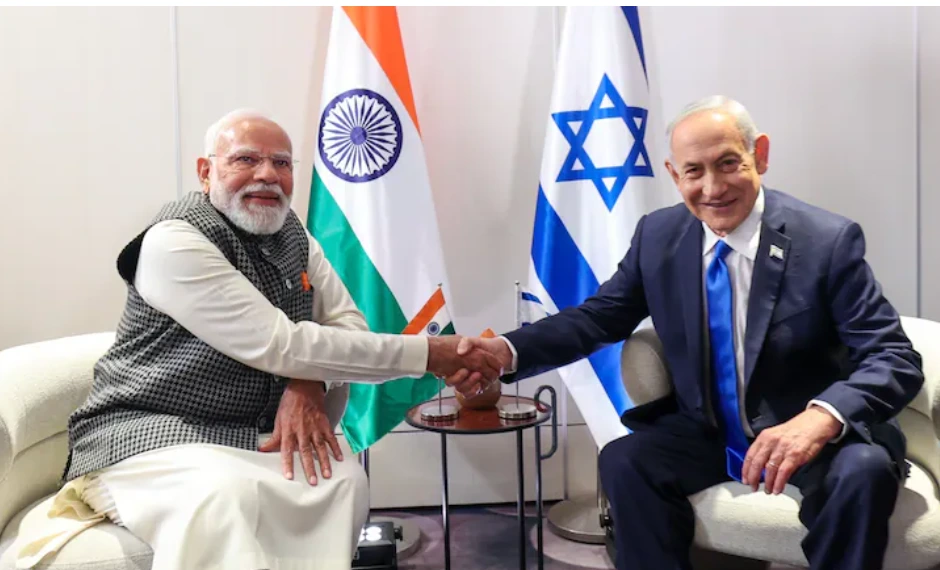
PM Modi and Netanyahu pledge deeper defence, trade ties during Israel visit

PM Narendra Modi and Benjamin Netanyahu pledged to deepen defence, trade and connectivity ties during Modi’s visit to Israel, with missile deals and IMEC discussions on the agenda.

Published

on

Prime Minister Narendra Modi and Israeli Prime Minister Benjamin Netanyahu have reaffirmed their commitment to strengthening defence, trade and security cooperation, marking a significant step forward in India-Israel relations during Mr Modi’s visit to Tel Aviv.

Addressing Israel’s parliament, the Knesset, Mr Modi described defence cooperation as an “important pillar” of the bilateral partnership and stressed the need for closer collaboration in an increasingly uncertain global environment.

“In today’s uncertain world, a strong defence partnership between trusted partners like India and Israel is of vital importance,” he said.

Defence deal likely on agenda

During the visit — Mr Modi’s first to Israel in nine years — discussions are expected to include a major order for Israeli-made missile systems. An official in New Delhi familiar with the matter indicated that details of the potential deal may not be publicly disclosed, as both governments are keen to keep the spotlight on broader strategic ties.

India’s Ministry of External Affairs has not commented on the reported missile purchase.

Israel has long been among India’s key arms suppliers. Over the years, the defence relationship has evolved into joint manufacturing projects, including drones and missile systems. Ahead of the visit, Israel’s Ambassador to India, Reuven Azar, said both sides are working towards a more comprehensive defence and security framework that could open doors for cooperation on more sensitive projects.

Focus on trade and investment

Trade and investment featured prominently in the leaders’ discussions. Mr Modi said both governments are committed to expanding bilateral trade, boosting investment flows and promoting joint infrastructure projects.

Israeli negotiators recently travelled to India to begin formal talks on a proposed free-trade agreement, building on terms agreed in November. Such a pact could provide Israel greater access to one of the world’s fastest-growing economies.

According to Israel’s Economy and Industry Ministry, India is Israel’s second-largest trading partner in Asia, with bilateral trade estimated at $5 billion in 2025, excluding defence transactions.

India is also the largest buyer of Israeli defence equipment, accounting for up to 34% of Israel’s total arms exports, according to data from the Stockholm International Peace Research Institute.

Regional security and Gaza ceasefire

The visit comes amid shifting regional alliances and ongoing security challenges. Referring to last year’s ceasefire in Gaza, Mr Modi said the truce created an opportunity for closer cooperation.

He also welcomed the US-brokered peace plan for Gaza, later endorsed by the United Nations, saying it holds the promise of a just and durable peace, including progress on the Palestine issue. However, uncertainty remains over the future of the truce with Hamas, with key governance and security questions yet to be resolved.

Strategic observers note that both leaders see their countries as operating in complex neighbourhoods marked by security threats and geopolitical shifts.

Connectivity push through IMEC

Connectivity initiatives also featured in the discussions. Mr Netanyahu told the Knesset that India and Israel are working on developing a maritime and land corridor linking India to Israel’s port of Haifa and onward to Europe.

The plan builds on the India-Middle East-Europe Economic Corridor initiative unveiled in September 2023. Although the outbreak of the Israel-Hamas conflict soon after raised concerns about the project’s future, Israeli officials have indicated that the corridor remains viable.

Haifa port, partly acquired by India’s Adani Group, is expected to play a key role as the Mediterranean endpoint of the corridor.

As India and Israel seek to reinforce strategic, economic and security ties, the visit underlines the growing convergence between New Delhi and Tel Aviv in defence, trade and regional connectivity.

Latest world news

India envoy Dinesh Trivedi meets PM Modi after talks with Bangladesh PM Tarique Rahman 

India’s High Commissioner to Bangladesh Dinesh Trivedi met PM Modi after talks with Bangladesh PM Tarique Rahman amid diplomatic tensions.

Published

on

India’s High Commissioner to Bangladesh Dinesh Trivedi met Prime Minister Narendra Modi in New Delhi on Tuesday, a day after his meeting with Bangladesh Prime Minister Tarique Rahman in Dhaka.

According to the High Commission of India in Bangladesh, Trivedi sought PM Modi’s guidance on further strengthening the bilateral relationship between India and Bangladesh through a constructive and people-centric approach.

The meeting came a day after Trivedi held discussions with Tarique Rahman on matters of mutual interest and ways to advance ties between the two neighbouring countries.

Dinesh Trivedi Meets Bangladesh PM

During his meeting with Tarique Rahman on Monday, Trivedi conveyed greetings from Prime Minister Modi and reiterated India’s commitment to working with the Bangladeshi administration and its people in a positive, constructive and forward-looking manner.

The two sides discussed issues of mutual interest and explored avenues for strengthening India-Bangladesh relations with a people-centric approach.

The engagement took place at the Prime Minister’s Office in the Cabinet Division at the Bangladesh Secretariat. Trivedi also shared his experience of serving in Dhaka over the previous two months.

Sheikh Hasina Extradition Request

The meeting assumed significance as Bangladesh has expressed hope that India will expedite the extradition process involving former Prime Minister Sheikh Hasina, who was ousted following a student-led uprising in 2024.

According to a statement issued by the Bangladesh Prime Minister’s Office, Dhaka also reiterated its request for India to return individuals it alleges were involved in the killing of Shahid Osman Hadi, a prominent figure associated with the July uprising who was shot on December 12, 2025.

Tarique Rahman stressed the need to create a suitable environment to take forward relations between Bangladesh and India.

Bangladesh Foreign Minister Khalilur Rahman, Prime Minister’s Foreign Affairs Adviser Humayun Kabir and other officials attended the meeting.

India-Bangladesh Ties Amid Diplomatic Friction

The latest high-level engagements come amid diplomatic tensions between the two countries following a virtual press interaction by Sheikh Hasina in New Delhi on August 5.

The event, organised by the Foreign Correspondents’ Club of South Asia to mark the second anniversary of her ouster, prompted strong objections from Dhaka.

During the interaction, Hasina said she remained determined to return to Bangladesh in December and restore democracy, while acknowledging the possibility of imprisonment or a death sentence upon her return.

Bangladesh’s Ministry of Foreign Affairs subsequently registered a strong protest and said the development had affected public sentiment and complicated efforts to strengthen bilateral cooperation.

India has said the government had no involvement in the event. Ministry of External Affairs spokesperson Randhir Jaiswal said it was organised by a private media entity and clarified that New Delhi did not endorse views expressed at the forum.

Continue Reading

Latest world news

Trump, PM Modi will resolve tariff issue over Russian oil trade, says US official

White House Trade Adviser Peter Navarro said Donald Trump and Prime Minister Narendra Modi will resolve the issue over US tariff threats linked to India’s Russian oil trade.

Published

on

Modi trump

US President Donald Trump and Prime Minister Narendra Modi will resolve the issue surrounding the threat of US tariffs linked to India’s purchase of Russian oil, White House Trade Adviser Peter Navarro said on Tuesday.

Navarro’s remarks came days after the US Senate passed a bill authorising the US President to impose tariffs of up to 100 per cent on the top five purchasers of Russian oil. The measure argues that such purchases directly contribute to financing Russia’s war in Ukraine.

Navarro comments on India’s Russian oil trade

Speaking to reporters at the White House, Navarro said India was not involved in the oil trade with Russia before the Ukraine war began in 2022.

He alleged that India became heavily involved in the trade after Russia’s invasion and sold refined products on behalf of Russia, which he said helped support the Russian war effort.

“Prior to the Russian invasion of Ukraine, India was not involved in the oil trade with Russia, but afterwards it got heavily involved,” Navarro said.

The White House adviser also claimed that the issue had since been resolved and attributed some of the shift in India’s Russian oil trade to an opinion article he recently wrote in the Financial Times.

Trump and Modi will resolve issue, Navarro says

Navarro said the relationship between Trump and Modi would help address the tariff-related issue.

“The president and your prime minister have a very good working relationship. They are going to work that out amongst themselves,” he said, adding that it was not his place to intervene.

His comments come amid US concerns over countries purchasing Russian oil and proposed measures aimed at imposing additional tariffs on major buyers.

Continue Reading

Latest world news

US Senate passes Russia sanctions bill, India-China face 100% tariff risk

The US Senate has passed a Russia sanctions bill that could allow 100% tariffs on major buyers of Russian oil and gas, including India and China.

Published

on

Donald Trump

The US Senate has approved a bipartisan Russia sanctions bill that could allow President Donald Trump to impose tariffs of up to 100% on major buyers of Russian oil or natural gas, including India and China.

The legislation was passed by an 86-11 vote and will now move to the US House of Representatives, which is scheduled to reconvene on August 31.

The bill is named in honour of Republican Senator Lindsey Graham, a strong supporter of Ukraine who died on July 11. Graham had pushed for tougher sanctions against Russia over its war in Ukraine.

India and China among major Russian energy buyers

The legislation gives the US president the power to impose tariffs on the world’s top five purchasers of Russian oil or natural gas.

India and China are among those countries, along with Azerbaijan, Hungary and Slovakia.

The bill also contains an exception for countries importing less than 15% of their natural gas from Russia and taking steps to reduce their dependence on Russian supplies.

What does the Russia sanctions bill contain?

Apart from the proposed tariffs, the legislation includes sanctions targeting Russian President Vladimir Putin, senior Russian political and military officials, financial institutions and energy projects.

The bill would also expand US sanctions to older and reflagged oil tankers allegedly used by Moscow to bypass existing restrictions on Russian oil and energy revenues.

At the same time, the White House would have the option to waive sanctions or restrictions if the president certifies to Congress that doing so is in the national interest.

Bill also extends Iran sanctions law

The legislation also contains a provision related to Iran. It would extend the expiration date of the Iran Sanctions Act of 1996 until 2031.

The law penalises companies that invest in Iran’s energy sector.

The bill’s passage in the Senate marks the next step in the US legislative process, but it still needs approval from the House of Representatives before it can move forward.

Continue Reading

Trending

© Copyright 2022 APNLIVE.com