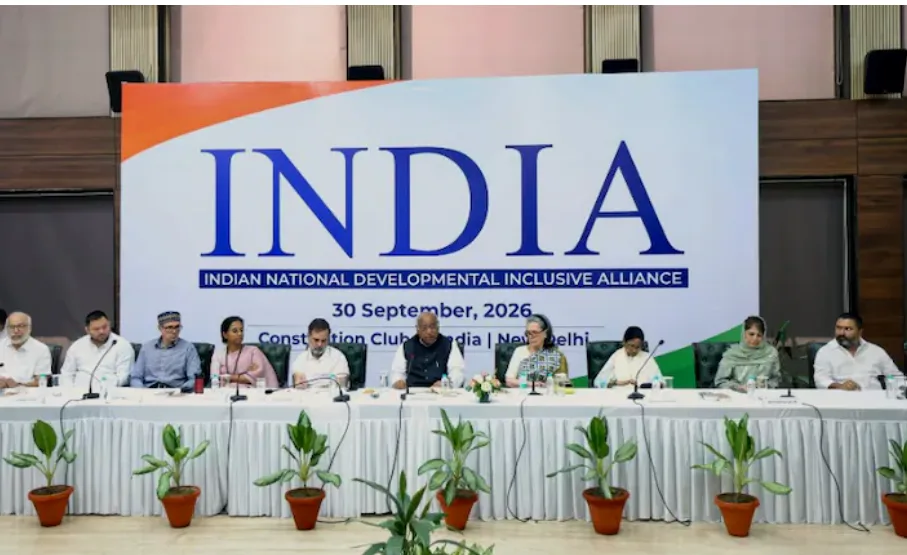
The Opposition INDIA bloc has approached the Supreme Court seeking permission to formally question the Election Commission of India (ECI) over its decision to conduct the nationwide Special Intensive Revision (SIR) of electoral rolls.
In an application filed before the top court, Congress leader Rahul Gandhi and other Opposition leaders have submitted a list of 48 questions seeking explanations about the decision-making process behind the exercise, alleged irregularities in voter registration and the functioning of the poll body’s electoral databases.
The petition seeks individual affidavits from Chief Election Commissioner Gyanesh Kumar, the two Election Commissioners, Sukhbir Singh Sandhu and Vivek Joshi, and the Election Commission’s Director General (IT).
The Opposition leaders have also sought clarification on whether decisions concerning SIR were taken collectively by the three-member Election Commission or whether certain decisions were made without the knowledge or approval of the other commissioners.
What are the 48 questions about?
The questions submitted by the INDIA bloc cover several aspects of the voter list revision exercise, including the authority behind the nationwide SIR, internal disagreements among Election Commissioners and changes to the online voter registration process.
One of the key questions seeks to establish who decided to conduct the nationwide SIR, when the decision was taken, and whether the approval of all three Election Commissioners was recorded.
The petitioners have also sought details of instances in which Election Commissioners Sukhbir Singh Sandhu and Vivek Joshi allegedly recorded objections or disagreements concerning SIR, ECINET, Form 6 and appeals related to electoral roll inclusion in West Bengal.
They have further questioned whether decisions linked to the revision exercise were unanimous or taken through majority voting, and whether any dissenting views were recorded before the relevant orders were issued.
Another set of questions concerns the authorisation of specific orders issued in July 2026, including the July 28 office order and the joint direction issued by two Election Commissioners on July 30.
Opposition raises questions over ECINET and Form 6
The INDIA bloc’s application also seeks information about the Election Commission’s digital systems, particularly ECINET and ERONET, which are connected to electoral roll management.
The petitioners want details about who authorised the centralisation of these systems and who has the authority to add, delete or restore entries in voter databases.
They have also sought information about the access available to officials, vendors and contractors, along with details of whether records of changes made to electoral rolls have been preserved.
Questions have also been raised about Form 6, which is used for registering new voters.
The petitioners want to know who authorised the incorporation of an additional declaration into the online Form 6 process, when it was introduced and whether the Election Commission formally approved the change.
They have also sought details of applications that were rejected, kept pending or not processed because applicants did not provide the additional declaration or electoral mapping details.
Questions over voter deletions and objections
Another important part of the application concerns the deletion of names from electoral rolls during SIR.
The petitioners have sought state-wise and gender-wise details of electors excluded between the pre-SIR, draft and final electoral rolls, along with the reasons for their exclusion.
They have also questioned the objections filed through Form 7 during the revision exercise, including instances of allegedly excessive or false objections and the action taken under Section 31 of the Representation of the People Act, 1950.
The application further seeks information about corrective measures introduced after the petitions were filed, particularly additional opportunities provided to voters marked as absent, shifted, dead or duplicate.
The Opposition has also asked whether electronic communications, including WhatsApp messages and emails, were used to obtain approvals from Election Commissioners and whether such communications have been preserved.
Election Commission’s stand and Supreme Court hearing
The latest application comes amid an ongoing legal dispute over the SIR exercise and allegations of irregularities in the preparation of electoral rolls.
In its counter-affidavit before the Supreme Court, the Election Commission maintained that key decisions concerning SIR were taken unanimously by its three members.
The poll body has also defended its position on Form 6, maintaining that the statutory form used for voter registration was not amended.
The petitioners, however, have argued that the Election Commission’s response does not provide the specific dates, file numbers, minutes and records needed to establish how important decisions were approved.
The controversy has also intensified following reports that Election Commissioners Sukhbir Singh Sandhu and Vivek Joshi had recorded objections to certain decisions concerning SIR.
The Supreme Court is scheduled to hear the petitions on November 17.