English हिन्दी
Connect with us

India News

Centre plans stricter compliance rules for VPN providers, may mandate compliance officers

The Centre is exploring stricter compliance requirements for VPN providers, including designated compliance officers, to improve cybercrime investigations and regulatory accountability.


Published

on

The Centre is considering stricter compliance measures for virtual private network (VPN) service providers operating in India as part of its broader efforts to strengthen cybersecurity enforcement and improve cybercrime investigations. Officials are exploring a framework that could require VPN companies to appoint designated compliance officers or authorised representatives to coordinate with enforcement agencies and the Indian Computer Emergency Response Team (CERT-In).

The move comes amid growing concerns within the government over the alleged misuse of VPN services to conceal user identities, bypass law enforcement, and access websites or online platforms that have been blocked in the country.

Government seeks stronger compliance framework

According to government officials, the proposal is intended to ensure that VPN providers establish a clear compliance mechanism in India. Designated officials would be responsible for responding promptly to lawful requests from investigating agencies and CERT-In during cyber incident investigations.

Authorities have stressed that the objective is to improve accountability and facilitate quicker coordination during investigations involving cyber offences rather than monitor ordinary internet users.

Officials also noted that cybercriminals frequently use anonymisation tools, including VPN services, while carrying out ransomware attacks, financial fraud, phishing campaigns, and other online crimes. The proposed framework is aimed at helping investigators trace those involved in such offences through lawful procedures.

Proposal draws from existing IT Rules

The proposed compliance model is similar to the framework introduced under the Information Technology (Intermediary Guidelines and Digital Media Ethics Code) Rules, 2021.

Under those rules, significant social media intermediaries are required to appoint a Chief Compliance Officer, a Nodal Contact Person for round-the-clock coordination with law enforcement agencies, and a Resident Grievance Officer. Officials believe adopting a comparable structure for VPN providers would improve accountability, particularly for companies serving Indian users from outside the country.

Existing CERT-In directions remain in focus

The renewed discussions also highlight the cybersecurity directions issued by CERT-In in April 2022.

Under these directions, VPN providers, cloud service providers, virtual private server (VPS) providers, and data centres are required to collect and retain subscriber information for at least five years, even after a customer stops using the service.

The framework requires providers to maintain verified subscriber details, including names, physical addresses, contact numbers, email addresses, IP addresses, the duration of service usage, and the purpose for which the service was obtained. These records must be made available to authorities when sought as part of a lawful cybercrime investigation.

Government officials have maintained that access to subscriber information is limited to lawful investigations and is not intended for indiscriminate surveillance.

VPN industry had opposed data retention rules

When the CERT-In directions were introduced in 2022, several VPN companies and digital rights groups opposed the requirements. They argued that mandatory retention of customer information conflicted with their “no-logs” policies, which are designed to protect user privacy.

Some providers responded by changing their operational models. ExpressVPN, for instance, removed its physical servers from India and began serving Indian users through virtual server locations outside the country. Other VPN companies adopted similar arrangements while continuing to offer services in the Indian market.

Following representations from industry associations and technology companies, the government had extended the compliance deadline from June 27 to September 25, 2022, allowing providers additional time to implement the required changes.

Focus remains on cybercrime investigations

Officials said the latest initiative is intended to place VPN providers under compliance standards comparable to those applicable to other digital intermediaries operating in India. The government believes the proposed measures will strengthen its ability to investigate cybercrimes while further expanding the country’s digital regulatory framework.

Continue Reading

India News

Akhilesh Yadav says corruption forcing honest officers to quit UP

Samajwadi Party chief Akhilesh Yadav alleged that corruption in Uttar Pradesh is forcing honest government officers to leave service before retirement.
Published

on

Akhilesh Yadav

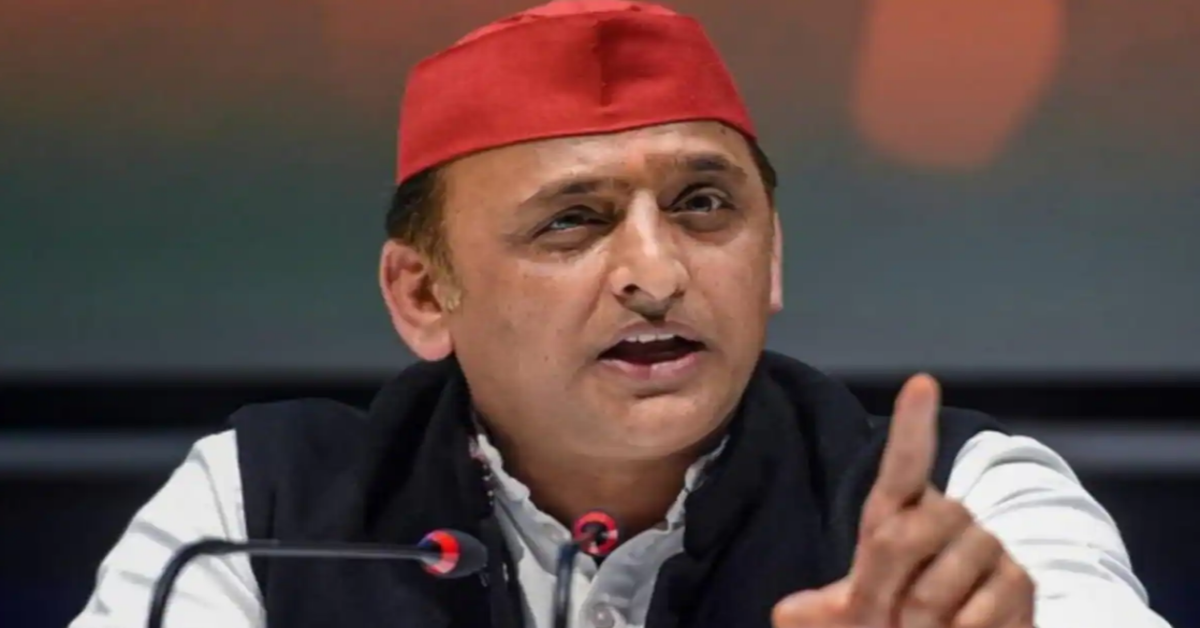
Samajwadi Party chief Akhilesh Yadav has alleged that corruption in Uttar Pradesh is making it difficult for honest government officers to continue in service, claiming that some are choosing to leave before completing their tenure.

Yadav made the remarks while commenting on the resignation of IAS officer Divya Mittal. He alleged that the situation in the state was such that honest officers were finding it increasingly difficult to work.

According to Yadav, officers who want to discharge their duties honestly are facing an environment that is not conducive to their functioning. He claimed that some such officers are opting to leave government service rather than continue under these circumstances.

Akhilesh Yadav’s remarks on honest officers

Yadav linked the resignation of officers to what he described as the prevailing corruption in the Uttar Pradesh administration.

The Samajwadi Party leader alleged that officers who do not want to compromise with corruption are being pushed towards leaving service. His remarks came in the context of Divya Mittal’s resignation from the IAS.

Yadav’s comments are allegations directed at the state administration and do not, by themselves, establish that corruption was the reason for any particular officer’s resignation.

Divya Mittal’s resignation

IAS officer Divya Mittal’s resignation was the immediate context for Yadav’s remarks. Yadav used the development to raise questions about the working environment for government officers in Uttar Pradesh.

The Samajwadi Party chief argued that the departure of officers before retirement raises concerns about the conditions under which government officials are expected to work.

His comments add to the political debate over governance and corruption in Uttar Pradesh.

Continue Reading

India News

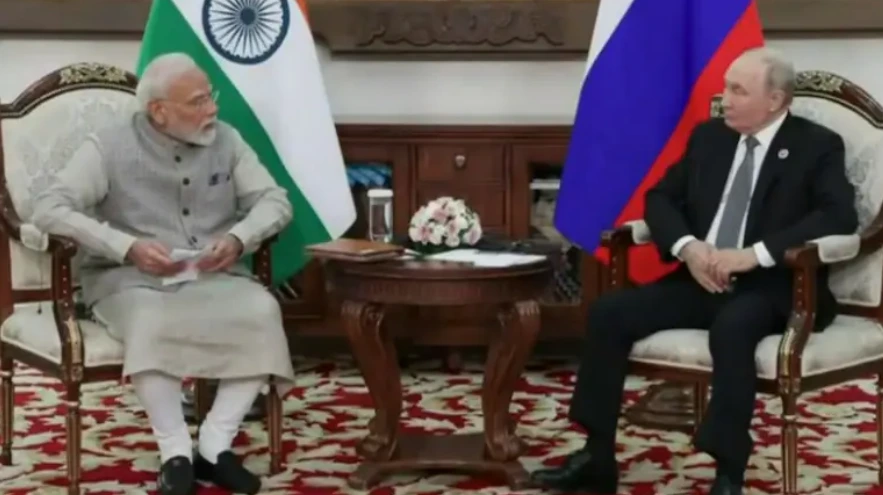
PM Modi meets Putin, says India supports peace in Ukraine

PM Modi met Russian President Vladimir Putin in Kyrgyzstan and reiterated India’s support for peaceful efforts to resolve the Russia-Ukraine conflict.
Published

on

Prime Minister Narendra Modi on Monday met Russian President Vladimir Putin in Kyrgyzstan and reiterated India’s support for efforts aimed at bringing peace to the Russia-Ukraine conflict.

During a joint statement with Putin, PM Modi said India supports all peaceful efforts to resolve the conflict and will continue to back such initiatives.

“India advocates for resolving all problems peacefully, which is necessary for all of humanity,” PM Modi said.

The meeting between the two leaders took place on the sidelines of the Shanghai Cooperation Organisation (SCO) summit in Bishkek, Kyrgyzstan.

Modi’s remarks underlined India’s stated position that conflicts should be addressed through peaceful means. The Prime Minister emphasised the broader importance of resolving disputes peacefully for humanity.

The meeting comes as India and Russia continue to maintain close bilateral ties, with the two countries also discussing matters of mutual interest during high-level engagements.

Continue Reading

India News

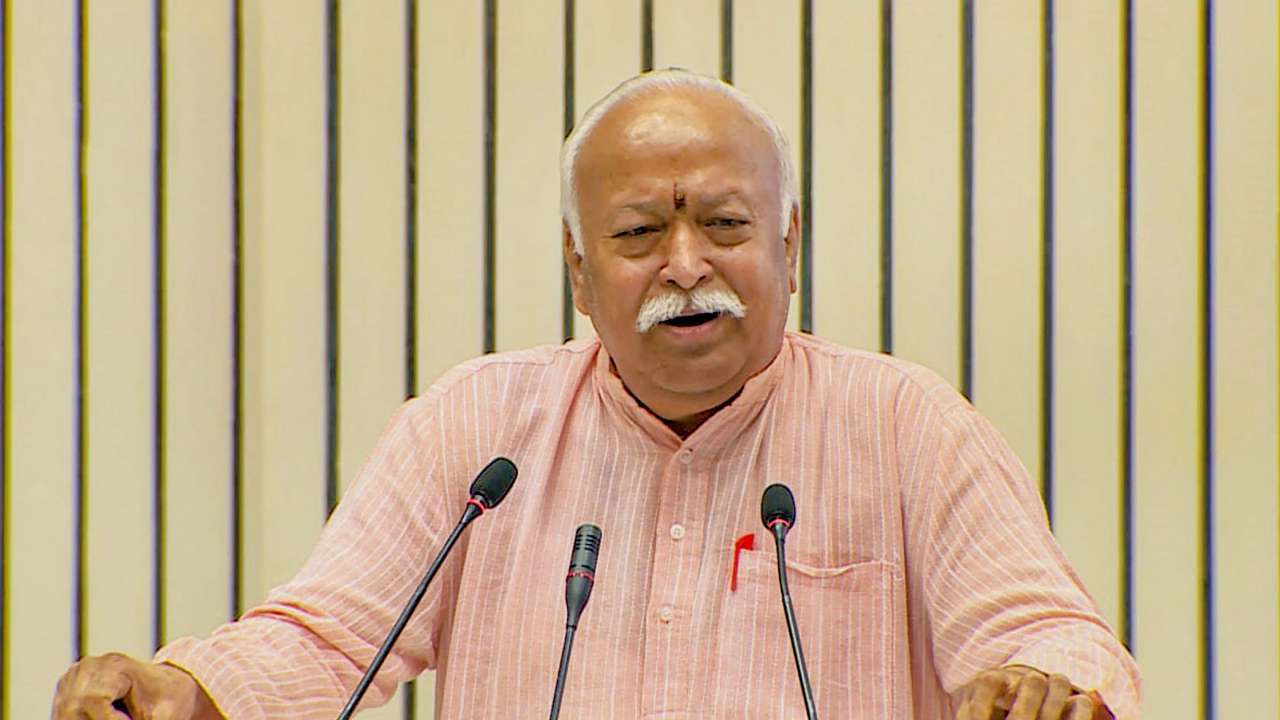
India became Vishwaguru through service, not power, says Mohan Bhagwat

RSS chief Mohan Bhagwat said India became a Vishwaguru through selfless service and its tradition of respecting diversity, rather than through power.

Published

on

Mohan Bhagwat

RSS chief Mohan Bhagwat said India’s standing in the world was built through its tradition of selfless service and humanitarian assistance, rather than through military or imperial power.

Addressing the “Hindu Vishwa Bandhu – Embrace the World in Friendship” gathering in Toronto, Bhagwat said India became a “Vishwaguru” (world teacher) through its character and service to humanity, rather than as a “Mahashakti” (superpower).

Bhagwat recalls India’s humanitarian tradition

Bhagwat cited historical examples of India providing refuge to people fleeing persecution and war. He recalled how the Maharaja of Jamnagar provided shelter and protection to Polish refugees during the Second World War until they could return safely.

He also referred to more recent humanitarian operations, saying Indian military transport aircraft had rescued citizens of seven other countries along with Indians during evacuations from a conflict zone in the Middle East.

The RSS chief said India has historically provided peaceful refuge to people belonging to different faiths, including Muslims, Christians, Jews and Parsis.

‘India never conquered any country’

Bhagwat contrasted India’s civilisational outreach with imperial expansion, saying Indian traditions focused on sharing knowledge rather than conquering territories.

He said Indian travellers historically reached different parts of the world but did not conquer countries. Instead, he said, they shared knowledge in areas including astronomy, Ayurveda and civilisational values.

Calling this tradition the “DNA of Bharat”, Bhagwat said India has continued to help people in distress, including in situations where assistance was not specifically requested.

Bhagwat stresses diversity and unity

Bhagwat also spoke about his understanding of the word “Hindu”, saying it cannot be defined by a particular language, form of worship or lifestyle. He said Hindus “respect all” and “accept all”.

He emphasised the need to respect and embrace diversity, describing it as an expression of an underlying unity.

According to Bhagwat, India’s ancient ethos recognises diversity as natural while treating unity as the fundamental reality.

He further invoked the philosophy of “Vasudhaiva Kutumbakam”, or the belief that the entire world is one family.

Bhagwat said that despite differences in appearance and other forms of diversity, people are essentially one and therefore serving others is a duty.

Continue Reading

Trending

© Copyright 2022 APNLIVE.com