English हिन्दी
Connect with us

Latest world news

Iranian leaders break down in tears during Ayatollah Ali Khamenei’s farewell ceremony

Iranian Parliament Speaker Mohammad Bagher Ghalibaf and Foreign Minister Abbas Araghchi became emotional during Ayatollah Ali Khamenei’s farewell ceremony in Tehran, which was attended by senior Iranian officials and international delegations.

Published

on

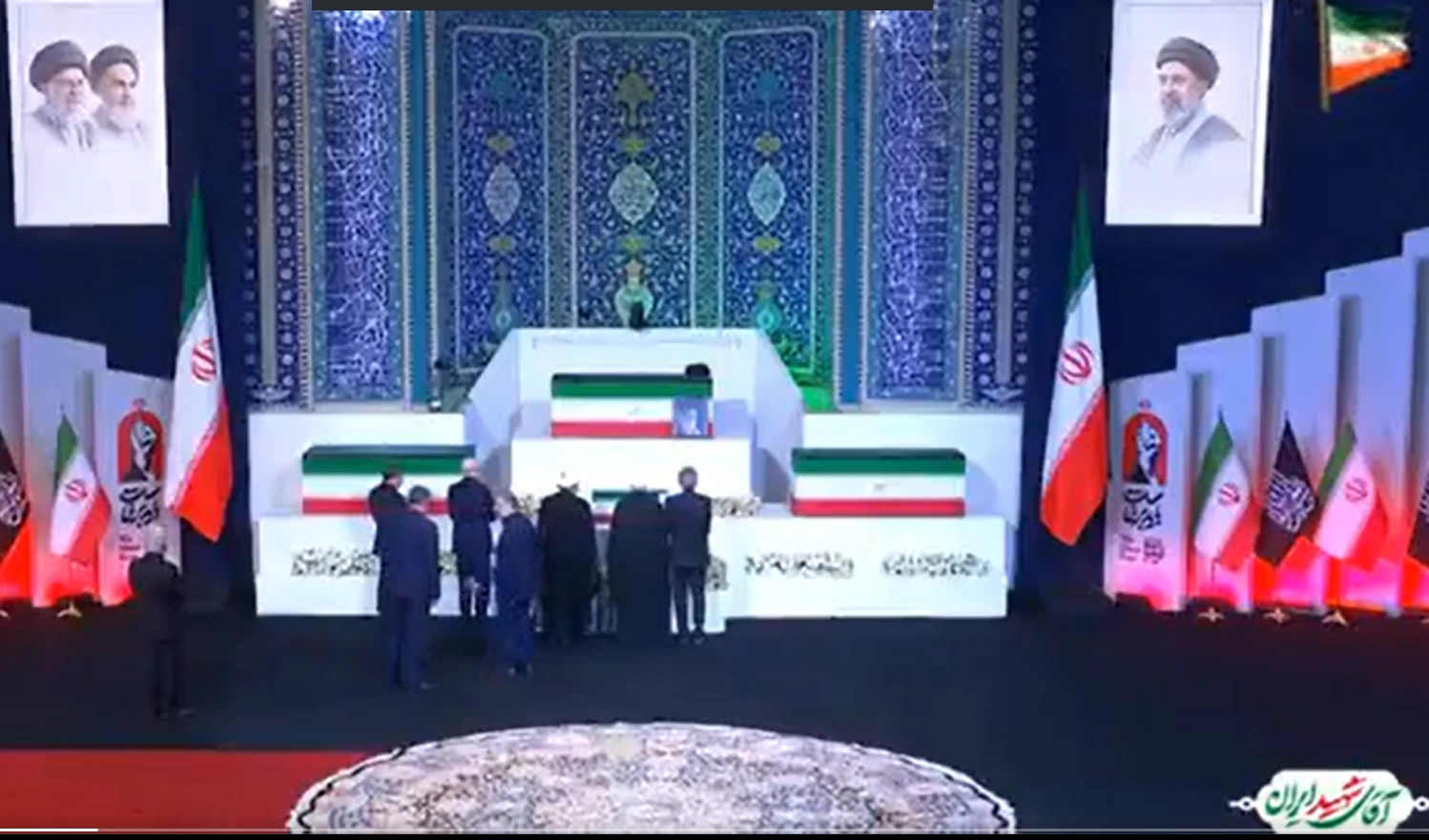
Iranian Parliament Speaker Mohammad Bagher Ghalibaf and Foreign Minister Abbas Araghchi were overcome with emotion during the farewell ceremony for former Iranian Supreme Leader Ayatollah Ali Khamenei in Tehran on Friday, as the country began official mourning ceremonies for the late leader.

The ceremony took place under extensive security arrangements, with senior Iranian officials and international delegations arriving in the capital to pay their respects.

Tight security in Tehran for farewell ceremonies

Tehran Governor Mohammad Sadegh Motamadian said authorities had implemented the highest level of security for the farewell and funeral events.

He said the gates of Tehran’s Grand Mosalla Prayer Grounds would open to the public at 6 a.m. local time, while urging people to plan their arrival accordingly. Organisers also indicated that the opening time could be advanced depending on the situation.

India among countries represented at ceremony

India was represented at the ceremony by Minister of State for External Affairs Pabitra Margherita and Bihar Governor Lt. Gen. (Retd.) Syed Ata Hasnain.

The Embassy of Iran in India said Indian dignitaries had paid tribute to Ayatollah Ali Khamenei. Images shared by the embassy showed People’s Democratic Party (PDP) president Mehbooba Mufti, Congress leader Salman Khurshid and several other attendees.

Russia also sent a high-level delegation, with Deputy Chairman of Russia’s Security Council Dmitry Medvedev attending the ceremonies in Tehran.

Global leaders attend tribute ceremony

The farewell ceremony at Tehran’s Grand Mosalla was attended by senior Iranian leaders, including President Masoud Pezeshkian, Parliament Speaker Mohammad Bagher Ghalibaf, Judiciary Chief Gholam-Hossein Mohseni Eje’i and Expediency Council Chairman Ayatollah Sadeq Amoli Larijani.

The event also drew heads of state, prime ministers, parliamentary speakers and ministers from several countries. Among those present were Turkmenistan People’s Council Chairman Gurbanguly Berdimuhamedow, Armenia Prime Minister Nikol Pashinyan, Tajikistan President Emomali Rahmon, Pakistan Prime Minister Shehbaz Sharif, Pakistan Army Chief General Asim Munir and Kurdistan Region President Nechirvan Barzani.

Delegations from Iraq, Azerbaijan, Bangladesh, Uzbekistan, Belarus, Kyrgyzstan, Oman, Saudi Arabia, Turkey, Egypt, Nicaragua, Congo and Burkina Faso also attended, alongside representatives from international organisations including the Shanghai Cooperation Council, the D-8 Organisation for Economic Cooperation and the Organisation of Islamic Cooperation.

Iran expected participation from nearly 100 countries

Iranian Foreign Ministry spokesperson Esmaeil Baghaei said before the ceremony that high-level delegations from neighbouring countries, including presidents, prime ministers and parliamentary speakers, would participate.

He added that representatives from around 100 countries, including public figures and members of parliament, were expected to attend. Baghaei also said countries in Europe that had officially supported military action by Israel and the United States against Iran had not been invited.

Funeral ceremonies to continue through the week

Iranian authorities estimate that between 15 and 20 million people could participate in the multi-day mourning events.

According to the announced schedule, the body will lie in state at Tehran’s Grand Mosalla before a funeral procession through Tehran on Monday. Additional ceremonies are planned in Qom, Baghdad, Karbala and Najaf before the burial in Mashhad on July 9.

Latest world news

US plans proposed $103,265 H-1B fee hike, Indians among those affected

The US is planning to propose a $103,265 H-1B visa fee, along with possible changes to F-1 OPT and the H-1B grace period.

Published

on

donald-trump

The US Department of Homeland Security is planning to propose a major increase in the H-1B visa fee to $103,265, according to a notice posted in the Federal Register on Monday.

The proposed changes could significantly increase the cost of employing foreign nationals in the United States if they are implemented. They could also affect students moving from universities into employment and employers sponsoring H-1B workers.

The proposals are particularly significant for Indians, who accounted for 71 per cent of H-1B beneficiaries among the petitions approved by the US Citizenship and Immigration Services in 2024.

Proposed H-1B and OPT fees

The Trump administration is planning new fees related to the H-1B and F-1 Optional Practical Training (OPT) programmes.

According to immigration services firm Fragomen, the proposed rules have already moved through the White House Office of Management and Budget (OMB).

Fragomen said a proposed rule concerning an OPT fee was sent to the OMB on August 20 and was under review. A separate proposal concerning a fee on certain H-1B petitions was received by the OMB and cleared review on August 19.

The contents of the proposed regulations have not yet been officially released.

Fragomen also noted that the Department of Homeland Security could propose a $100,000 fee on OPT applications. The proposed H-1B fee could also be linked to ongoing legal proceedings concerning the administration’s previously blocked $100,000 H-1B petition fee.

Indians account for over 70% of H-1B beneficiaries

The proposed fee increase could have a substantial impact on Indian nationals because they make up the largest share of H-1B beneficiaries.

US Citizenship and Immigration Services approved 399,402 H-1B petitions in 2024, with Indian-born beneficiaries accounting for 71 per cent of them.

If the proposed regulations are eventually implemented, the higher costs could affect foreign workers as well as US employers that sponsor H-1B employees.

More than 5.2 million people of Indian origin live in the United States, according to recent estimates based on US Census data.

Proposed end to 60-day H-1B grace period

The potential fee increases come alongside another proposed immigration change affecting H-1B workers.

Earlier this month, the Department of Homeland Security proposed eliminating the existing 60-day grace period for certain H-1B workers whose employment ends before their authorised period of stay expires.

Under the proposal, affected workers and their dependants could be required to leave the US almost immediately if the regulation is finalised.

The proposed change would remove the existing 60-day grace period for certain workers and their dependants when the employment supporting their immigration status ends before their authorised stay expires.

Continue Reading

Latest world news

Hindu family killed in Bangladesh, suspects stayed overnight after killings

Two suspects have been arrested in the killing of a Hindu family of four in Bangladesh’s Rangpur. Police said they allegedly stayed overnight inside the victims’ home after the murders.

Published

on

Four members of a Hindu family were killed inside their locked home in Bangladesh’s Rangpur city, with police saying two neighbours remained inside the house overnight after the killings.

The victims were identified as retired schoolteacher Ganapati Chakraborty, 65, his wife Pritilata Chakraborty, 50, their daughter Agami Chakraborty Prarthi, 23, and their 12-year-old son Priyam Chakraborty.

Their bodies were recovered from their home on Saturday. Police said the victims’ faces had been burned using an inflammable substance.

According to police, the killings took place late on Thursday night after two neighbours, also Hindu, allegedly went to the rooftop of the Chakraborty family’s two-storey house in the Machuapara area to consume yaba, a methamphetamine-based drug.

Two suspects arrested

Rangpur Metropolitan Police Commissioner Mohammad Abdul Mabud said two maternal cousins, Siddhartha Das, 19, and Mugdha Das, 23, had been arrested in connection with the killings.

Police said the two men allegedly went to the family’s rooftop to consume yaba. After hearing noises upstairs, Ganapati Chakraborty went to check what was happening.

According to the police account, the suspects allegedly used a towel that Chakraborty was carrying to strangle him.

When his wife followed him after hearing the commotion, she was allegedly attacked and killed on the staircase.

The couple’s daughter also came out of her room to find out what was happening and was allegedly attacked. Police said the two suspects struggled with her for several minutes before allegedly strangling her with a rope.

The couple’s 12-year-old son was subsequently killed because the suspects allegedly feared that he could identify them, police said.

Suspects allegedly stayed overnight

Police said they believe the two suspects did not immediately leave the house after the killings.

According to the police account, the suspects allegedly stayed inside the home overnight and left the following day when the streets were relatively empty during Jummah, or Friday prayers.

During their alleged stay, the suspects reportedly bathed inside the house and took dates and cucumbers from the family’s refrigerator.

Police also said the suspects consumed drugs, which were found on a table inside the house.

Before leaving, the two men allegedly opened cupboards and drawers and scattered clothes and other belongings around the home in an apparent attempt to mislead investigators into believing that a robbery had taken place.

Gold jewellery allegedly looted

Police said gold jewellery was allegedly taken from the victims’ home. Investigators also found evidence suggesting that an attempt had been made to test a gold bangle using fire.

According to the source text, Siddhartha runs a fish business, while Mugdha works as a goldsmith.

Police said the two suspects have confessed to the killings and that gold jewellery allegedly looted from the house has been recovered.

The family’s two mobile phones were also allegedly destroyed by submerging them in water mixed with detergent, police said.

Investigators have seized date pits from inside the house and are conducting DNA testing as they continue to investigate the case.

Continue Reading

Latest world news

India calls US religious freedom body biased over RSS sanctions demand

India has criticised USCIRF as biased and lacking credibility after the US body urged sanctions against RSS members ahead of Mohan Bhagwat’s New York visit.

Published

on

India has criticised the United States Commission on International Religious Freedom (USCIRF) after the US body called for sanctions against members of the Rashtriya Swayamsevak Sangh (RSS) ahead of RSS chief Mohan Bhagwat’s scheduled visit to the United States.

External Affairs Ministry spokesperson Randhir Jaiswal described USCIRF as a “biased organisation” and said it lacked credibility.

“It is a biased organisation. I would say that we should keep away from such organisations as they have their own agenda and lack any credibility,” Jaiswal said.

He also accused the body of making “disparaging and inflammatory remarks” about India and said the USCIRF was unlikely to engage with the country’s “pluralistic framework” or acknowledge the harmonious coexistence of its diverse communities.

USCIRF seeks sanctions against RSS members

USCIRF chair Asif Mahmood opposed Mohan Bhagwat’s upcoming visit to the US and called on the American government to impose sanctions against the RSS. Bhagwat is scheduled to visit New York on August 29.

The US body also urged Washington not to extend diplomatic courtesies to RSS leaders. It described the RSS as an “umbrella organisation” and alleged that its sub-groups had “perpetrated attacks on religious minorities”.

USCIRF said the US government should instead focus on imposing sanctions on RSS members found responsible for freedom of religious belief violations.

USCIRF’s earlier criticism of India

In its annual report released in March, USCIRF criticised India over alleged violations of religious freedom and recommended targeted sanctions against individuals and entities, including the RSS and Research and Analysis Wing.

The commission also recommended designating India as a “country of particular concern”.

USCIRF is an independent, bipartisan US federal government agency that makes policy recommendations to the US President, Secretary of State and Congress and tracks their implementation.

Hindu advocacy group criticises USCIRF

US-based Hindu advocacy group HinduPACT also condemned USCIRF members’ public opposition to Bhagwat’s New York visit.

Ajay Shah, founder and chair of HinduPACT, accused the commission of having “disgraced its mandate” and alleged that its chair’s remarks reflected an anti-Hindu narrative.

Shah also criticised groups including CAIR, IAMC and HfHR, alleging that they had portrayed Hindu self-assertion as extremism.

Continue Reading

Trending

© Copyright 2022 APNLIVE.com