English हिन्दी
Connect with us

India News

Omar Abdullah criticises Martyrs’ Day restrictions, calls LG administration temporary guests

Omar Abdullah criticised the LG administration after being prevented from visiting Srinagar’s Martyrs’ Graveyard, alleging the 1931 martyrs’ sacrifices are being overlooked.

Published

on

Omar Abdullah

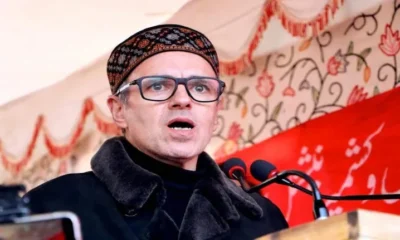
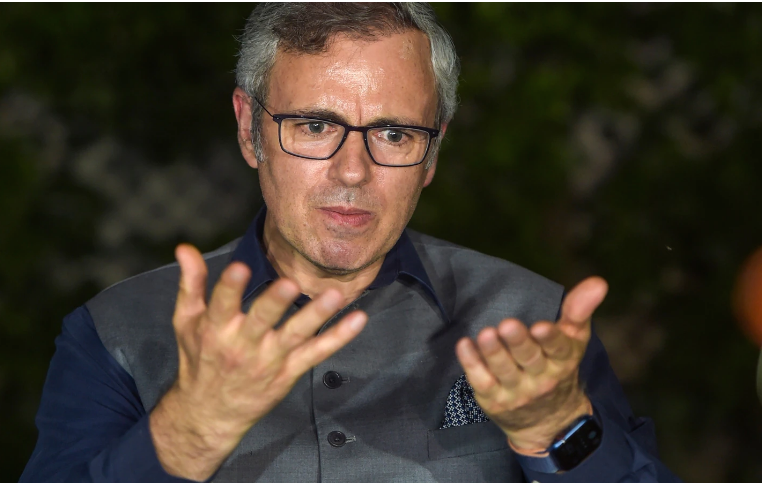
Jammu and Kashmir Chief Minister Omar Abdullah on Monday criticised the Lieutenant Governor (LG) administration after he was prevented from visiting the Martyrs’ Graveyard in Srinagar to pay tribute to those killed during the 1931 uprising.

The area surrounding the Martyrs’ Graveyard in downtown Srinagar was sealed by the authorities, with police declaring it a no-go zone and restricting entry to the site.

Omar Abdullah questions restrictions

Unable to visit the graveyard, Abdullah, along with his ministers, MLAs and National Conference leaders, held a tribute meeting at the party headquarters in Srinagar.

Addressing party workers after the meeting, the Chief Minister said the administration’s decision to block access would not erase the memory of the 1931 martyrs.

Calling the LG administration “temporary guests”, Abdullah said those responsible for preventing political leaders from paying homage would not remain in office forever, while the martyrs’ cemetery would continue to stand. He added that he and his party would visit the site in the future to offer floral tributes and prayers.

Alleges selective treatment of history

Abdullah alleged that the sacrifices of those who fought against British-era rule in Jammu and Kashmir were being ignored because they were Muslims and had opposed the Dogra Maharaja, who ruled under British paramountcy.

He argued that the 1931 movement was not based on religion but represented a struggle for democratic rights, principles and freedom during the British period.

The Chief Minister also said attempts were being made to portray participation in the freedom movement against British rule in a negative light.

Background of the annual observance

July 13 was earlier observed as a public holiday in the erstwhile state of Jammu and Kashmir. Every year, officials, political leaders and members of the public would gather at the Martyrs’ Graveyard to pay homage to those killed during the 1931 incident, with police also offering a ceremonial gun salute.

Following the abrogation of Article 370 and the reorganisation of Jammu and Kashmir into a Union Territory in 2019, July 13 was removed from the list of official public holidays. Since then, authorities have not permitted official or public commemorative events at the graveyard.

The Lieutenant Governor continues to exercise authority over key subjects in the Union Territory, including law and order and policing.

Why July 13 is significant

July 13 commemorates the deaths of 22 civilians who were killed in police firing outside Srinagar Central Jail in 1931 while protesting against the rule of Dogra Maharaja Hari Singh during the British era.

The protesters had gathered in support of Abdul Qadeer, who had urged Kashmiris to oppose the Maharaja’s administration.

The incident led to widespread protests and prompted the Maharaja and the British administration to appoint commissions to examine the grievances of the Valley’s Muslim population. It also contributed to political reforms, with Jammu and Kashmir holding its first Assembly elections in 1934, marking the beginning of an electoral process in the region.

Changes after 2019

Since 2020, both July 13 and December 5—the birth anniversary of former Jammu and Kashmir Prime Minister and Chief Minister Sheikh Abdullah—have ceased to be official holidays in the Union Territory.

Instead, the birth anniversary of Dogra ruler Maharaja Hari Singh is now observed as a public holiday in Jammu and Kashmir.

India News

PM Modi-Xi meeting: Xi says India, China can learn from each other’s strengths

PM Modi and Xi Jinping held bilateral talks on the sidelines of the BRICS Summit, with discussions focused on border peace, bilateral relations and cooperation.
Published

on

China President Xi Jinping

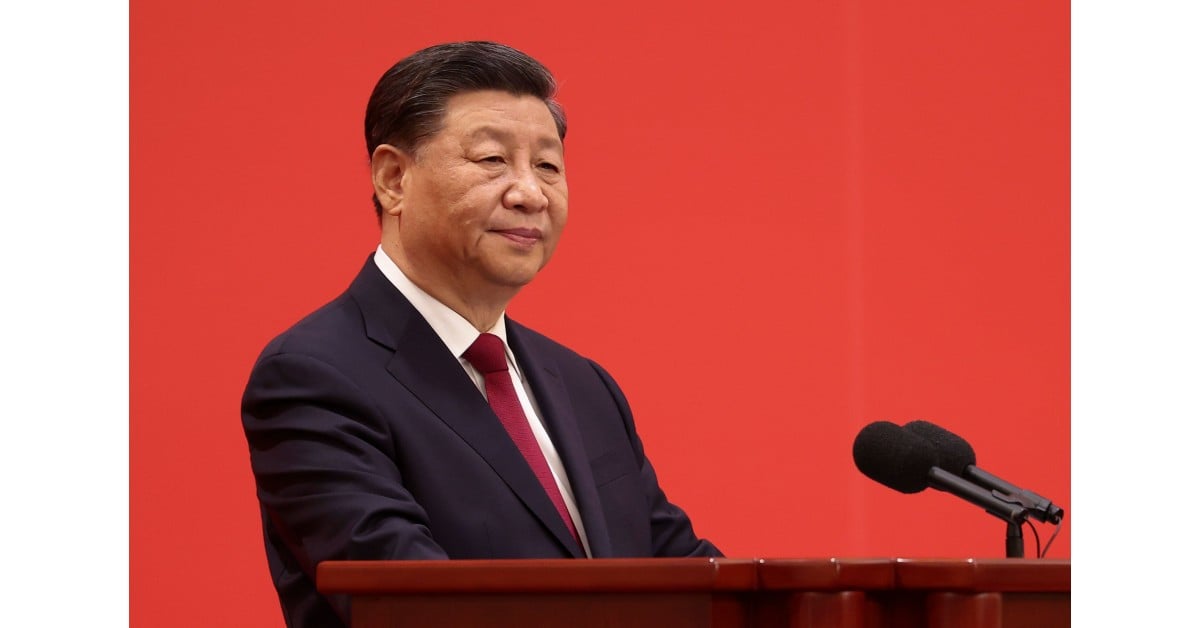
Chinese President Xi Jinping said India and China can learn from each other’s strengths and support one another as he held bilateral talks with Prime Minister Narendra Modi in New Delhi on Saturday.

The meeting took place on the sidelines of the BRICS Summit 2026 during Xi’s two-day visit to India. It was his first visit to the country in seven years. The discussions covered bilateral relations, border issues, trade and investment.

PM Modi stresses importance of border peace

Prime Minister Narendra Modi emphasised that peace and tranquillity in the border areas are essential for the continued development of India-China relations.

He also underlined the need for both countries to follow existing agreements and understandings related to border issues. The two leaders reaffirmed their commitment to pursuing a fair, reasonable and mutually acceptable resolution of the boundary question while keeping the long-term interests of both countries in mind.

The two sides also noted steady progress in bilateral relations since Modi and Xi last met in Tianjin in August 2025.

Modi stressed that differences between India and China should not turn into disputes. He said the relationship should be guided by three principles — mutual respect, mutual sensitivity and mutual interest.

Xi calls for long-term India-China ties

During the meeting, Xi Jinping said China has consistently viewed its relationship with India from a strategic and long-term perspective.

He recalled that he and Modi have met 21 times over the years and said these meetings had helped guide India-China relations towards steady development.

Xi said that despite differences in their national conditions, India and China could learn from each other’s strengths, support one another and pursue common development.

He also highlighted the responsibilities of India and China as two of the world’s most populous countries and important members of the Global South.

Both sides review bilateral relations

The two leaders carried out a comprehensive review of India-China relations and discussed measures to expand engagement.

The talks also highlighted the importance of maintaining peace and tranquillity along the border and continuing cooperation based on mutual respect, mutual sensitivity and mutual interest.

After the meeting, Modi said the two sides had reviewed the full range of India-China relations. He also conveyed India’s best wishes to China ahead of its BRICS presidency next year.

Continue Reading

India News

Bank holiday on September 14: Banks closed in these cities

Banks will remain closed on September 14 in nine cities, including Mumbai, Bengaluru, Chennai and Hyderabad, due to Ganesh Chaturthi and related festival observances.

Published

on

Bank holidays

The bank holiday on September 14 will affect branches in select cities across India as banks observe a regional holiday for Ganesh Chaturthi and related festival observances.

September 14, 2026, falls on a Monday and is listed as a holiday for Ganesh Chaturthi, Ganesh Puja, Varasiddhi Vinayaka Vrata, Vinayakar Chathurthi and Hartalika in certain banking centres.

Bank holiday on September 14: Full city-wise list

According to the holiday listings, bank branches will remain closed on September 14 in the following centres:

CityFestival/occasion
BelapurGanesh Chaturthi/Ganesh Puja/related observances
BengaluruGanesh Chaturthi/Ganesh Puja/related observances
BhubaneswarGanesh Chaturthi/Ganesh Puja/related observances
ChennaiGanesh Chaturthi/Ganesh Puja/related observances
HyderabadGanesh Chaturthi/Ganesh Puja/related observances
MumbaiGanesh Chaturthi/Ganesh Puja/related observances
NagpurGanesh Chaturthi/Ganesh Puja/related observances
PanajiGanesh Chaturthi/Ganesh Puja/related observances
VijayawadaGanesh Chaturthi/Ganesh Puja/related observances

The holiday is therefore not applicable to bank branches across the entire country. Bank holidays in India vary by state and banking centre, depending on local festivals and occasions.

Why are banks closed on September 14?

September 14 marks Ganesh Chaturthi in 2026. The festival falls on Monday this year, with the date confirmed as September 14.

The banking holiday calendar uses different names for the observance across centres, including Ganesh Chaturthi, Ganesh Puja, Varasiddhi Vinayaka Vrata, Vinayakar Chathurthi and Hartalika.

The National Stock Exchange’s 2026 holiday circular also lists September 14 as a trading holiday for Ganesh Chaturthi.

Will online banking services work on September 14?

The closure applies to physical bank branches in the affected centres. Customers can generally continue to use digital banking channels such as mobile banking, internet banking and UPI, although specific services can depend on the bank.

Customers who need to visit a branch for cash deposits, withdrawals, account-related work or other in-person services should check the holiday status of their particular branch before visiting.

What about banks in other cities?

Banks in cities that are not covered by the September 14 regional holiday are not automatically closed because of Ganesh Chaturthi.

The bank holiday calendar is centre-specific, so customers should check their bank’s branch holiday schedule before planning a branch visit.

Continue Reading

India News

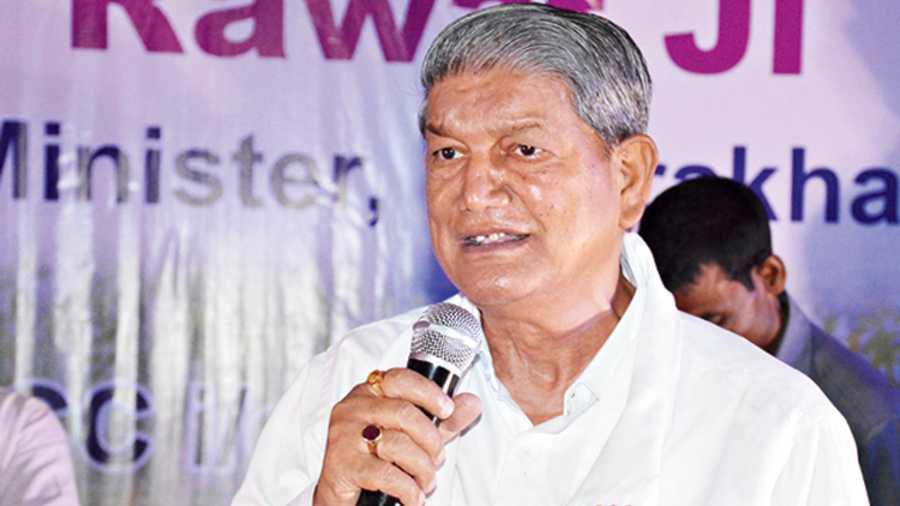
Harish Rawat quits Congress posts after ED raid on aide

Former Uttarakhand chief minister Harish Rawat resigned from two Congress posts after the ED searched his aide Chandan Singh Jeena’s premises in a money laundering probe.
Published

on

Harish Rawat

Former Uttarakhand chief minister Harish Rawat has resigned from two organisational positions in the Congress after the Enforcement Directorate (ED) conducted searches at the premises of his personal assistant, Chandan Singh Jeena.

Rawat announced his decision on Friday, saying he did not want the controversy surrounding his close associate to weaken the Congress’s campaign against corruption. He stepped down as a member of the Uttarakhand Pradesh Congress Committee executive and as a permanent invitee to the Congress Working Committee.

The ED searches were linked to a money laundering investigation concerning alleged irregularities in the 2016 Gram Panchayat Vikas Adhikari examination conducted by the Uttarakhand Subordinate Service Selection Commission (UKSSSC).

What ED recovered from Rawat’s aide

The ED carried out searches at multiple locations in Dehradun, including premises connected with former UKSSSC officials, a private computer agency involved in processing OMR sheets and alleged middlemen.

According to the agency, its search of Jeena’s residence resulted in the seizure of Rs 32 lakh in unaccounted cash, gold coins and chains weighing around 200.5 grams, and 12 luxury watches.

The gold comprised 13 coins and seven chains. The watches included brands such as Rolex, Rado, Piaget, Movado, Tissot and Casio Edifice, according to the ED.

The agency also said bank accounts belonging to Jeena and his family members containing Rs 52.16 lakh were frozen. His mobile phone was seized for forensic examination.

The ED alleged that Jeena had made substantial cash expenditures for which no legitimate source of income could be established. It also said unaccounted cash, jewellery and other valuables were recovered from some former UKSSSC officials and associated individuals.

What is the UKSSSC exam case?

The ED’s money laundering investigation stems from four FIRs registered by the Uttarakhand Police and Vigilance Bureau over alleged irregularities in the 2016 Gram Panchayat Vikas Adhikari examination.

According to the agency, OMR answer sheets were allegedly removed from secure custody and taken to the residence of the commission’s then secretary. Roll numbers of under-filled answer sheets were recorded and passed to personnel of a private computer agency.

The ED has alleged that answer bubbles were subsequently filled or altered fraudulently before the sheets were resealed, with illegal payments allegedly routed through middlemen.

Jeena is currently serving as Rawat’s personal assistant. He had earlier served as Rawat’s officer on special duty when Rawat was Uttarakhand chief minister between 2014 and 2017.

What Harish Rawat said

Reacting to the allegations, Rawat said he found it difficult to believe that Jeena had been involved in wrongdoing. He acknowledged Jeena’s association with him and said the truth behind the allegations would emerge with time.

Rawat said that if evidence showed Jeena had tampered with OMR sheets in the recruitment examination, he would be ashamed of such conduct, while adding that he did not believe the allegation.

Explaining his resignation, Rawat said Uttarakhand politics was entering an election phase and that attempts were being made to create a narrative against him.

He said Congress and its workers were fighting corruption and that he did not want any action associated with him to weaken the party’s campaign. Since he did not hold a government position from which he could resign, he chose to step down from his organisational responsibilities in the party.

Continue Reading

Trending

© Copyright 2022 APNLIVE.com