English हिन्दी
Connect with us

India News

Bhupen Hazarika’s son slams citizenship amendment bill, calls it ‘painfully unpopular’

Published

on

Bhupen Hazarika

[vc_row][vc_column][vc_column_text]Legendary musician Bhupen Hazarika’s son Tez Hazarika has lashed out at the government over the Citizenship (Amendment) Bill 2016 – a proposed law to grant citizenship to non-Muslim immigrants, saying the Bill was “actually undermining” his father’s “documented position” and “would in reality be in direct opposition to what Bhupenda believed in his heart of hearts”.

Tez Hazarika, who is based in the US, said in a statement that he was unhappy how the centre planned to pass the “painfully unpopular” Bill which was against his father’s beliefs and position.

“I believe that my father’s name and words are being invoked and celebrated publicly while plans are afoot to pass a painfully unpopular bill regarding citizenship that is actually undermining his documented position. It would in reality be in direct opposition to what Bhupenda believed in his heart of hearts,” Tez Hazarika said.

Just a couple of days ago Prime Minister Narendra Modi, paying tribute to Bhupen Hazarika, had taken a swipe at previous governments for delaying the Bharat Ratna to the celebrated singer. The Modi government, this Republic Day, named Bhupen Hazarika for the Bharat Ratna, the country’s highest civilian award, along with former President Pranab Mukherjee and Bharatiya Jana Sangh leader Nanaji Deshmukh.

In a statement, Tez Hazarika said: “I go on record here to answer that A), I have not received any invitation so far there is nothing to reject, and B), how the center moves on this matter far outweighs in importance the awarding and receiving of such national recognition – a display of short lived cheap thrills.”

Bhupen Hazarika’s brother Samar Hazarika shares different opinion. He said in Assam he was “not in touch” with Tez. “This award should be given to Bhupen. It’s too late now,” he said.

The maestro’s sister-in-law Manisha Hazarika agreed: “Being a member of the Bhupen Hazarika family I am saying that this award is one of the most respected awards of this nation and Bhupen Da is a legendary figure. He is above politics, so raking up this controversy is wrong.”

The citizenship Bill, one of the key projects of the government, proposes smoother and quicker grant of citizenship to non-Muslim illegal migrants from Bangladesh, Pakistan and Afghanistan after six years’ stay in India. However, there have been wide scale protests against it throughout the northeast.

The Bill has been listed to come up in the Rajya Sabha on Tuesday. It will be moved by Home Minister Rajnath Singh.

You might also be interested in:

[/vc_column_text][/vc_column][/vc_row]

India News

PM Modi speaks to Mark Carney as India and Canada push to strengthen ties

Prime Minister Narendra Modi held a telephone conversation with Canadian Prime Minister Mark Carney on October 13, with both leaders agreeing to strengthen India-Canada ties and pursue concrete outcomes across key areas of their strategic partnership.

Published

on

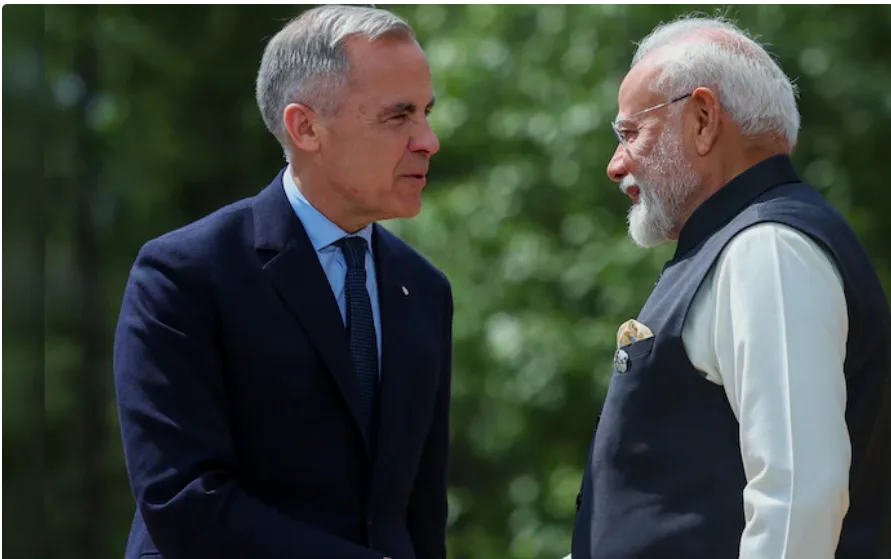
Prime Minister Narendra Modi held a telephone conversation with Canadian Prime Minister Mark Carney on Tuesday, October 13, as the two countries seek to strengthen bilateral relations and translate renewed diplomatic engagement into concrete outcomes.

Following the conversation, Modi said both leaders had agreed to build on the positive momentum in India-Canada ties and work towards progress across key areas of their strategic partnership.

In a post on X, the prime minister described the conversation as “warm and productive”. He identified trade, energy, technology, security and people-to-people ties as important areas for further cooperation.

Modi also said India and Canada were contributing towards a more stable and prosperous world.

India and Canada focus on trade and strategic cooperation

The latest conversation comes amid increased engagement between New Delhi and Ottawa across economic, security and diplomatic matters.

According to the Canadian Prime Minister’s Office, the two leaders welcomed the expansion of engagement over the past year, including cooperation in finance, defence and security, people-to-people ties and artificial intelligence.

The two leaders reaffirmed their commitment to concluding negotiations on a Comprehensive Economic Partnership Agreement (CEPA) at the earliest opportunity. The proposed agreement is intended to support efforts to double two-way trade between India and Canada by 2030.

The leaders welcomed the ongoing Team Canada Trade Mission in India, led by Canadian International Trade Minister Maninder Sidhu, along with the visit of Canadian Foreign Minister Anita Anand to New Delhi.

The engagements are aimed at advancing shared priorities, including trade, energy and people-to-people ties.

Security cooperation remains on the agenda

The conversation followed a bilateral security dialogue held in India the previous week as part of ongoing engagement between the two countries on security and law enforcement.

The Canadian Prime Minister’s Office said the two leaders welcomed the bilateral security dialogue held in India the previous week as part of ongoing security and law enforcement engagement at the National Security Advisor level. They also agreed to remain in close contact ahead of Modi’s planned visit to Canada in December.

The Canadian readout also said the two prime ministers discussed the effects of geopolitical instability on the Indo-Pacific region and the need for trusted partners in energy and agriculture.

Carney thanked Modi for his leadership in seeking a peaceful resolution to Russia’s war against Ukraine.

India-Canada relations seek to move beyond diplomatic tensions

Relations between India and Canada deteriorated sharply in 2023 after then Canadian Prime Minister Justin Trudeau alleged a potential Indian link to the killing of Khalistan separatist Hardeep Singh Nijjar in Canada.

India rejected the accusation as absurd. In October 2024, India recalled its high commissioner and five other diplomats after Ottawa attempted to link them to the Nijjar case. New Delhi also expelled an equal number of Canadian diplomats.

Relations have since shown signs of improvement through renewed diplomatic engagement and cooperation in several areas. Both countries now have high commissioners posted in each other’s capitals.

Canadian Prime Minister Carney’s visit to India in March 2026 also contributed to renewed efforts to strengthen bilateral ties.

The latest conversation between Modi and Carney reflects the two governments’ stated intention to build on this progress, with trade negotiations, security cooperation and other shared priorities remaining central to their engagement.

Modi’s planned visit to Canada in December is expected to provide another opportunity for the two sides to advance their bilateral agenda.

Continue Reading

India News

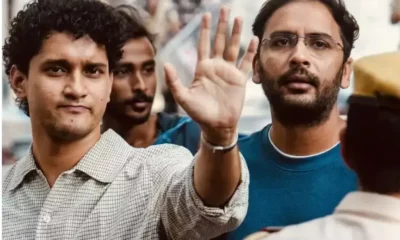
CJP leaders Saurav Das, Ashutosh Ranka, Ajinkya Shinde sent to 5-day judicial custody

Three CJP leaders, Saurav Das, Ashutosh Ranka and Ajinkya Shinde, were placed under preventive arrest following a protest at Delhi’s Jantar Mantar over Chief Election Commissioner Gyanesh Kumar.
Published

on

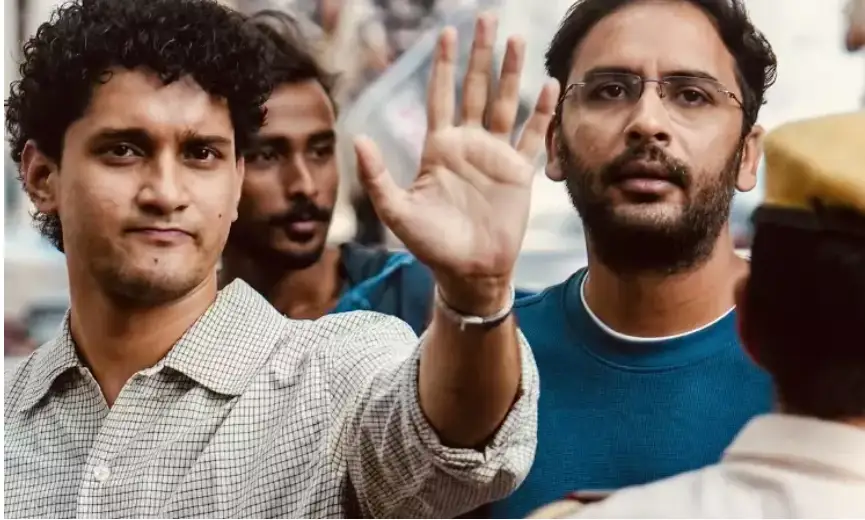
Three leaders of the Cockroach Janata Party (CJP) — Saurav Das, Ashutosh Ranka and Ajinkya Shinde — have been placed under preventive arrest in connection with a protest at Delhi’s Jantar Mantar, where demonstrators demanded the resignation of Chief Election Commissioner Gyanesh Kumar.

The three were detained early Tuesday after crossing police barricades and entering Jantar Mantar, which was recently removed from the list of designated protest venues. A case was registered against them over their alleged actions.

According to the police case, the charges include trespassing, violation of a bond, and obstructing a public official from performing official duties.

The three leaders were produced before a Special Court of the Executive Magistrate on Wednesday and could be sent to judicial custody at Tihar Jail.

Why CJP leaders protested at Jantar Mantar

The protest comes amid demonstrations by the CJP and opposition groups over alleged irregularities in the Special Intensive Revision (SIR) of electoral rolls.

The protesters were demanding the resignation of Chief Election Commissioner Gyanesh Kumar. The controversy centres on allegations concerning the electoral roll revision exercise, which the Election Commission and the BJP have denied.

Jantar Mantar was recently removed from the list of designated protest venues in Delhi. The change followed an order naming alternative locations for demonstrations, prompting criticism from groups that want to hold protests at the established site.

CJP legal team raises concerns over detention

Ratna Singh, head of the CJP legal team, said in a post on X that Delhi Police had arrested Saurav Das, Ashutosh Ranka and Ajinkya Shinde at Parliament Street Police Station in connection with the Jantar Mantar case.

Singh alleged that the three were brought to the police station in a private van at around 3 am and were not allowed to meet their lawyers until late at night.

She also raised concerns about the legal process and the possibility of the leaders being sent to judicial custody.

The allegations regarding access to legal counsel were made by the CJP legal team and should be distinguished from the charges registered by the police.

The arrests mark another development in the ongoing dispute over protests at Jantar Mantar and the CJP’s campaign against the Chief Election Commissioner over the SIR exercise.

Continue Reading

India News

BJP focuses on religion as opposition pushes BDM strategy in UP

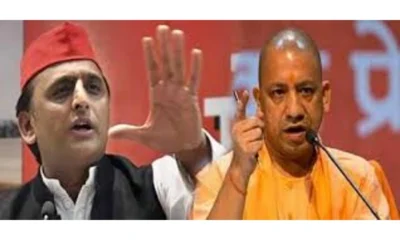
The BJP is emphasising religious issues ahead of the Uttar Pradesh Assembly elections, while opposition parties are seeking to consolidate Backward, Dalit and Minority voters. Recent exchanges involving Yogi Adityanath, Akhilesh Yadav and Asaduddin Owaisi have added to the political contest over the state’s electoral narrative.
Published

on

Ahead of the 2027 Uttar Pradesh Assembly elections, the BJP is emphasising religious issues, while opposition parties are seeking to build a coalition of Backward, Dalit and Minority voters. The competing approaches have brought caste representation and religious messaging to the forefront of the state’s political discourse.

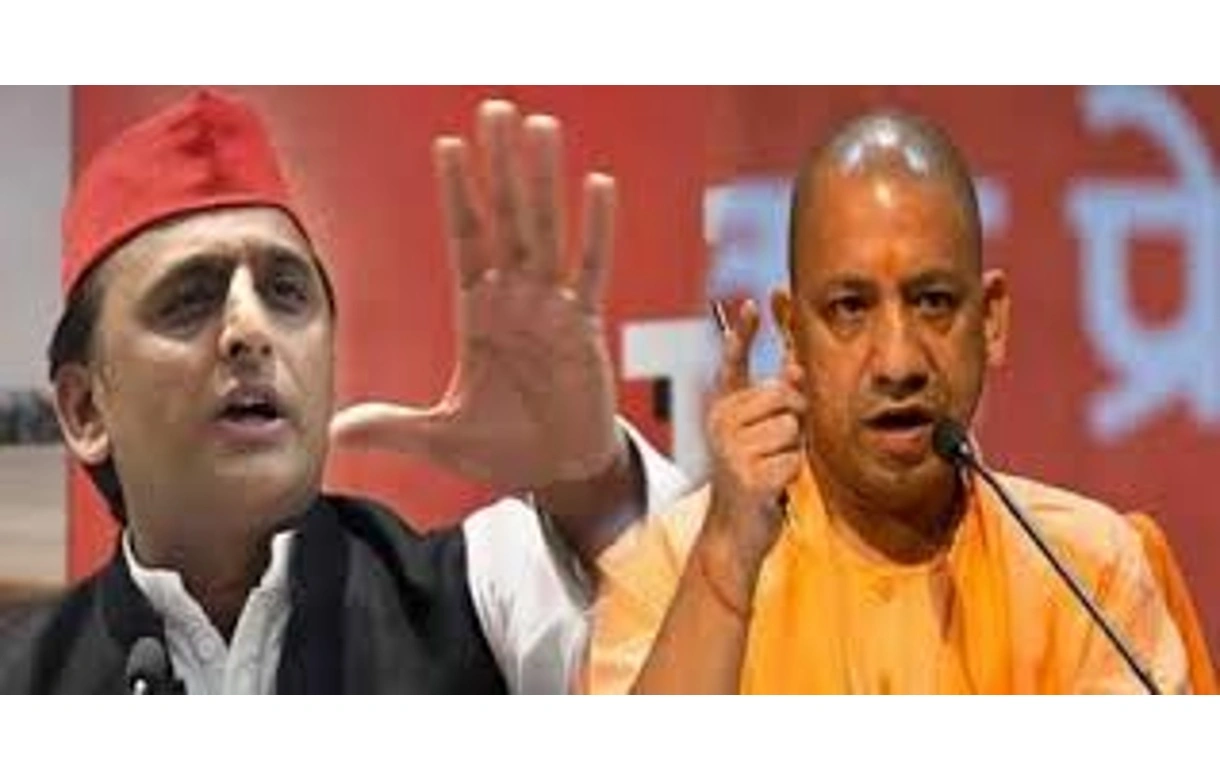
Recent temple-related controversies in Kashi, Ayodhya, Mathura and Sambhal have brought religious messaging back into the political conversation. The developments have also coincided with exchanges between Chief Minister Yogi Adityanath and Samajwadi Party chief Akhilesh Yadav over possible electoral contests.

Yogi Adityanath, Akhilesh Yadav trade election challenges

The latest round of political exchanges followed Yogi Adityanath’s invocation of the “80-20” formula during the Rajya Sabha election. Akhilesh Yadav subsequently challenged the Chief Minister to contest from Ayodhya.

During his visit to Ayodhya, the Samajwadi Party president attended a Bhagwat Katha but did not visit the Ram Mandir for darshan. His visit, during which he attended a Bhagwat Katha but did not visit the Ram Mandir for darshan, became another point of political discussion.

The Chief Minister responded during a visit to Balrampur, asking Akhilesh Yadav to contest against him.

The exchanges continued as political leaders questioned the Samajwadi Party chief’s religious outreach. State minister Om Prakash Rajbhar asked why Yadav had not visited Mathura, while AIMIM chief Asaduddin Owaisi challenged him to contest from Sambhal.

Responding to questions about the challenges, Akhilesh Yadav said the Chief Minister does not decide which candidates the parties nominate.

At a press conference in Lucknow, Yadav also remarked, “What could be better than getting the Chief Minister’s chair without even contesting the election?” His comment suggested that Adityanath might not contest the Assembly elections.

Adityanath, meanwhile, said he was pleased to have several options available to him.

BJP works on its own caste coalition

Alongside its emphasis on religious issues, the BJP is also seeking to broaden its social support base through caste representation.

During the Rajya Sabha elections, the party fielded three candidates from Backward Classes, two Dalits, two Brahmins and one Rajput. The Backward Class candidates included representatives of the Pal, Kurmi and Lodh communities.

The report describes the BJP’s selection of candidates from the Sonkar and Rawat communities as an attempt to attract support among the Gaur and Jatav Dalit vote banks. Its selection of two Brahmins and one Rajput was also part of its outreach to upper-caste voters.

These choices reflect the BJP’s efforts to build a social coalition that extends beyond its religious messaging as the state approaches the next Assembly election.

Akhilesh Yadav balances caste outreach with temple politics

The Samajwadi Party is also combining its BDM approach with religious outreach, described in the report as “soft Hindutva”.

Akhilesh Yadav is overseeing the construction of the Kedareshwar Temple in Etawah. When questioned about not visiting the Ram Mandir during his Ayodhya trip, he said he was waiting for the temple’s “Pran Pratishtha”, or consecration ceremony, implying that the ceremony held in 2024 did not count.

Yadav has also raised the issue of alleged theft of offerings at the Ram Temple, a move the report interprets as an attempt to appeal to Hindu voters.

The competing strategies indicate that caste representation, religious issues and temple-related controversies are all featuring in political messaging ahead of the 2027 Uttar Pradesh Assembly elections.

Continue Reading

Trending

© Copyright 2022 APNLIVE.com