
Latest Politics News
1041 File Nomination for 117 Punjab Seats


[vc_row][vc_column][vc_column_text]The three-cornered battle in the upcoming assembly polls is heading for an exciting finish as new entrant AAP is emerging as the dark horse amid strong anti-incumbency sentiments and Congress’ poor track record
By Sujit Bhar[/vc_column_text][vc_column_text]Punjab election nominations saw a surge on the last day (January 18) when 1,040 candidates submitted their papers, bringing the total to 1,041. Elections to 117 assembly constituencies in this state are scheduled for February 4.[/vc_column_text][vc_column_text]Among those filing on the last day were cricketer-turned-politician Navjot Singh Sidhu, who just joined the Congress, his party’s chief in the state, Amarinder Singh, and Bhagwant Mann of the Aam Admi Party (AAP). Sidhu will fight for the Amritsar East seat, Amarinder for the Lambi seat (where his opponent will be Chief Minister Parkash Singh Badal) and Mann will fight in Jalalabad.[/vc_column_text][vc_column_text]The Punjab elections were supposed to be a little different this year, with not only a shift from the typical Congress versus the BJP-Shiromani Akali Dal (SAD) combine tussle being extended to a three-corner one with the advent of AAP. It was also supposed to be a fight for development and modernism against the entrenched traditions of religious sentiments that have in the recent past taken the state down perilous paths.[/vc_column_text][vc_column_text]The introduction of AAP sees a definitive move by its chief Arvind Kejriwal to possess a real seat of power, instead of the truncated system he heads in Delhi. In the process, he has chosen a point where anti-incumbency could have become a huge factor. The BJP-SAD combine has survived the last elections, retaining power, but their administration has been embroiled in a multitude of controversies, including that of the spread of drugs use, and religious one-upmanship.[/vc_column_text][vc_column_text]Amarinder’s comment that chief minister Badal had initiated a bloody war between Sikh religious leaders and that this was Badal’s plan for “controlled destabilisation” in the state, could, in fact, help the AAP, which is coming in with no baggage at all. If anything, AAP is coming in with an established reputation of having stumped the powerful BJP in Delhi, despite everybody, from Prime Minister Narendra Modi to BJP president Amit Shah throwing their weights behind the BJP campaign.
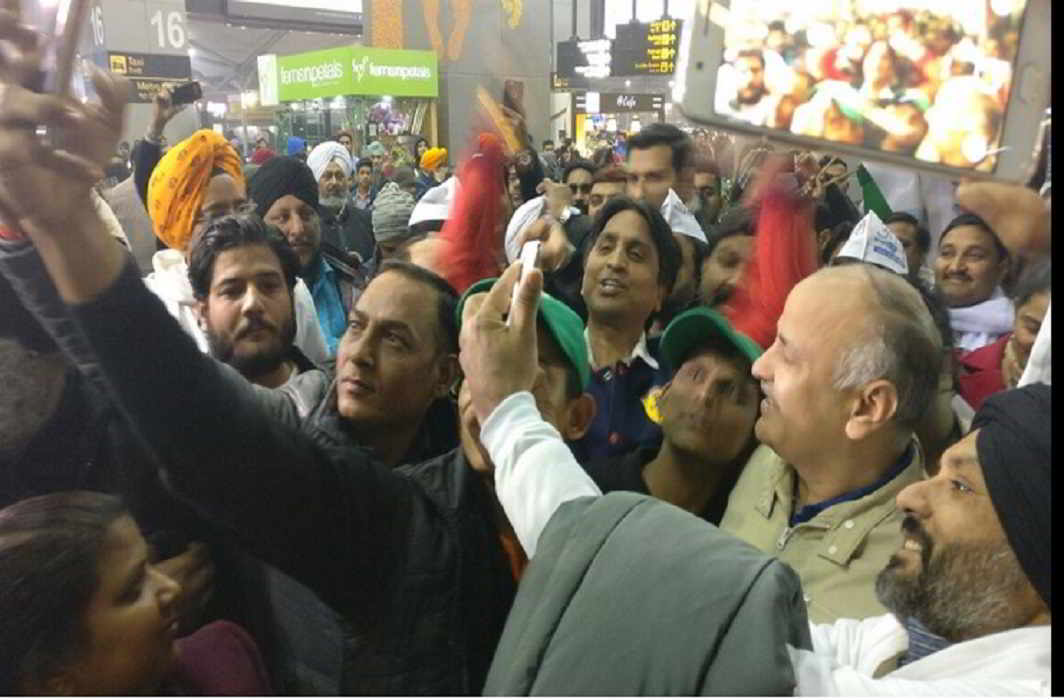
Deputy CM of Delhi, Manish Sisodia meeting NRI supporters of AAP who specially flew to render support for the party in upcoming Punjab polls. Photo: Twitter/AAP
[/vc_column_text][vc_column_text]To this end the AAP is venturing out into a new field, something that people associated the BJP with at the last Lok Sabha elections.[/vc_column_text][vc_column_text]On January 19 about a hundred AAP supporters arrived in Delhi from Canada – all NRIs – and were to leave for Punjab, where they would drum up support for Kejriwal and the AAP. The message is clear: development and the painting of a rosy future under AAP. It was a timely move, with Delhi deputy chief minister Manish Sisodia receiving them at the airport in the morning, a day after the CBI initiated a probe against him for graft.[/vc_column_text][vc_column_text]It is not that these 100 NRIs would be able to turn local sentiments in Punjab on its head, but the youth see this as a huge positive. Emotions in Punjab have always swung between the Congress and the BJP-SAD combine for a good reason. The people of Punjab recognise these people, and they have had the touch and feel of a known devil, against AAP, an unknown identity. But the new element in publicity would be interesting.[/vc_column_text][vc_column_text]Also, while the AAP might not really be holding high hopes for a victory, it would be useful for the other two combines to study how the AAP draws out their vote banks and who could lose as a result. AAP volunteers have been visiting lakhs of homes, even in rural Punjab for a long time now and fresh faces and fresh promises always have an appeal with the youth. They declared their candidates’ list way ahead of the others, and people have had time to look into each and every one of them.[/vc_column_text][vc_column_text]The youth of Punjab sees AAP as a symbol of hope amid chaos and despair. Hitesh Sofat, from Patiala, now working for a private organisation in Noida, has high hopes for AAP in Punjab. “I think the AAP would win this time,” he told APN. “I come from Patiala, where the sporting atmosphere is great (the National Institute of Sports is headquartered there), and people are sports minded. I have seen how the BJP-SAD combine has dragged the youth of the state into drugs and how Bikram Majithia, minister in the Badal cabinet has been hand in glove with the process.”[/vc_column_text][vc_column_text]Sofat is a technical person, and he sees the future with hope. “I do think that the promoters of a drugged world will be put behind bars, and the AAP has the ability and vision to do that,” he says. “Plus, the AAP is right about procuring the money from the state itself for development projects. We do not need the courtesy of the centre for our projects in the Punjab. Just as he did it in Delhi, he will be able to do it in the Punjab.”[/vc_column_text][vc_column_text]Such optimism should reflect, to an extent, in the ballot boxes, though people with entrenched positions would be loathe to let that happen. And for Kejriwal, Punjab is still a long way off. It would be great if he can form a credible opposition.[/vc_column_text][vc_column_text]The presence of the AAP could see a lot more happening in the social fabric of the state: more involvement of women in the political process, for example. The state, which has one of the lowest male to female ratios in the country, should have hit out with more participation of women in the polling process. But this time the number of women filing nominations has fallen sharply. From 93 in the 2012 polls, the number has fallen to just 27, fielded by the four parties in fray.[/vc_column_text][/vc_column][/vc_row]








India News
CJP leaders Saurav Das, Ashutosh Ranka, Ajinkya Shinde sent to 5-day judicial custody
Three CJP leaders, Saurav Das, Ashutosh Ranka and Ajinkya Shinde, were placed under preventive arrest following a protest at Delhi’s Jantar Mantar over Chief Election Commissioner Gyanesh Kumar.


India News
BJP focuses on religion as opposition pushes BDM strategy in UP
The BJP is emphasising religious issues ahead of the Uttar Pradesh Assembly elections, while opposition parties are seeking to consolidate Backward, Dalit and Minority voters. Recent exchanges involving Yogi Adityanath, Akhilesh Yadav and Asaduddin Owaisi have added to the political contest over the state’s electoral narrative.

India News
L Murugan quits Union ministry to strengthen BJP in Tamil Nadu
L Murugan has resigned from his Union ministerial post and Rajya Sabha membership, saying he wants to return to grassroots politics and dedicate himself to strengthening the BJP in Tamil Nadu before the 2029 Lok Sabha elections.

Dhruv Rathee gets fresh summons in 2018 BJP IT cell video case

Nobody can browbeat judiciary, Chief Justice warns over Rahul Gandhi’s march

India-US trade deal first phase finalised, drafting underway

Election Commission orders voter roll revision in 17 states, UTs

Actor Imran Khan asked to leave India after CJP protest

Delhi Police offers 11-person limit for CJP’s Connaught Place protest
Actor Imran Khan asked to leave India after CJP protest
Election Commission orders voter roll revision in 17 states, UTs
India-US trade deal first phase finalised, drafting underway
Nobody can browbeat judiciary, Chief Justice warns over Rahul Gandhi’s march

Afghan Men Try To Hang With The Jet Engine Of The Aircraft in Kabul- Afghanistan News – Kabul News
Trending Top 10 News: 10000 Crore Fine on Flipkart, Apple to Launch Unique Feature, Hdfc Bank Job Ad

Trending Top 10 News: Nokia 6310, Apple sales, Bachpan ka Pyar Video Kid, Dainik Bhaskar IT Raid

Trending Top 10 News: Canada bans Indian flights, Rain in Delhi NCR, AIMIM Twitter hacked, Raj Kundra case

Trending Top 10 News: Shein India, Apple New Service, Pocket Oxygen, Oppo Launched New Phone
-
 India News12 hours ago
Dhruv Rathee gets fresh summons in 2018 BJP IT cell video case
-
 India News8 hours ago
Nobody can browbeat judiciary, Chief Justice warns over Rahul Gandhi’s march
-
 India News4 hours ago
India-US trade deal first phase finalised, drafting underway
-
 India News2 hours ago
Election Commission orders voter roll revision in 17 states, UTs
-
 India News1 hour ago
Actor Imran Khan asked to leave India after CJP protest
-
 India News9 mins ago
Delhi Police offers 11-person limit for CJP’s Connaught Place protest
