English हिन्दी
Connect with us

India News

Punjab Chief Minister Amarinder Singh introduces 4 new bills to counter Centre’s farm laws

The resolution was moved by Singh on the second day of a special assembly session in Chandigarh over centre’s contentious farm laws. He introduced three new bills to counter new farm laws.

Published

on

Amarinder Singh

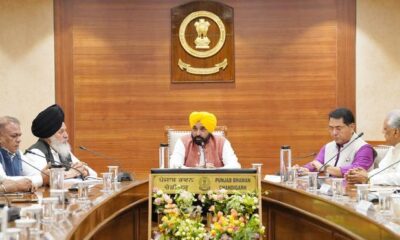
Punjab Chief Minister Captain Amarinder Singh on Tuesday said he is not afraid of resigning, but he won’t let farmers suffer or be ruined. His statement came after his administration moved a resolution in the state assembly against the controversial farm laws enacted by the Modi government recently. The resolution was moved by Singh on the second day of a special assembly session in Chandigarh over centre’s contentious farm laws. He introduced four new bills to counter new farm laws.

The bills introduced by the Chief Minister are the Essential Commodities (Special Provisions and Punjab Amendment) Bill 2020, the Farmers Produce Trade and Commerce (Promotion and Facilitation) Special Provisions and Punjab Amendment Bill 2020, and the Farmers (Empowerment and Protection) Agreement on Price Assurance and Farm Services (Special Provisions and Punjab Amendment) Bill 2020.

In an appeal to the farmers, Singh said that the administration has stood with the farmers, now it is time for the farmers to stand with the government.

The central government passed three contentious farm laws on September 29 with President Ram Nath Kovind giving his assent to the bills that cost its alliance with Shiromani Akali Dal and widespread protests across the country especially in Punjab and Haryana.

The three farm bills that became law were the Farmers (Empowerment and Protection) Agreement of Price Assurance and Farm Services Bill, 2020, the Farmer’s Produce Trade and Commerce (Promotion and Facilitation) Bill, 2020, and the Essential Commodities (Amendment) Bill, 2020.

Read Also: Punjab farmers protests continue, Railways cite Rs 200 crore revenue loss

The move caused a huge political storm with many opposition parties criticising the centre for not thinking about the plight of farmers. The critics say that the farmers will lose their bargaining powers with the entry of private sectors in the agricultural field and they won’t get a minimum support price (MSP) for their produce.

Meanwhile, the centre has stood its ground by saying that the new laws will help the small and medium farmers.

India News

India welcomes US tariff cut as PM Modi thanks Trump for easing trade barriers

PM Modi has thanked US President Donald Trump after the US reduced tariffs on Indian goods to 18%, calling the move beneficial for bilateral trade.

Published

on

pm modi

Prime Minister Narendra Modi on Sunday welcomed US President Donald Trump’s decision to lower tariffs on Indian goods, describing the move as one that unlocks significant opportunities for cooperation between the two countries.

Minutes after President Trump announced the reduction on his social media platform, the Prime Minister took to X to express his appreciation, calling the development a boost for “Made in India” products entering the US market.

“Delighted that Made in India products will now have a reduced tariff of 18 per cent,” PM Modi said, thanking President Trump on behalf of India’s 1.4 billion people.

The Prime Minister said he had a “wonderful” conversation with President Trump and underlined the broader significance of the decision, noting that closer economic cooperation between the world’s two largest democracies benefits people on both sides.

PM Modi also said that when two major economies work together, it opens doors for mutually beneficial growth, adding that India supports President Trump’s efforts aimed at global peace, stability, and prosperity. He said he looked forward to strengthening the partnership further.

President Trump, while announcing the tariff reduction, described the move as a “trade deal” and referred to PM Modi as a close friend and a respected leader.

Trade signals positive momentum

The US India Strategic Partnership Forum described the tariff reduction as an important and positive first step in strengthening bilateral trade relations.

While the detailed terms of the agreement are yet to be finalised, the announcement reflects political intent on both sides to move towards a broader US-India bilateral trade agreement. Such an agreement is expected to address issues related to tariffs, market access, non-tariff barriers, and trade across multiple sectors.

How tariffs on Indian goods evolved

The latest decision comes after months of tariff fluctuations on Indian exports to the US.

Timeline of key developments

  • April 2, 2025: The US imposed a 26% reciprocal tariff on several Indian imports as part of global tariff actions.
  • April 10, 2025: The tariffs were paused for 90 days, with a 10% duty retained on all US imports.
  • July 31, 2025: A 25% tariff was announced on Indian goods, along with a warning linked to India’s purchase of Russian oil.
  • August 7, 2025: Tariffs were raised to 50%, the highest imposed on any US trade partner at the time.
  • February 2, 2026: The US announced a reduction in tariffs on Indian goods to 18%.

The latest rollback marks a significant easing of trade tensions and sets the stage for deeper engagement between India and the United States.

Continue Reading

India News

US-India trade deal to strengthen strategic partnership, says Amit Shah

Amit Shah says the US-India trade deal with reduced tariffs will elevate strategic partnership and pave the way for stronger trade ties and mutual growth.

Published

on

Amit Shah

Union Home Minister Amit Shah on Monday said the newly announced trade deal between India and the United States will elevate the strategic partnership between the two countries and pave the way for stronger trade ties and mutual growth.

In a post on social media platform X, Shah said the agreement marks a significant moment in India-US relations, with business between the two nations set to expand further. He noted that the deal, which includes a reduction in reciprocal tariffs, will benefit both countries and their people.

Calling it a “big day” for bilateral ties, Shah said the trade deal has been locked with a significantly reduced tariff of 18 per cent, creating fresh opportunities for economic cooperation. He also congratulated Prime Minister Narendra Modi and US President Donald Trump on what he described as a historic agreement.

According to Shah, the agreement will strengthen the strategic partnership between the two democracies and support growth on both sides. He added that trade and business activity between India and the US is expected to flourish in the coming period.

Modi welcomes reduced tariffs on Indian goods

Prime Minister Narendra Modi also welcomed the development, saying he was delighted that tariffs on “Made in India” products would now be reduced to 18 per cent. He thanked President Trump for the announcement and said the move would benefit the people of both nations.

Modi said cooperation between two large economies and the world’s largest democracies creates opportunities for mutually beneficial growth. He added that such collaboration helps unlock new possibilities for trade and development.

The prime minister also said he looked forward to working closely with the US president to take the bilateral partnership to unprecedented heights.

Trump outlines terms of the agreement

US President Donald Trump said the United States agreed to lower the reciprocal tariff on Indian goods from 25 per cent to 18 per cent following a phone conversation with Prime Minister Modi. He added that India would move forward to reduce tariffs and non-tariff barriers against the US.

Trump said New Delhi had also committed to purchasing American goods at a much higher level, including energy, technology, agricultural products, coal and other items. He mentioned that India would buy US energy worth more than USD 500 billion.

The US president said the relationship between the two countries would become even stronger going forward. He also noted that the two leaders discussed the ongoing war between Russia and Ukraine during their conversation.

Background to the trade talks

India and the US had agreed earlier to finalise the first tranche of a bilateral trade agreement, but negotiations had slowed after higher tariffs were imposed on Indian goods. The latest agreement follows several rounds of talks between the two sides.

Officials said India now faces lower tariffs compared to several competing export economies, which could provide an advantage to Indian exporters in the US market.

Continue Reading

India News

Markets surge as Nifty jumps 750 points after India-US trade deal

Indian equity markets rallied sharply with Nifty and Sensex posting strong gains after the India-US trade agreement announcement.

Published

on

Sensex

The Indian equity markets opened sharply higher on Tuesday morning, buoyed by optimism following the announcement of a trade agreement between India and the United States.

In early trade, the Nifty jumped around 750 points, while the Sensex surged nearly 2,400 points, reflecting strong investor confidence hours after the deal was made public.

The rally came after US President Donald Trump announced that Washington would slash tariffs on Indian goods to 18 per cent from 50 per cent, as part of a broader trade agreement with New Delhi. In return, India agreed to halt purchases of Russian oil and lower trade barriers, according to the announcement.

President Trump shared the development in a post on his social media platform, calling it a major trade breakthrough. The announcement was followed by a message from Prime Minister Narendra Modi, who thanked the US President on behalf of the people of India for the decision.

Rupee opens stronger against dollar

The positive sentiment was also reflected in the currency market. The Indian rupee opened stronger at 90.40 against the US dollar, gaining 1.10 rupees in early trade, supported by expectations of increased foreign investor inflows following the deal.

Asian markets rebound

Asian markets also traded higher, adding to the positive global cues. Japan’s Nikkei rose about 2.5 per cent, recovering from previous losses, while South Korea’s KOSPI climbed nearly 4 per cent. Market sentiment was further supported by signs of improved US factory activity overnight.

Futures indicated a recovery in Hong Kong markets, while S&P 500 futures were up around 0.3 per cent, as investors tracked upcoming corporate earnings.

With global cues turning favourable and optimism surrounding the India-US trade agreement, Indian markets are expected to remain buoyant, with investors closely watching further developments during the trading session.

Continue Reading

Trending

© Copyright 2022 APNLIVE.com