English हिन्दी
Connect with us

India News

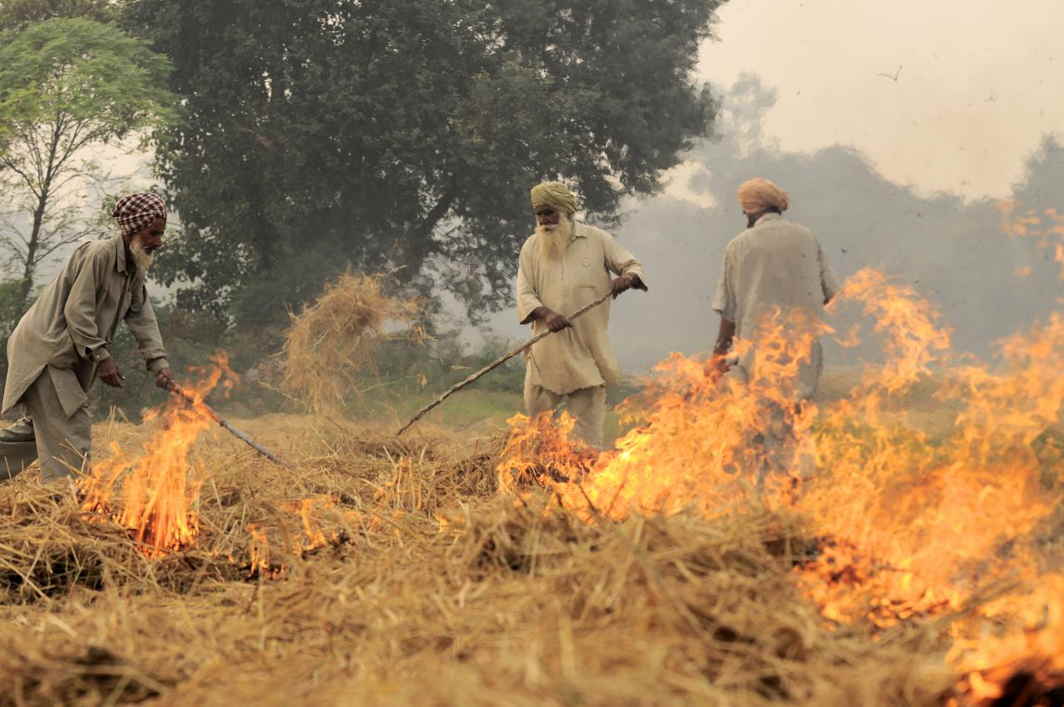
Stubble burning sees 90% drop in Punjab, Haryana, Centre updates Parliament

The Centre informed Parliament of a 90% drop in stubble burning in Punjab and Haryana, citing extensive residue management measures, even as Delhi’s pollution levels worsened again.

Published

on

Stubble burning

The Centre has informed Parliament that incidents of stubble burning across Punjab and Haryana have fallen sharply by 90% during the 2025 paddy harvesting season compared to 2022. The update comes at a time when Delhi-NCR continues to struggle with deteriorating air quality despite a significant reduction in farm fires.

Stubble burning declines, but Delhi pollution persists

Union Environment Minister Bhupendra Yadav, responding to a question by Congress MP Charanjit Singh Channi, said that while stubble burning contributes to winter pollution, Delhi’s toxic air is shaped by several factors. These include vehicle emissions, industrial activities, construction dust, waste burning and unfavourable weather patterns.

The government noted that Delhi has still recorded its best average AQI levels in eight years. The number of “good” air quality days has risen to 200 in 2025, up from 110 in 2016. “Very poor” and “severe” days have also dropped from 71 in 2024 to 50 in 2025.

Measures behind the decline

The Centre attributed the drastic reduction in farm fires to coordinated steps such as:

  • Distribution of over 2.6 lakh crop residue management (CRM) machines
  • Free rental access to CRM equipment for small and marginal farmers
  • Mandatory use of paddy-straw biomass pellets in brick kilns
  • Action against officials failing to curb stubble burning

The Commission for Air Quality Management has further directed Punjab and Haryana to ensure brick kilns outside NCR districts use paddy straw-based pellets or briquettes, creating sustained demand for crop residue and deterring burning.

Thirty-one CPCB flying squads were deployed this season to monitor priority districts.

Delhi air quality dips again

After marginal improvement on Sunday, Delhi’s air quality slipped back into the “very poor” category on Monday, with AQI numbers rising beyond 300.

Rahul Gandhi seeks debate on pollution crisis

Leader of Opposition Rahul Gandhi reiterated the need for a detailed parliamentary discussion on Delhi’s worsening pollution. He questioned Prime Minister Narendra Modi’s silence, calling the situation a “health emergency”. Gandhi also interacted with mothers concerned over their children’s exposure to toxic air and shared a video of the meeting on X, urging government action.

India News

Internal report warned of imminent Wayanad tunnel slope failure before deadly landslide

An internal geological assessment reportedly warned of imminent slope failure at the Wayanad tunnel project days before the landslide that claimed six lives.

Published

on

Wayanad Tunnel

Six days before the Kerala government halted work at the Wayanad tunnel project, an internal geological report prepared by the project’s sub-contractor had reportedly warned that the slope above the tunnel’s north portal could fail at any moment under prevailing monsoon conditions.

The landslide struck the north portal of the under-construction tunnel in Wayanad on Tuesday, killing six people and raising serious questions over slope stability and safety measures at the site.

Report highlighted severe slope instability

According to the internal assessment prepared by Dilip Buildcon Limited (DBL), the sub-contractor handling the tunnel work, the hillside above the north portal had already begun showing signs of structural distress.

The report was jointly prepared by DBL senior geologist Raju Sagar, Geological Survey of India (GSI) official A. Ramesh Kumar and Authority Engineer Dr H.K. Singh from Turkish Engineering Consulting & Contracting.

The assessment covered inspections carried out between June 3 and June 11 at the north portal near Kalladi-Meppadi in Wayanad.

Engineers found that the slope consisted of nearly 35 metres of loose silty soil over hard rock. The report noted that this type of soil retains water during heavy rainfall, increasing its weight while reducing stability and making it vulnerable to landslides.

Despite slope protection measures including stepped cutting, shotcrete and soil nailing, engineers observed widening cracks, soil movement, muddy seepage and cavities developing within the slope.

Underground water flow raised major concerns

One of the report’s key findings was the presence of underground water flowing between two support levels inside the slope.

According to the assessment, such internal water movement could erode the soil from within, significantly weakening the hillside and increasing the likelihood of a sudden collapse.

The report specifically identified the left side of the north portal as carrying a much higher risk than the right slope and warned that, under existing rainfall conditions, it “may culminate in sudden slope failure at any time.”

Safety systems found to be inadequate

The report also pointed to shortcomings in the site’s safety infrastructure.

It found that several drainage holes designed to reduce water pressure inside the slope were either ineffective or not functioning properly on the high-risk section. It also noted that piezometers, which monitor underground water pressure and provide early warning of slope instability, had not yet been installed.

The assessment added that the existing monitoring equipment was not accurately reflecting the visible signs of distress observed at the site.

Blasting not identified as primary cause

Trial blasting for tunnel excavation was conducted on June 5, June 6 and June 11 while the slope was already showing signs of instability.

However, the report concluded that recorded blast vibrations remained within permissible limits and indicated that prolonged heavy rainfall, rather than blasting, was the primary factor behind the slope deterioration.

Engineers recommended multiple corrective measures

The internal assessment recommended several immediate measures to improve slope stability.

These included constructing gabion retaining walls along the vulnerable left slope, covering exposed soil with protective matting and tarpaulin, creating lined drainage channels to divert rainwater, and carrying out field tests to verify the effectiveness of existing soil nails and drainage systems under saturated conditions.

The report also expressed concern over the location of a nearby concrete batching plant, stating that its weight and heavy vehicle movement could further affect slope stability. It recommended relocating the facility away from the vulnerable area.

Contractor and project authorities respond

Project authorities said the report had primarily been commissioned to assess the impact of blasting activities.

An engineer associated with Konkan Railway Corporation reportedly said work at the north portal was stopped after the findings emerged.

The engineer maintained that shotcrete was used alongside 12-metre-long concrete anchor rods installed at two-metre intervals to strengthen the slope. He also claimed that the landslide occurring above the site would have been difficult to prevent through conventional safety measures.

When asked about monsoon preparedness and slope protection, project representatives said standard engineering practices had been followed. However, they did not provide a clear explanation regarding the status of gabion wall construction or whether there had been shortcomings in preparing the site for tunnel work.

The contractor also stated that delays in government land allocation for storing excavated soil affected project logistics.

Following the landslide, the engineer said nearly 200 workers at the project’s south portal left the site out of fear and that construction would not resume until an expert committee appointed by the Kerala government approved future safety measures.

The internal report was prepared days before the District Collector issued a stop-work order on June 20, indicating that work at the north portal had already been halted amid growing concerns over slope stability.

Continue Reading

India News

Four alleged gangsters killed, three police personnel injured in Gurugram encounter

Four alleged gangsters were killed and three Gurugram Police personnel injured after an exchange of around 60 rounds of gunfire during an operation targeting suspected extortion-linked shooters.

Published

on

A late-night encounter between Gurugram Police and suspected gang members left four alleged criminals dead and three police personnel injured after an exchange of around 60 rounds of gunfire in the city’s Sushant Lok Phase-2 area on Thursday.

According to police, Crime Branch teams acted on intelligence about a suspicious Scorpio SUV carrying armed men. Multiple teams rushed to the area and established barricades after receiving the information.

Suspects allegedly targeted businessman facing extortion threats

Police said the suspects had allegedly opened fire at the residence of a businessman before officers reached the scene. The businessman had reportedly been receiving repeated extortion threats from a wanted gangster operating from abroad, making him a potential target of the attack.

Officers surrounded the vehicle and repeatedly asked the suspects to surrender. However, the accused allegedly opened indiscriminate fire on the police in an attempt to escape, prompting the police to retaliate.

Four accused killed, one undergoing treatment

According to police, all five alleged shooters linked to the foreign-based Deepak Nandal gang sustained bullet injuries during the exchange of fire.

They were taken to a private super-specialty hospital, where doctors declared four of them dead. The fifth accused remains hospitalised and is undergoing treatment.

Three police personnel injured during operation

The encounter also left three Gurugram Police personnel with gunshot injuries. They were shifted to a hospital for treatment, and doctors are closely monitoring their condition.

Forensic teams collect evidence

Police said teams from the Scene of Crime (SoC) unit, the Forensic Science Laboratory (FSL), and other investigation units examined the encounter site and collected forensic and technical evidence.

Officials added that legal proceedings are underway. The identities of the deceased and injured accused, along with details of their criminal backgrounds, will be disclosed after verification. Police also said they recovered five foreign-made pistols from the suspects.

Continue Reading

India News

Mahadev betting app founder Sourabh Chandrakar detained in Oman, India seeks extradition

Mahadev betting app founder Sourabh Chandrakar has been detained in Oman on an Interpol Red Notice, with Indian authorities pursuing his extradition in the alleged Rs 6,000 crore betting case.

Published

on

Sourabh Chandrakar

Indian authorities are working to bring back alleged Mahadev betting app founder Sourabh Chandrakar after he was detained in Oman, according to officials. Chandrakar, one of the key accused in the alleged online betting syndicate, has been held by the Royal Oman Police following an Interpol Red Notice issued at the request of Indian investigating agencies.

Officials said India is pursuing both extradition and deportation options to secure Chandrakar’s return, citing the seriousness of the charges against him.

Chandrakar detained following Interpol Red Notice

According to officials, Chandrakar, a native of Chhattisgarh in his 30s, was detained in Oman a few weeks ago based on an Interpol Red Notice issued by agencies including the Enforcement Directorate (ED) and Chhattisgarh Police.

Investigators tracking the case have also received informal inputs suggesting that Chandrakar was allegedly travelling using a passport issued by a Southeast Asian country.

Before his detention in Oman, Indian agencies had reported that Chandrakar was in Dubai. Authorities had earlier claimed that he was detained there in 2024 before being released. Officials have also stated that his alleged associate and Mahadev app co-founder Ravi Uppal later moved from Dubai to Vanuatu.

ED alleges Rs 6,000 crore betting racket

The Enforcement Directorate has described the Mahadev betting app case as a large-scale international online betting syndicate with alleged proceeds of crime estimated at around Rs 6,000 crore.

The agency has previously alleged that the investigation involves several high-ranking politicians and bureaucrats from Chhattisgarh.

According to the ED, the syndicate allegedly operated through multiple online betting platforms and domain names, including Tiger Exchange, Gold365 and Laser247. Investigators claim the operation functioned through a franchise-based network of panels and branches across India, while Chandrakar and Uppal allegedly managed its operations from Dubai.

Assets worth Rs 1,700 crore attached

In March, the ED said it had attached assets worth approximately Rs 1,700 crore linked to Chandrakar and associated entities. A significant portion of these properties is located in Dubai, including assets in the Burj Khalifa.

The agency has so far arrested 13 individuals in connection with the investigation and has named 74 entities as accused across five charge sheets filed before a special Prevention of Money Laundering Act (PMLA) court in Raipur.

The ED has also approached a court seeking to declare Chandrakar, Ravi Uppal and other accused, including Anil Agrawal alias Atul and Shubham Soni, as Fugitive Economic Offenders under the Fugitive Economic Offenders Act, 2018.

India hopeful of Chandrakar’s return

Officials expressed confidence that India would be able to secure Chandrakar’s return from Oman, highlighting the strong bilateral relationship between the two countries.

Authorities also referred to the Free Trade Agreement between India and Oman, which came into effect on June 1, as a sign of strengthening cooperation. Bilateral trade between the two nations stood at USD 11.2 billion during 2025-26.

Before leaving India for Dubai in 2019, Chandrakar reportedly operated a juice shop named “Juice Factory” with his brother in Bhilai, Chhattisgarh.

Chandrakar and Ravi Uppal have previously denied any involvement in the alleged betting racket through a statement issued a few years ago.

Continue Reading

Trending

© Copyright 2022 APNLIVE.com