The Central Board of Secondary Education (CBSE) SST Term 1 Class 10 Board Exam 2022 was successfully conducted yesterday from 11:00 am to 1:00 pm. The CBSE board has now released the answer key of the SST exam.
Students who took the CBSE 10th Social Science board exam in 2021-22 are looking for answers now. So, we have published the solution key for the CBSE Class 10 Social Science board exam 2021-22 in this.
Disclaimer: This answer key is provided as a guide only, and is not final. Following the announcement of the results, the board is scheduled to provide the official CBSE Class 10 Social Science answer key.
Here are the answer key of CBSE Term 1 Exam 2021
Industrialisation began in which one of the following European countries in the second half of the eighteenth century ?
(a) Germany (b) France (c) Italy (d) England
Answer: (d) England
Which type of governments were mainly driven in Europe after the defeat of Napoleon in 1815 ?
(a) Conservative
(b) Liberal
(c) Federal
(d) Feudal
Answer: (a) Conservative
Which one of the following group of countries collectively defeated Napoleon in 1815 ?
(a) Britain, Russin, Prussia and Austria (b) Britain, Russian, Prussia and Australia (c) Britain, Russia, Netherlands and Germany (d) Britain, Luxembourg, Germany and Italy
Answer: (a) Britain, Russia, Prussia and Austria
In which one of the following countries did the first liberalist-nationalist upheaval take place in July 1830 ?
(a) France (b) Germany (c) England (d) Italy
Answer: (a) France
Who among the following remarked “When France sneezes, the rest of Europe catches cold” ?
(a) Lord Byron (b) Metternich (c) Johann Herder (d) Napoleon
Answer: (b) Metternich
Who among the following was the architect for the unification of Germany ?
(a) Otto von Bismarck (b) William 1 (c) Frederick III (d) William II
Answer: (a) Otto von Bismarck
Who among the following had sought to put together a coherent programme for a unitary Italian Republic during the 1830s ?
(a) Victor Emmanuel I (b) Victor Emmanuel II (c) Giuseppe Mazzini (d) Count Cavour
Answer: (c) Giuseppe Mazzini
In which one of the following states is overgrazing the main reason for land degradation ?
Which one of the following forces leads to maximum soil erosion in plains ?
(a) Wind (b) Glacier (c) Running water (d) Earthquake
Answer: (c) Running water
Deforestation due to mining has caused severe land degradation in which one of the following states ?
(a) Odisha (b) Tamil Nadu (c) Kerala (d) Gujarat
Answer: (a) Odisha
Who among the following was proclaimed King of united Italy in 1861 ?
(a) Charles 1 (b) Victor Emmanuel II (c) Giuseppe Garibaldi (d) Nero
Answer: (b) Victor Emmanuel II
Which one of the following subjects is included in the Union list ?
(a) Communication (b) Trade (c) Commerce (d) Irrigation
Answer: (a) Communication
Which one of the following elements is not included in the Belgium model ?
(a) Dutch and French-speaking ministers shall be equal in the government. (b) Many powers of the central government have been given to state governmental (c) Brussels has a separate government in which both the communities have equal representation (d) There is a community government that has special powers of administration
Answer: (d) There is a community government that has special powers of administration
Which one of the following countries is the example of ‘Holding together federation’?
(a) Australia (b) India (c) U.S.A (d) Switzerland
Answer:(b) India
Which one of the following ethnic communities is in majority in Sri Lanka ?
(a) Sri Lankan Tamils (b) Indian Tamils (c) Muslims (d) Sinhalese
Answer: (d) Sinhalese
Which one of the following subjects is included in the State list ?
(a) Banking (b) Business (c) Currency (d) Communication
Answer: (b) Business
Activities that help in the development of Primary and Secondary sectors come under which one of the following sectors ?
Identify the correct feature of Unitary form of government from the following options:
(a) There are two or more levels of government. (b) Different tiers of government govern the same citizens. (c) Each tier of government has its own jurisdiction. (d) The sub-units are subordinate to the central government.
Answer: (d) The sub-units are subordinate to the central government
At the initial stages of development, which one of the following sectors was the most important of economic activity?
Which one of the following subjects is included in the Concurrent List ?
(a) Trade (b) Commerce (c) Agriculture (d) Marriage
Answer: (d) Marriage
Two statements are given below as Assertion (A) and Reasoning (R). Read the statement and choose the most appropriate option. Assertion (A): After Russian occupation in Poland, the Russian language was imposed on its people. Reason (R): The use of Polish soon came to be a symbol of struggle against Russian dominance.
(a) Both Assertion (A) and Reason (R) are true and Reason (R) is the correct explanation of Assertion (A). (b) Both Assertion (A) and Renson (R) are true, but Reason (R) is not the correct explanation of Assertion (A). (c) Assertion (A) is true but Reason (R) is false. (d) Assertion (A) is false but Reason (R) is true.
Answer: (a) Both Assertion (A) and Reason (R) are true and Reason (R) is the correct explanation of Assertion (A).
Read the facts regarding the Revolution of the Liberals in Europe during 1848 and choose the correct option:
Abdication of the monarch
Universal male suffrage had been proclaimed
Political Rights to women were given
Freedom of the press had been asked for
(a) Only 1 and 2 are correct. (b) Only 1, 2 and 3 are correct. (c) Only 1 and 4 are correct. (d) Only 1, 2 and 4 are correct
Answer: (d) Only 1, 2 and 4 are correct
Two statements are given below as Assertion (A) and Reasoning (R). Read the statement and choose the most appropriate option. Assertion (A): Weavers in Silesia had led a revolt against contractors in 1845. Reason (R): Contractors had drastically reduced their payments
(a) Both Assertion (A) and Reason (R) are true and Reason (R) is the correct explanation of Assertion (A). (b) Both Assertion (A) and Reason (R) are true but Reason (R) is not the correct explanation of Assertion (A). (c) Assertion (A) is true but Ronson (R) is false. (d) Assertion (A) is false but Reason (R) is true.
Answer: (a)
On which of the following modern aspects did the new Germany place a strong emphasis ?
Currency 2. Banking 3. Legal system 4. Demography
(a) Only 1 and 2 are correct. (b) Only 2 and 3 are correct. (c) Only 3 and 4 are correct. (d) Only 1, 2 and 3 are correct.
Answer: (d) Only 1, 2 and 3 are correct.
Which one of the following Italian states was ruled by an Italian princely house?
(a) Papal State (b) Lombardy (c) Venetia (d) Sardinia-Piedmont
Answer: (d) Sardinia-Piedmont
Identify the characteristics of Cavour among the following and choose the correct option:
He was an Italian statesman.
He spoke French much better than Italian
He was a tactful diplomat.
He belonged to a Royal family.
(a) Only 1 and 2 are correct. (b) Only 1, 2 and 3 are correct. (c) Only 2, 3 and 4 are correct. (d) Only 1, 2 and 4 are correct.
Answer: (b) Only 1, 2 and 3 are correct.
Two statements are given below as Assertion (A) and Reasoning (R). Read the statement and choose the most appropriate option. Assertion (A): In Britain, the formation of the nation-state was not the result of a sudden upheaval. Reason (R): Ethnic groups of Britain extended its influence.
(a) Both Assertion (A) and Reason (R) are true and Reason (R) is the correct explanation of Assertion (A) (b) Both Assertion (A) and Reason (R) are true but Reason (R) is not the correct explanation of Assertion (A). (c) Assertion (A) is true but Reason (R) is false. (d) Assertion (A) is false but Reason (R) is true.
Answer: (a) Both Assertion (A) and Reason (R) are true and Reason (R) is the correct explanation of Assertion (A)
Which among the following is not a problem of resource development?
(a) Depletion of resources for satisfying the greed of few individuals (b) Accumulation of resources in few hands (c) Indiscriminate exploitation of resources (d) An equitable distribution of resources
Answer: (d) An equitable distribution of resources
33. Which one of the following human activities has contributed most in land degradation?
34. Two statements are given below as Assertion (A) and Reasoning (R). Read the statement and choose the most appropriate option: Assertion (A): Indian farmers should diversify their cropping pattern from cereals to high-value crops. Reason (R): This will increase income and reduce environmental degradation simultaneously.
(a) Both Assertion (A) and Ronson (R) are true and Reason (R) is the correct explanation of Assertion (A) (b) Both Assertion (A) and Reason (R) are true but Reason (R) is not the correct explanation of Assertion (A) (c) Assertion (A) is true but Reason (R) is false (d) Assertion (A) is false but Reason (R) is true
Answer: (a) Both Assertion (A) and Reason (R) are true and Reason (R) is the correct explanation of Assertion (A)
Two statements are given below as Assertion (A) and Reasoning (R). Read the statement and choose the most appropriate option: Assertion (A): Majority community is dominant in a few democratic states Reason (R) : Dominance can undermine the unity of the country
(a) Both Assertion (A) and Renson (R) are true and Reason (R) is the correct explanation of Assertion (A) (b) Both Assertion (A) and Reason (R) are true but Reason (R) is not the correct explanation of Assertion (A) (c) Assertion (A) is true but Reason (R) is false. (d) Assertion (A) is false but Reason (R) is true.
Answer 35: (a) Both Assertion (A) and Renson (R) are true and Reason (R) is the correct explanation of Assertion (A)
Answer 36: a Answer 37: d Answer 38: a Answer 39: a Answer 40: c Answer 41: a Answer 42: a Answer 43: a Answer 44: c Answer 45: c Answer 46: a Answer 47: a Answer 48: a Answer 49: c Answer 50: d Answer 51: b Answer 52: a Answer 53: a Answer 54: c Answer 55: b Answer 56: c Answer 57: a Answer 58: d
On the outline political map of India (on page 24) ‘A’ is marked as a Dam. Identify it! from the following options: (a) Tehri (b) Sardar Sarovar (c) Hirakud (d) Nagarjuna Sagar
Answer: (c) Hirakud
On the same map ‘B’ is also marked as the largest Jute producer state. Identify it from the following options in (a) West Bengal (b) Bihar (c) Assam (d) Odisha
Answer: (a) West Bengal
Kindly refresh the website for questions.
For further details, students can check the date sheet of CBSE Term 1 Exam 2022 of class 10th.
MCC announces NEET UG Counselling 2026 dates, check complete schedule
The Medical Counselling Committee has released the NEET UG Counselling 2026 schedule. Round 1 registration will begin on August 5, followed by four counselling phases, including the Online Stray Vacancy Round.
The Medical Counselling Committee (MCC) has released the complete counselling schedule for NEET UG 2026 admissions under the 15% All India Quota (AIQ) and 100% seats of Deemed Universities, Central Universities, AIIMS, and JIPMER institutions for the 2026-27 academic session.
The counselling process covers admissions to MBBS, BDS and BSc Nursing courses. According to the official schedule, the Round 1 registration process will begin on August 5, while verification of the tentative seat matrix by participating institutes will be completed on August 4.
Round 1 counselling schedule
Registration and fee payment for Round 1 will be available from August 5 to August 12 until 3 pm. Candidates can complete the payment process up to 6 pm on August 12.
Choice filling will begin on August 6 and continue until August 13, with the window closing at 11 am on August 13. Choice locking will be available from 4 pm on August 12 until 11 am on August 13.
The seat allotment process will be conducted between August 13 and August 16, while the Round 1 result will be announced on August 17. Candidates allotted seats must report to their respective institutes between August 18 and August 22. Institutes will verify the details of joined candidates on August 23.
Round 2 counselling dates
Verification of the tentative seat matrix for Round 2 will be conducted on August 24.
Registration and fee payment will be open from August 25 to August 29 until 3 pm, with payment accepted until 6 pm on August 29. Candidates can fill their choices from August 25 to August 30, while the choice-locking facility will remain available between 4 pm and 11 pm on August 30.
Seat allotment will take place from August 31 to September 1, and the results will be declared on September 2. Candidates can report and join their allotted institutes between September 3 and September 8, while institute verification of joined candidates will be carried out on September 9.
Round 3 schedule
For Round 3, verification of the tentative seat matrix is scheduled for September 10.
Registration and fee payment will remain open from September 11 to September 15 until 3 pm, while the payment window will close at 6 pm on September 15. Choice filling will continue from September 11 to September 16, with choice locking available from 4 pm on September 15 until 11 am on September 16.
The seat allotment process will be conducted between September 16 and September 17, and the results will be announced on September 18. Candidates allotted seats can report to their institutes from September 19 to September 26. Verification of joined candidates by institutes will take place on September 27.
Online stray vacancy round
The Online Stray Vacancy Round will begin with verification of the tentative seat matrix on September 27.
Registration and fee payment will be conducted from September 28 to September 30 until 3 pm, while payments can be completed until 6 pm on September 30. Choice filling will also be available during the same period, with choice locking scheduled between 4 pm and 11 pm on September 30.
The seat allotment process will be held on October 1 and October 2, and the result will be declared on October 3. Candidates allotted seats must report to their respective institutes between October 4 and October 10.
The MCC has also instructed all participating institutes and colleges to treat Saturdays, Sundays and gazetted holidays as working days to ensure that the counselling process is completed within the prescribed timeline.
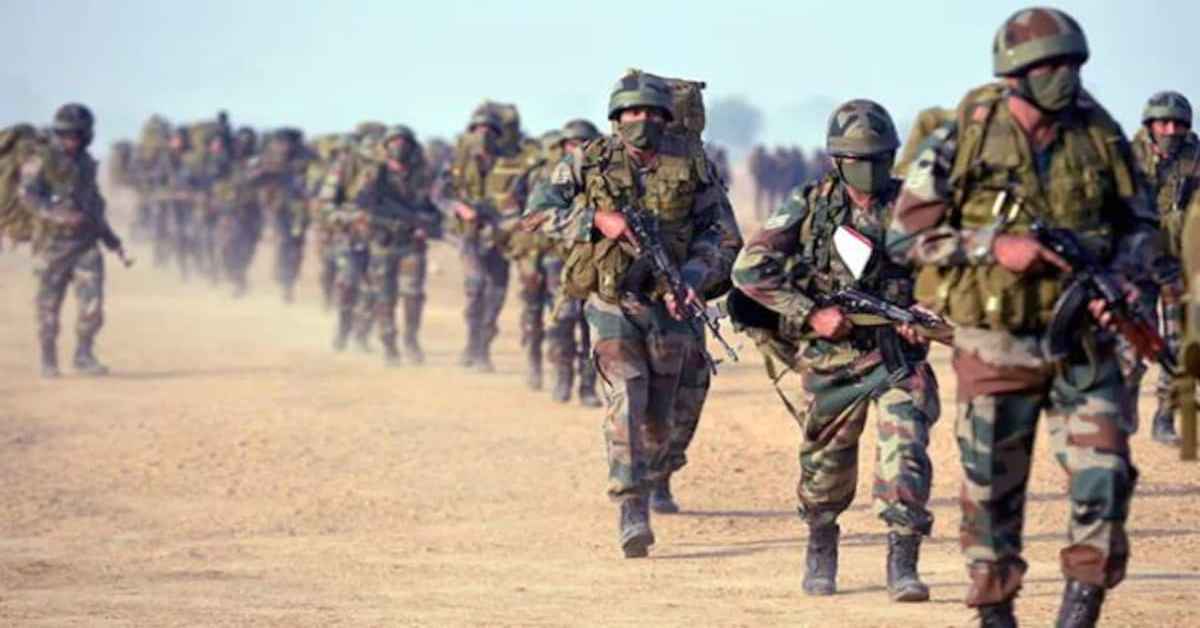
Indian Army Agniveer CEE Result 2026 declared, ARO-wise merit list released
The Indian Army has announced the Agniveer CEE Result 2026. Candidates can now download the ARO-wise merit list and check their eligibility for the next stages of recruitment.
The Indian Army has announced the Agniveer Common Entrance Examination (CEE) Result 2026, allowing candidates to check their qualifying status through the official recruitment portal. The Army Recruitment Office (ARO)-wise merit lists have been uploaded on joinindianarmy.nic.in, where candidates can download the PDF corresponding to their recruitment region.
The merit lists contain the names and roll numbers of candidates who have successfully cleared the written examination and become eligible for the next phase of the Agniveer recruitment process.
How to check Indian Army Agniveer CEE Result 2026
Candidates can access their results by following these steps:
Visit the official Indian Army recruitment website.
Click on the Agniveer CEE Result 2026 link available on the homepage.
Select the relevant Army Recruitment Office (ARO) or recruitment region.
Download the merit list PDF.
Search for your roll number or name to confirm your qualification status.
What happens after the Agniveer CEE result?
Candidates shortlisted in the Common Entrance Examination will now have to undergo the remaining stages of the recruitment process. These include:
Physical Fitness Test (PFT)
Physical Measurement Test (PMT)
Document Verification (DV)
Medical Examination
Only candidates who successfully clear every stage will be considered for final selection under the Agniveer recruitment programme.
Candidates advised to verify details carefully
After downloading the merit list, candidates should carefully check all the information mentioned in the document. If they notice any discrepancy related to their result or personal details, they should immediately contact their respective Army Recruitment Office (ARO) for assistance.
Candidates are also advised to keep checking the official Indian Army recruitment portal for updates regarding the schedule, venue and instructions for the upcoming physical tests, document verification and medical examination.
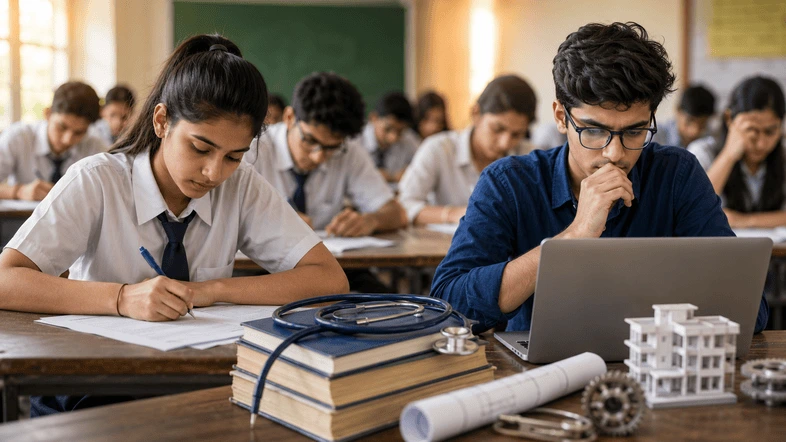
Board exam marks may get 50% weightage in NEET, JEE admissions under proposed reforms
The Centre is considering giving 50% weightage to board exam marks in admissions based on NEET and JEE. The proposal is part of broader education reforms aimed at reducing exam stress and improving fairness in the admission process.
Board examination marks could soon carry greater significance in admissions to medical and engineering courses, with the Centre reportedly considering a proposal to assign 50% weightage to board scores alongside entrance examinations such as NEET and JEE.
The proposal is part of a broader set of education reforms aimed at reducing the pressure associated with high-stakes examinations and making the admission process more balanced.
According to sources, the proposal is being examined by the Ministry of Education’s nine-member committee that was constituted last year. The panel was tasked with studying students’ growing dependence on coaching institutes, the rise of “dummy schools”, and concerns over fairness in major entrance examinations.
The committee is exploring several measures to improve the existing admission system while reducing the emphasis on a single examination.
Why the reforms are being considered
The discussions come in the wake of multiple controversies involving the examination system, including reported evaluation errors and paper leak incidents. These developments have sparked a wider debate over the credibility and reliability of high-stakes entrance examinations.
To address these concerns, the committee is considering giving 50% weightage to board examination marks in the admission merit process.
Other changes under consideration
Apart from increasing the role of board examination scores, the panel is also examining several other reforms.
These include aligning entrance examinations more closely with school syllabi to reduce students’ dependence on coaching centres, allowing multiple attempts for entrance tests, and gradually introducing adaptive, on-demand computer-based examinations.
Current admission process
At present, admissions to medical and engineering programmes are primarily based on candidates’ performance in entrance examinations such as NEET and JEE. Students are also required to secure the prescribed qualifying marks in their board examinations to become eligible for these entrance tests.
The proposed reforms are currently under consideration, and no final decision has been announced.
APN News is today the most watched and the most credible and respected news channel in India. APN has been at the forefront of every single news revolution. The channel is being recognized for its in-depth, analytical reportage and hard hitting discussions on burning issues; without any bias or vested interests.