
Education
What is a smart classroom? Why is it a necessity rather than a luxury?

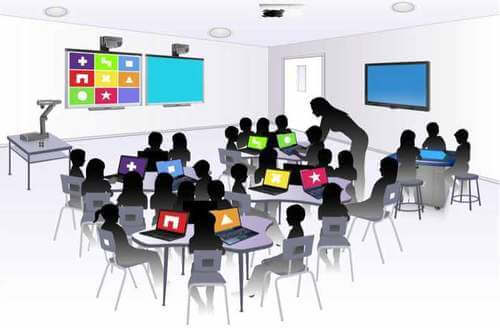
The magnitude of change that the education system has undergone in recent times has been enormous. The industry has quickly progressed from traditional education to smart learning. Smart classrooms have revolutionized the education industry, preventing knowledge loss in institutions all around the world.
A smart classroom is indeed an EdTech-enhanced classroom that uses sound, video, simulations, graphics, and multimedia to improve the education and learning experience for both faculty and learners. This enhances student involvement and results in higher academic performance. This method has worked brilliantly, especially when students can’t seem to focus in an online setting—smart classes technology aids student engagement.
Technology-enabled learning is invading classrooms and paving the road for smart learning. Smart classrooms have risen to prominence as a result of the creation of modern hardware and cutting-edge software techniques to enhance education and keep track of students’ progress.
This smart classroom also assists the instructor by the use of technologies. There are many tools that can assist professors to manage their classrooms or even saving an online class for later analysis. The smart classroom is really a modern and comprehensive classroom that offers a wide range of teaching approaches.
Here are some of the reasons, which indicate the necessity of smart classrooms.
- Enhancing the interest of the future –
Smart classrooms ensure a future vision of student engagement, resilience, stress resistance, and flexibility for students. Smart classroom technology enables students to learn skills that would otherwise be lacking in a regular classroom setting. Employers value analytical reasoning and problem-solving abilities, and smart classes software aids in the development of these abilities through group learning.
Smart classrooms also allow students to educate at their own speed with abundant resources, allowing them to become self-sufficient. Smart classroom technology also enables a hybrid learning paradigm, which is critical in these turbulent times.
- Efficient than the traditional classroom –
In a smart classroom, you can assist youngsters to grasp technology in a way that is not possible with a traditional classroom. Educators can deliver 100 percent of the entire education to students using web services and Applications. Schools that use software applications can do more. Teachers can prepare teaching materials and concentrate more on the learners’ studies with fewer administrative responsibilities.
Faculty members do not have much opportunity to explore or change inside a traditional classroom environment. However, within a smart classroom, one could experiment in a variety of ways based on the students ’ needs.
- The necessity of technology than before –
The enhanced version of schooling is more interesting, which has a favorable influence on productivity. Changing the traditional school structure into such an innovative as well as practical teaching-learning structure is a fantastic idea. The utilization of smart classrooms in education causes a significant shift in learners’ learning curves. The classroom atmosphere is made more favorable to learning through the use of the web and e technologies.
Teaching kids using computers, the web, and audio equipment will speed up the training steps and help them find the necessary skills to be future-ready. Smart classroom allows instructors to provide more to their students.
- Technology provides you more than expected –
When the globe comes to a halt, it becomes critical to utilize technology in order to survive, particularly in the education sector. Many academic institutions have resisted technology because they believe it requires radical changes; nevertheless, this is erroneous. New-age technologies make it simple for school administrators to implement technology without requiring any infrastructure adjustments.
A class turns smart with the support of an integrated approach, and other administration duties that were previously hard due to an indefinite classroom closure become simple.
Conclusion
The path to creating the smart classroom has indeed been long and winding. From a classroom where communication is purely based on chalk and boards, “computer technologies” have been introduced. It integrates the best “digital ink technologies,” which helps youngsters remain focused on formal learning in a fun way, transforming the old concept of teaching. We’re developing technologically, and smart classrooms could be the right path if we can solve the issue of internet connectivity in rural areas.
Using augmented reality, intelligent systems, and VR technology, smart classrooms could be implemented while children are there in the class. Some educational players utilize readily available technology, like desktops, to construct software packages on computers and educate people using it, which is indeed a type of smart classroom. Different industries, especially education, will begin to evolve by becoming “smart” with their own methods as technology advances.
Digital Classrooms are gaining popularity among students and teachers all around the world, who are excited about these newly immersive and engaging learning sessions. To keep up with the present educational environment, the smart classroom strategy allows for the use of a desktop, projection, web, and audio equipment.
Education
MCC announces NEET UG Counselling 2026 dates, check complete schedule
The Medical Counselling Committee has released the NEET UG Counselling 2026 schedule. Round 1 registration will begin on August 5, followed by four counselling phases, including the Online Stray Vacancy Round.


India News
Indian Army Agniveer CEE Result 2026 declared, ARO-wise merit list released
The Indian Army has announced the Agniveer CEE Result 2026. Candidates can now download the ARO-wise merit list and check their eligibility for the next stages of recruitment.

Education
Board exam marks may get 50% weightage in NEET, JEE admissions under proposed reforms
The Centre is considering giving 50% weightage to board exam marks in admissions based on NEET and JEE. The proposal is part of broader education reforms aimed at reducing exam stress and improving fairness in the admission process.


CJP leaders Saurav Das, Ashutosh Ranka, Ajinkya Shinde sent to 5-day judicial custody

PM Modi speaks to Mark Carney as India and Canada push to strengthen ties

S Jaishankar says India is a natural option for Russia amid Europe tensions

Meerut murder: Muskaan Rastogi and Sahil Shukla get death sentence

Rahul Gandhi joins India Gate protest by Ankita Bhandari’s parents

Supreme Court questions EC over missing records in Sringeri election dispute
Rahul Gandhi joins India Gate protest by Ankita Bhandari’s parents
Meerut murder: Muskaan Rastogi and Sahil Shukla get death sentence
PM Modi speaks to Mark Carney as India and Canada push to strengthen ties
S Jaishankar says India is a natural option for Russia amid Europe tensions

Afghan Men Try To Hang With The Jet Engine Of The Aircraft in Kabul- Afghanistan News – Kabul News
Trending Top 10 News: 10000 Crore Fine on Flipkart, Apple to Launch Unique Feature, Hdfc Bank Job Ad

Trending Top 10 News: Nokia 6310, Apple sales, Bachpan ka Pyar Video Kid, Dainik Bhaskar IT Raid

Trending Top 10 News: Canada bans Indian flights, Rain in Delhi NCR, AIMIM Twitter hacked, Raj Kundra case

Trending Top 10 News: Shein India, Apple New Service, Pocket Oxygen, Oppo Launched New Phone
-
 India News14 hours ago
CJP leaders Saurav Das, Ashutosh Ranka, Ajinkya Shinde sent to 5-day judicial custody
-
 India News14 hours ago
PM Modi speaks to Mark Carney as India and Canada push to strengthen ties
-
 Latest world news14 hours ago
S Jaishankar says India is a natural option for Russia amid Europe tensions
-
 India News3 hours ago
Meerut murder: Muskaan Rastogi and Sahil Shukla get death sentence
-
 India News3 hours ago
Rahul Gandhi joins India Gate protest by Ankita Bhandari’s parents
-
 India News2 hours ago
Supreme Court questions EC over missing records in Sringeri election dispute
