English हिन्दी
Connect with us

India News

SEBI fines stock market influencer Asmita Patel who made Rs 104 crore by selling tips

SEBI concluded that Patel’s assertions about managing a substantial portfolio “appear completely false and were likely made to entice participants to various courses.”

Published

on

Asmita Jitesh Patel, a director of the well-known Asmita Patel Global School of Trading Pvt Ltd, appears to have constructed her business empire through exaggerated claims and false promises of effortless wealth.

One of the most troubling aspects of her approach was the irresponsible advice given to participants in her courses and workshops, including urging them to borrow money for trading and to quit their jobs to pursue trading full-time.

On February 6, the Securities and Exchange Board of India (SEBI) froze illegal profits totalling nearly ₹54 crore and demanded that the school and its directors explain why approximately ₹104 crore in fees should not be confiscated.

SEBI officials found that representatives from the school, including Patel, cited numerous examples of individuals abandoning their jobs and achieving remarkable success after taking her courses or following her trading strategies. For instance, it was claimed that a vice president of a large company increased his trading capital from ₹30 lakh to ₹3 crore, a chartered accountant boosted his capital from ₹30 lakh to ₹12 crore, and an engineer left his job to become a full-time trader, accumulating ₹80 lakh in trading capital.

The SEBI order highlighted that “students/investors/participants were encouraged to leave their jobs and join MPAT (a course offered by her institute) in order to achieve significant success.” Participants were even advised to withdraw from mutual fund investments or to use borrowed money if they lacked sufficient capital. In a recorded conversation with a course participant, Patel suggested borrowing for trading, recommending that the interest rate not exceed 18 per cent.

Over multiple discussions, stock trading was portrayed as a lucrative business with continuous profits. One student was told to anticipate returns of 35-40 per cent, and the risk-reward ratio was touted as 1:3, among other enticing figures.

While SEBI regulations allow minors to hold demat and trading accounts, the operation of these accounts requires the involvement of a guardian, and trading accounts can only be used for selling securities acquired through gifts, transfers, or regulatory directives. According to SEBI’s guidelines, “a minor cannot enter into a contract with a stock broker to buy or sell any security.”

In one video, Patel downplayed the necessity of understanding financial markets or statements, stating that even someone with a basic education who could perform simple arithmetic could invest in stocks.

Patel frequently referred to herself using grandiose titles, dubbing herself the “She Wolf of the stock market” and the “options queen,” asserting that her strategies could yield returns of up to 300 per cent. However, SEBI’s investigation revealed that from 2019 to January 2024, the school and Patel registered trading profits of merely ₹12.28 lakh.

She also claimed to manage portfolios totalling ₹140 crore and oversee funds worth ₹283 crore, but the investigation indicated these figures were grossly inflated. The actual turnover from the trades associated with her accounts and the school was just over ₹15.27 crore, a fraction of her claim regarding the ₹140 crore portfolio.

SEBI concluded that Patel’s assertions about managing a substantial portfolio “appear completely false and were likely made to entice participants to various courses.”

Furthermore, the agreements signed by clients and students enrolling in her programs contained peculiar clauses, one of which stated that any loss in trading capital during the program would not affect the participant’s “mental stability, physical health, and social well-being.”

The agreements included a disclaimer asserting that the institute does not endorse get-rich-quick schemes, emphasizing a belief in hard work and value addition. However, SEBI’s preliminary findings suggested that “despite disclaimers in the agreements with students/investors/participants asserting that it was not a get-rich program and that no returns were guaranteed, the actual circumstances stood in stark contrast.”

India News

BJP sharpens Bengal strategy after Bihar win, shifts focus to Trinamool’s grassroots network

Fresh off its Bihar victory, the BJP has begun shaping its Bengal campaign by prioritising TMC’s grassroots workers over turncoats, while preparing to target dynastic politics and regional equations.

Published

on

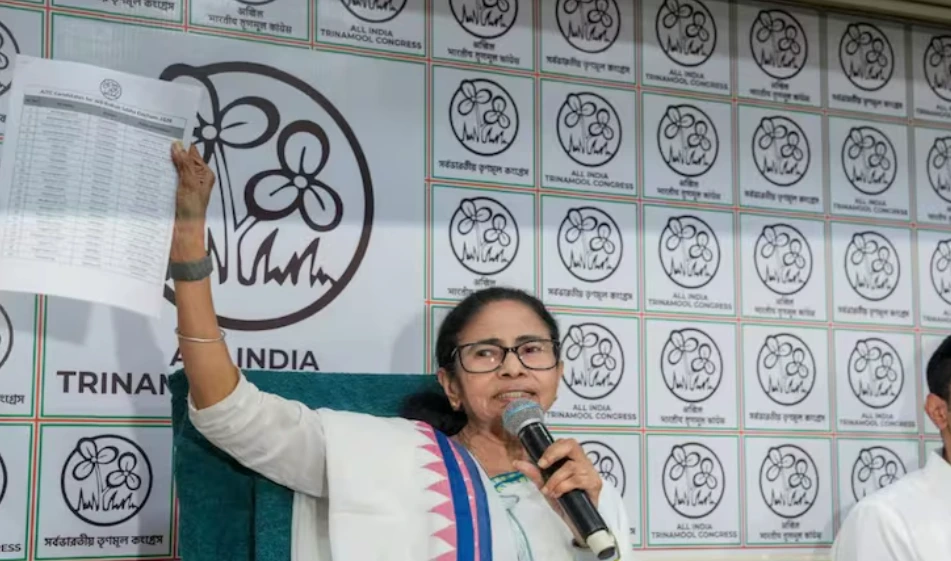
Mamata Banerjee

The Bharatiya Janata Party (BJP) has moved swiftly from its sweeping victory in Bihar to preparing for its next major battle — the West Bengal Assembly election scheduled for March-April next year. According to information shared with media, the party is recalibrating its approach with an emphasis on undermining the Trinamool Congress’ (TMC) ground-level strength rather than relying on high-profile defections.

BJP targets TMC’s grassroots to counter Mamata Banerjee

With plans to challenge Mamata Banerjee once again, the BJP intends to concentrate on Trinamool cadres who are not firmly aligned with Abhishek Banerjee. The party believes this segment could be susceptible to shifting loyalties and may help weaken the ruling party’s booth-level reach.

Even as the BJP prepares to question ‘dynastic politics’ in Bengal by highlighting Abhishek Banerjee’s prominence, the broader strategy remains rooted in boosting its cadre-based presence rather than replicating the pre-2021 influx of TMC defectors.

No major push for turncoats this time

Before the 2021 Assembly polls, the BJP had brought in several senior Trinamool leaders, including Suvendu Adhikari, who went on to defeat Mamata Banerjee in Nandigram. But party leaders now believe more defections will not significantly impact vote share. Instead, inducting grassroots workers is seen as a safer, more effective alternative that won’t create internal friction among BJP’s existing leadership ranks.

Caste arithmetic replaced with regional, religious balance

The BJP’s sweeping performance in Bihar was built on a carefully planned caste matrix. However, Bengal’s political landscape differs considerably, with caste playing a limited role. The party is expected to focus on regional dynamics and religious polarisation instead.

While Muslim voters constitute roughly 30% of the state’s population, their electoral influence is concentrated in a limited number of seats. The BJP hopes that Hindu consolidation in other regions could give it a competitive advantage.

‘Outsider’ narrative likely to intensify

The BJP is expected to continue pressing its charge that illegal migration from Bangladesh has altered electoral patterns in the state. Meanwhile, the Trinamool has long branded the BJP as an ‘outsider’ force. This narrative battle is expected to shape much of the campaign.

BJP eyes 160-170 seats, plans careful candidate selection

Over the last two Assembly and Lok Sabha elections, the BJP has crossed the 100-seat mark in total seats won across Bengal. The party now aims to convert this base into a larger Assembly footprint, targeting 160–170 seats. For this, candidate selection will be critical — an area where the leadership wants to avoid the issues that arose after the wave of defections in 2021.

Strong presence in north and south Bengal

The BJP continues to hold strong ground in north and south Bengal, regions where it has consistently gained vote share. Its best performance so far came in the 2019 Lok Sabha polls, when it secured 18 seats with over 40% vote share. However, the party recently witnessed a decline after losing six of its 12 seats in the latest national election.

To surpass the Trinamool’s peak vote share of around 48%, the BJP will need to secure an additional six per cent of votes — a challenge that will heavily test its organisational strength in the months leading to the election.

Continue Reading

India News

PM Modi attends oath ceremony of Justice Surya Kant, extends best wishes for his tenure

Justice Surya Kant was sworn in as the 53rd Chief Justice of India in a ceremony attended by PM Modi, senior leaders and global judicial representatives.

Published

on

Prime Minister Narendra Modi on Monday attended the swearing-in of Justice Surya Kant as the 53rd Chief Justice of India at Rashtrapati Bhavan, where President Droupadi Murmu administered the oath. Justice Kant, who will serve a tenure of around 14 months, will demit office on February 9, 2027.

Justice Surya Kant takes oath in Hindi

In a notable deviation from recent practice, Justice Surya Kant took his oath in Hindi, invoking God before signing on as the country’s top judge. The event was attended by the Prime Minister, Vice President CP Radhakrishnan, Union ministers, Haryana Chief Minister Naib Singh Saini, Supreme Court judges, and judicial representatives from Bhutan, Kenya, Malaysia, Brazil, Mauritius, Nepal and Sri Lanka.

Soon after the ceremony, the Prime Minister congratulated Justice Kant on social media, writing, “Attended the oath-taking ceremony of Justice Surya Kant as the Chief Justice of India. Best wishes to him for his tenure ahead.”

Journey of the new Chief Justice

Born on February 10, 1962, in Haryana, Justice Surya Kant graduated from Government Post Graduate College, Hisar, in 1981 and completed his law degree from Maharishi Dayanand University, Rohtak, in 1984. After beginning his practice in Hisar, he shifted to the Punjab and Haryana High Court in 1985.

Over the years, he represented several institutions including universities, Boards, banks and corporations. He became the youngest Advocate General of Haryana on July 7, 2000, and was designated a senior advocate in 2001.

Justice Kant was elevated as a judge of the Punjab and Haryana High Court in 2004, later serving as Chief Justice of the Himachal Pradesh High Court from October 2018 until his elevation to the Supreme Court in May 2019.

He has also been part of various legal service bodies. He served on the Governing Body of the National Legal Services Authority (NALSA) from 2007 to 2011 and has been Chairman of the Supreme Court Legal Services Committee since November 2024.

Appointment notification issued in October

The Centre had cleared Justice Kant’s appointment on October 30, acting on the recommendation of former CJI Bhushan R Gavai. A notification issued at the time confirmed that he would assume charge as CJI from November 24, 2025, under Article 124(2) of the Constitution.

Continue Reading

India News

Bollywood legend Dharmendra passes away at 89

Veteran Bollywood actor Dharmendra died at his Mumbai residence at 89, just weeks before turning 90. He was recently discharged from hospital after a bout of breathlessness.

Published

on

Dharmendra

Veteran actor Dharmendra, regarded as one of Hindi cinema’s most enduring icons, died at his Mumbai residence on November 24 at the age of 89. The actor’s death comes just weeks before his 90th birthday on December 8.

Dharmendra passed away nearly two weeks after being discharged from Mumbai’s Breach Candy Hospital, where he was admitted in late October following complaints of breathlessness.

A celebrated journey spanning over six decades

Dharmendra made his film debut in 1960 with Dil Bhi Tera Hum Bhi Tere. Through the 1960s, he became known for portraying relatable, everyday characters in films such as Anpadh, Bandini, Anupama and Aaya Sawan Jhoom Ke.

As his career progressed, he emerged as a leading star of mainstream Hindi cinema, delivering memorable performances in iconic films like Sholay, Dharam Veer, Chupke Chupke, Mera Gaon Mera Desh and Dream Girl.

His final screen appearances

Dharmendra was last seen in Teri Baaton Mein Aisa Uljha Jiya, featuring Shahid Kapoor and Kriti Sanon. His next appearance will be in Ikkis, starring Agastya Nanda, set for release on December 25.

Continue Reading

Trending

© Copyright 2022 APNLIVE.com