English हिन्दी
Connect with us

India News

Bank holidays January 2022: Banks to remain closed for 16 days | Check full list

Before visiting the bank in January 2022, make sure to consider these important dates to avoid any hassle. Banks will remain closed for 16 days. Check full list here.


Published

on

Bank holidays January 2022

Before visiting the bank in January 2022, make sure to consider these important dates to avoid any hassle. Banks will remain closed for 16 days including second and fourth Saturdays and all Sundays.

According to the list issued by RBI, the banks will remain closed in the month of January 2022, although online banking activities will continue to work.

However, the banks will not be closed for 16 days in all states and regions. This is the total number of days that banks will remain shut across the country for state-observed holidays. For example, bank branches in Mizoram may be closed for Losoong but not in Punjab for the same festival.

The RBI has categorised these holidays under three brackets — Holiday under Negotiable Instruments Act and Real-Time Gross Settlement Holiday, Holiday under Negotiable Instruments Act, and Banks’ Closing of Accounts.

Here’s the detailed list of bank holidays across the country in January 2022

1 January: Banks will remain closed in Gangtok, Shillong, Aizawl, and Chennai due to New Year.
2 January: Weekly off (Sunday).
3 January: Banks will be closed in Aizawl and Gangtok due to Losoong festival.
4 January: On account of Losoong festival, banks will be shut in Gangtok.
8 January: Weekly off (Second Saturday).
9 January: Weekly off (Sunday).
11 January: In Aizawl, banks will be closed for Missionary Day.
12 January: Due to Swami Vivekananda’s birth anniversary, banks will be closed in Kolkata.
14 January: Due to Makar Sankranti or Pongal festival, banks will be shut in Ahmedabad, Imphal and Chennai.
15 January: Banks will be closed in Bengaluru, Gangtok, Guwahati, Chennai, Hyderabad and Imphal on account of Uttarayaana Punyakaala Makar Sankranti Festival/Maghe Sankranti/Sankranti/Pongal/Thiruvalluvar Day/Gaan-Ngai/Magh Bihu.
16 January: Weekly off (Sunday).
18 January: On account of Thai Poosam festival, banks will be closed in Chennai.
22 January: Weekly off (Fourth Saturday).
23 January: Weekly off (Sunday).
26 January: Banks across the country will be closed on account of Republic Day.
30 January: Weekly off (Sunday).

Read Also: BEL Recruitment 2022: Applications invited for trainee engineer posts, check details here

India News

Nashik shaken by 3.8-magnitude earthquake, no immediate damage reported

A 3.8-magnitude earthquake struck Nashik in Maharashtra early Thursday morning. The National Center for Seismology said the tremor occurred at a depth of 5 km, with no immediate reports of damage or casualties.

Published

on

earthquake-tremors

A mild earthquake measuring 3.8 on the Richter scale struck Maharashtra’s Nashik district in the early hours of Thursday, according to the National Center for Seismology (NCS). The tremor was recorded at 2:37:41 am IST and originated at a depth of 5 kilometres beneath the surface.

NCS shares earthquake details

The National Center for Seismology said the earthquake’s epicentre was located at latitude 20.448° North and longitude 73.708° East. The agency shared the information in a post on X, confirming the magnitude, location and depth of the seismic event.

“EQ of M: 3.8, On: 30/07/2026 02:37:41 IST, Lat: 20.448 N, Long: 73.708 E, Depth: 5 Km, Location: Nashik, Maharashtra,” the NCS said in its update.

There were no immediate reports of casualties or damage to property following the earthquake.

Why shallow earthquakes can be more damaging

According to the United States Geological Survey (USGS), earthquakes can occur at depths ranging from the Earth’s surface to about 700 kilometres underground. These are generally classified into three categories based on depth: shallow, intermediate and deep earthquakes.

Shallow earthquakes are typically considered more hazardous because seismic waves travel a shorter distance before reaching the Earth’s surface. This can result in stronger ground shaking, increasing the likelihood of structural damage and casualties, depending on the earthquake’s magnitude and the affected area’s infrastructure.

Continue Reading

India News

Focus should be on preventing paper leaks, not just punishment, says Shashi Tharoor

During the Lok Sabha debate on the Public Examinations Amendment Bill, 2026, Shashi Tharoor called for systemic reforms to prevent paper leaks and reduce dependence on single high-stakes examinations.

Published

on

India’s public examination system requires structural reforms that prevent paper leaks instead of relying solely on stricter punishments after the damage is done, Congress MP Shashi Tharoor said while participating in the Lok Sabha debate on the Public Examinations (Prevention of Unfair Means) Amendment Bill, 2026.

Speaking in Parliament on Tuesday, the Thiruvananthapuram MP said millions of students and their families invest years of effort, financial resources and emotional commitment into competitive examinations, making the credibility of the examination process critical.

Tharoor says students deserve a fair and secure examination system

Tharoor said students appearing for examinations such as NEET, JEE and UGC-NET carry far more than an admit card into the examination hall.

He noted that families often spend significant savings on education, coaching and study material while students devote years of preparation in pursuit of professional opportunities. According to him, a paper leak undermines not only an examination but also the hard work and sacrifices made by candidates and their families.

While acknowledging the proposed legislation’s tougher penalties, including lengthy imprisonment and heavy financial penalties for those involved in paper leaks, Tharoor argued that punishment comes only after students have already suffered the consequences.

Calls for reforms beyond stricter penalties

The Congress leader said every paper leak points to deeper weaknesses within the country’s examination system rather than being an isolated incident.

He stressed that Parliament’s objective should be to prevent such incidents altogether through stronger safeguards instead of focusing primarily on punitive measures.

Tharoor also questioned whether the judicial system would be able to consistently deliver speedy trials under the proposed fast-track provisions included in the legislation.

Suggests multiple exam attempts through computer-based testing

Advocating long-term reforms, Tharoor proposed moving away from the existing model in which a student’s future often depends on a single high-stakes examination.

He suggested introducing continuous computer-based entrance examinations with multiple attempts during the year, allowing candidates to submit their best score for admissions. According to him, such a system could reduce stress, accommodate emergencies, strengthen examination integrity and minimise the risk of paper leaks.

Raises concern over competition and student mental health

Highlighting the intense competition for professional education, Tharoor said the large gap between the number of aspirants and available seats contributes to the pressure surrounding entrance examinations.

He also expressed concern over student suicides, saying these figures represent individual lives and families affected by the immense stress associated with competitive examinations.

Calling for broader educational reforms, Tharoor said India needs more quality institutions, increased professional education seats and multiple pathways to higher education so that a single examination does not determine a student’s future.

Concluding his remarks, he said the responsibility of students is to prepare sincerely, while the responsibility of the system is to ensure that their preparation is rewarded through a fair, credible and secure examination process. He added that although the proposed legislation is likely to be passed, broader reforms are necessary to restore confidence in India’s public examination system.

Continue Reading

India News

Delhi Police issue notices to X accounts over abusive posts targeting PM Modi during CJP protests

Delhi Police have issued notices to several X accounts over allegedly abusive posts targeting Prime Minister Narendra Modi during recent student protests, while continuing to monitor social media for content that may violate the law.

Published

on

PM Modi

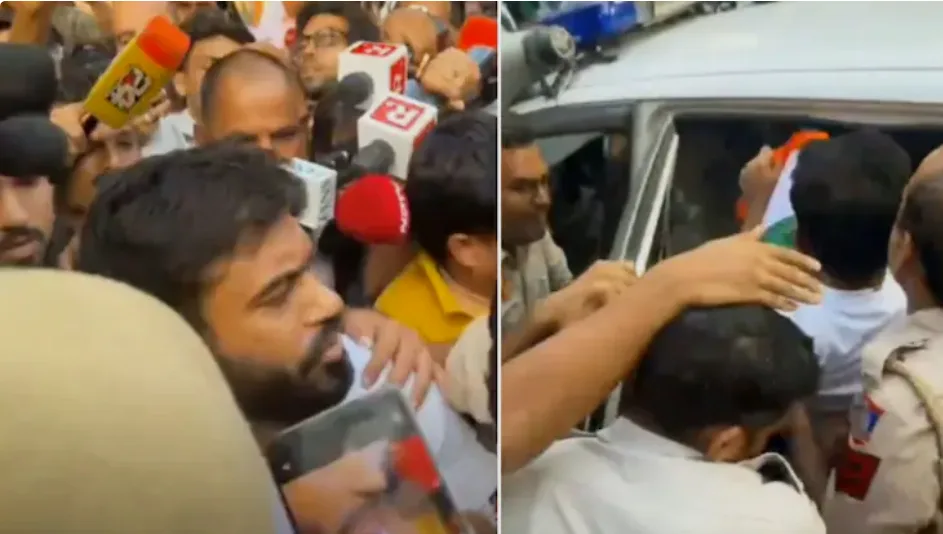
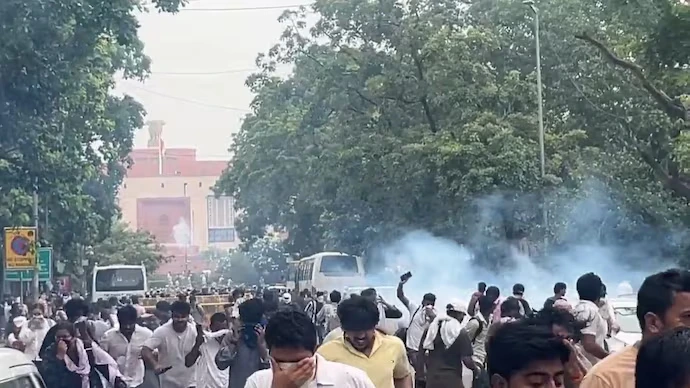
Delhi Police have issued notices to several X (formerly Twitter) accounts, including some associated with news portals, over posts containing abusive remarks targeting Prime Minister Narendra Modi and security forces during recent student protests in Delhi and other locations.

According to police sources, the notices seek information about individuals who allegedly used abusive language in social media posts. The exact number of X accounts that have received notices has not been disclosed.

The action comes after authorities reviewed content shared during and after the protests, examining posts, videos and comments across multiple social media platforms for possible violations of law and their potential impact on public order.

Police continue social media monitoring

Delhi Police said its social media monitoring team has been continuously tracking online platforms for content related to the protests. Officials stated that notices are being issued to social media intermediaries whenever objectionable or abusive content is identified, directing them to remove such material.

According to the police, multiple posts containing abusive language directed at the Prime Minister surfaced during the student protests at Jantar Mantar and following the violence linked to the July 20 ‘Sansad Chalo’ march.

Officials said several comments and videos flagged by the police have already been removed after notices were served to the respective platforms.

Police had earlier flagged Pakistan-linked accounts

Earlier, Delhi Police said it had identified more than 400 social media handles allegedly linked to Pakistan that were circulating fake narratives, rumours and deepfake videos related to the protests.

The police said cyber and social media teams are continuing to monitor online activity connected to the demonstrations. Authorities said the exercise is aimed at identifying additional content that may violate applicable rules and taking appropriate action where necessary.

Continue Reading

Trending

© Copyright 2022 APNLIVE.com