English हिन्दी
Connect with us

India News

BJP gets its first mayor in Kerala as VV Rajesh takes charge in Thiruvananthapuram

The BJP has created history in Kerala after VV Rajesh was sworn in as Thiruvananthapuram’s first mayor from the party, ending decades of CPM control over the civic body.

Published

on

BJP

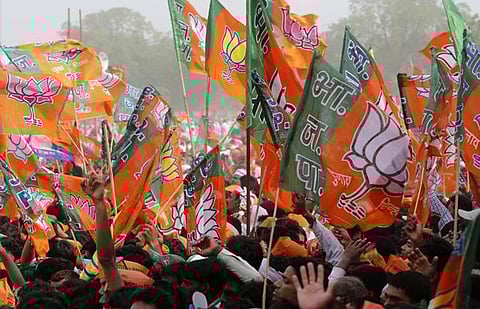
The BJP on Friday marked a historic political moment in Kerala after VV Rajesh was sworn in as the mayor of the Thiruvananthapuram Municipal Corporation. This is the first time the party has secured the mayor’s post in the state capital, signalling a significant shift in Kerala’s urban political landscape.

Rajesh’s election follows the party’s unexpected performance in the municipal elections held earlier this month, where the BJP emerged as the single-largest party by winning 50 of the 101 seats in the civic body.

Rajesh promises inclusive development across all wards

After taking oath, VV Rajesh said the focus of the new leadership would be on collective growth and inclusive governance. He stated that development work would be carried out across all 101 wards, with the aim of transforming Thiruvananthapuram into a developed city.

Rajesh secured 51 votes in the mayoral election conducted in the 100-member House, crossing the halfway mark. The CPM candidate RP Shivaji received 29 votes, while the Congress-led UDF nominee KS Sabarinathan got 19 votes. One independent councillor abstained, while support from another independent councillor proved crucial for the BJP’s victory.

Breakthrough comes ahead of key state election

The development comes less than six months before a major election in Kerala, a state where the BJP has historically struggled. The party has never formed a government in the state and has had limited legislative presence in the past.

The mayoral win also ends decades of control by the CPM over the Thiruvananthapuram civic body. The state capital is also a Lok Sabha constituency currently represented by Congress leader Shashi Tharoor.

BJP leadership targets governance overhaul

Following the swearing-in ceremony, Kerala BJP president Rajeev Chandrasekhar criticised the previous administration, alleging long-standing governance failures and corruption in the civic body. He said basic civic issues such as drainage, water supply and solid waste management had been neglected for years, and asserted that the new administration would begin work immediately to improve the city’s infrastructure.

The party has set a target of making Thiruvananthapuram one of the top cities in the country, according to Chandrasekhar.

Internal debate preceded mayoral choice

The selection of VV Rajesh as mayor followed internal discussions within the BJP. The party was reportedly divided between Rajesh and former Director General of Police R Sreelekha before consensus emerged in Rajesh’s favour. Sreelekha, who won from the Sasthamangalam ward, is known for her earlier role handling economic offence cases.

Union minister Suresh Gopi and Rajeev Chandrasekhar were present during Rajesh’s oath-taking ceremony.

Wider impact on Kerala’s political landscape

Overall results in the local body elections have posed challenges for the ruling Left Democratic Front, while the Congress-led United Democratic Front secured control of four out of six municipal bodies. Prime Minister Narendra Modi later described the BJP’s Thiruvananthapuram win as a “watershed moment,” crediting party workers for the breakthrough.

Continue Reading
Click to comment

Leave a Reply

Your email address will not be published. Required fields are marked *

India News

Veer Bal Diwas reflects courage, conviction and righteousness, Says PM Modi

PM Modi on Friday paid tribute to the Sahibzades on Veer Bal Diwas, calling it a day of courage, conviction and righteousness.

Published

on

pm modi speech

Prime Minister Narendra Modi on Friday paid tribute to the Sahibzades on the occasion of Veer Bal Diwas, remembering their sacrifice and courage. He said the day stands as a reminder of courage, conviction and righteousness, values that continue to inspire generations.

In a message shared on social media, the Prime Minister said Veer Bal Diwas is dedicated to remembering the sacrifice of the brave Sahibzades. He recalled the unwavering faith of Mata Gujri Ji and the immortal teachings of Sri Guru Gobind Singh Ji, describing them as ideals that motivate people even today.

According to the Prime Minister’s Office, the Prime Minister will participate in the national programme marking Veer Bal Diwas at Bharat Mandapam in the national capital. He is also scheduled to address the gathering during the event.

Nationwide programmes to mark Veer Bal Diwas

To commemorate Veer Bal Diwas, the Government of India is organising participative programmes across the country. The objective is to inform and educate citizens about the extraordinary courage and supreme sacrifice of the Sahibzades, and to honour the valour of the young heroes of India’s history.

These activities include storytelling sessions, recitations, poster-making and essay-writing competitions. The programmes will be conducted in schools, Child Care Institutions, Anganwadi centres and other educational platforms, along with online activities through the MyGov and MyBharat portals.

Veer Bal Diwas is observed on December 26 to commemorate the martyrdom of Sahibzadas Baba Zorawar Singh Ji and Baba Fateh Singh Ji, the sons of Sri Guru Gobind Singh Ji. The Prime Minister had announced the observance on the occasion of the Prakash Purab of Sri Guru Gobind Singh Ji in January 2022.

Awardees of the Pradhan Mantri Rashtriya Bal Puraskar will also be present at the programme.

Continue Reading

India News

Delhi air quality improves slightly but stays in poor category

Delhi’s air quality improved slightly on Friday with the AQI falling to the poor category, though many areas continue to record very poor pollution levels.

Published

on

Delhi's air quality

Delhi witnessed a marginal improvement in air quality on Friday, with the overall Air Quality Index (AQI) slipping into the ‘poor’ category. Official data showed the city’s average AQI at 292, offering limited relief after pollution levels had touched the ‘severe’ mark earlier this week.

The improvement comes days after Delhi recorded an AQI of 412 on December 23, placing air quality firmly in the ‘severe’ category. Over the last two days, pollution levels have shown a gradual decline across multiple monitoring stations in the national capital.

Some stations record moderate air quality

According to data from the Central Pollution Control Board’s Sameer mobile application, three locations reported ‘moderate’ air quality as of early morning. Lodhi Road-IITM recorded an AQI of 160, Lodhi Road-IMD stood at 194, while Najafgarh reported 188.

Several other parts of the city remained in the ‘poor’ category. Areas including Aya Nagar, CRRI Mathura Road, Dr Karni Singh Shooting Range, Dwarka Sector 8, IGI Airport Terminal 3, IIT Delhi, Jawaharlal Nehru Stadium and Mandir Marg recorded AQI values ranging between the low 200s and high 200s.

Very poor air persists in pollution hotspots

Despite the overall improvement, many parts of Delhi continued to struggle with ‘very poor’ air quality. Anand Vihar, Bawana, Jahangirpuri, Narela, Nehru Nagar, Sonia Vihar and Vivek Vihar reported some of the highest AQI readings, with values crossing 350 at several locations.

In view of the easing pollution levels, the Commission for Air Quality Management lifted Graded Response Action Plan (GRAP) Stage-IV restrictions across the Delhi-National Capital Region on December 24. Officials indicated that further relaxations could be considered if the downward trend in pollution continues.

Mixed air quality across NCR

Air quality in neighbouring NCR regions showed mixed trends. In Haryana, Bahadurgarh recorded a ‘very poor’ AQI of 301, while Gurugram’s overall AQI stood at 270, falling in the ‘poor’ category. One monitoring station in Gurugram’s Sector 51 reported ‘very poor’ air quality with an AQI of 375. Dharuhera also remained in the ‘poor’ range.

In Uttar Pradesh, pollution levels stayed elevated. Ghaziabad recorded an overall AQI of 344, with all monitoring stations reporting ‘very poor’ air quality. Greater Noida’s AQI stood at 362, while Knowledge Park-V and Knowledge Park-III recorded AQI levels of 386 and 337 respectively. Noida also remained in the ‘very poor’ category with an AQI of 334.

Authorities have restricted the entry of non-BS 6 vehicles into Delhi, a move that has blocked around 1.2 million older vehicles registered outside the city. Vehicular emissions remain a key contributor to winter pollution, with experts estimating that vehicles account for up to 40 per cent of particulate matter pollution in the NCR.

Continue Reading

India News

Train fares increased from December 26: check revised ticket prices across classes

Indian Railways has increased long-distance train fares from December 26, with higher ticket prices for mail, express, sleeper and select ordinary classes.

Published

on

Train fair

Long-distance train travel has become costlier from Friday as the Ministry of Railways implemented a revision in passenger fares. This is the second fare hike in the last six months, with the ministry stating that the decision aims to balance passenger affordability with the sustainability of railway operations.

What has changed in train ticket prices

According to the revised structure, the fare hike applies only to tickets booked on or after December 26. Passengers who booked tickets before this date will not have to pay any additional amount, even if their journey takes place later.

There is no increase in fares for suburban train services and season tickets, covering both suburban and non-suburban routes.

Revised fares for second class ordinary travel

For passengers travelling in Second Class Ordinary coaches, the fare increase depends on the distance:

  • Journeys up to 215 km: no change
  • 216 km to 750 km: increase of Rs 5
  • 751 km to 1,250 km: increase of Rs 10
  • 1,251 km to 1,750 km: increase of Rs 15
  • 1,751 km to 2,250 km: increase of Rs 20

Sleeper and first class ordinary fares

For Sleeper Class Ordinary and First Class Ordinary, fares have been increased by 1 paisa per kilometre.

Mail and express train fare hike

Mail and Express trains have seen a uniform increase of 2 paise per kilometre across all non-AC and AC classes. This includes Sleeper Class, First Class, AC Chair Car, AC 3-Tier, AC 2-Tier and AC First Class. As a result, a passenger travelling around 500 km in a non-AC Mail or Express coach will pay approximately Rs 10 extra.

The revised fares are also applicable to premium and special services such as Rajdhani, Shatabdi, Duronto, Vande Bharat, Tejas, Garib Rath, Jan Shatabdi, Humsafar, Amrit Bharat, Antyodaya, Gatimaan, Mahamana, Yuva Express and Namo Bharat Rapid Rail.

No change in reservation and other charges

The ministry has clarified that there is no change in reservation fees, superfast surcharges or other ancillary charges. GST rules remain unchanged, and fares will continue to be rounded off as per existing norms.

The Railways said the updated fare structure follows a balanced approach to ensure passenger convenience while supporting operational requirements.

Continue Reading

Trending

© Copyright 2022 APNLIVE.com