English हिन्दी
Connect with us

India News

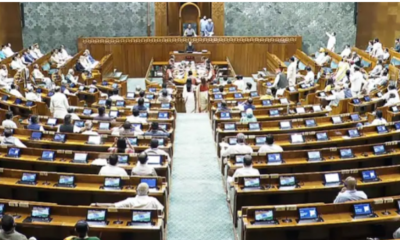
BJP MP alleges Trinamool lawmaker smoked e-cigarette inside Lok Sabha

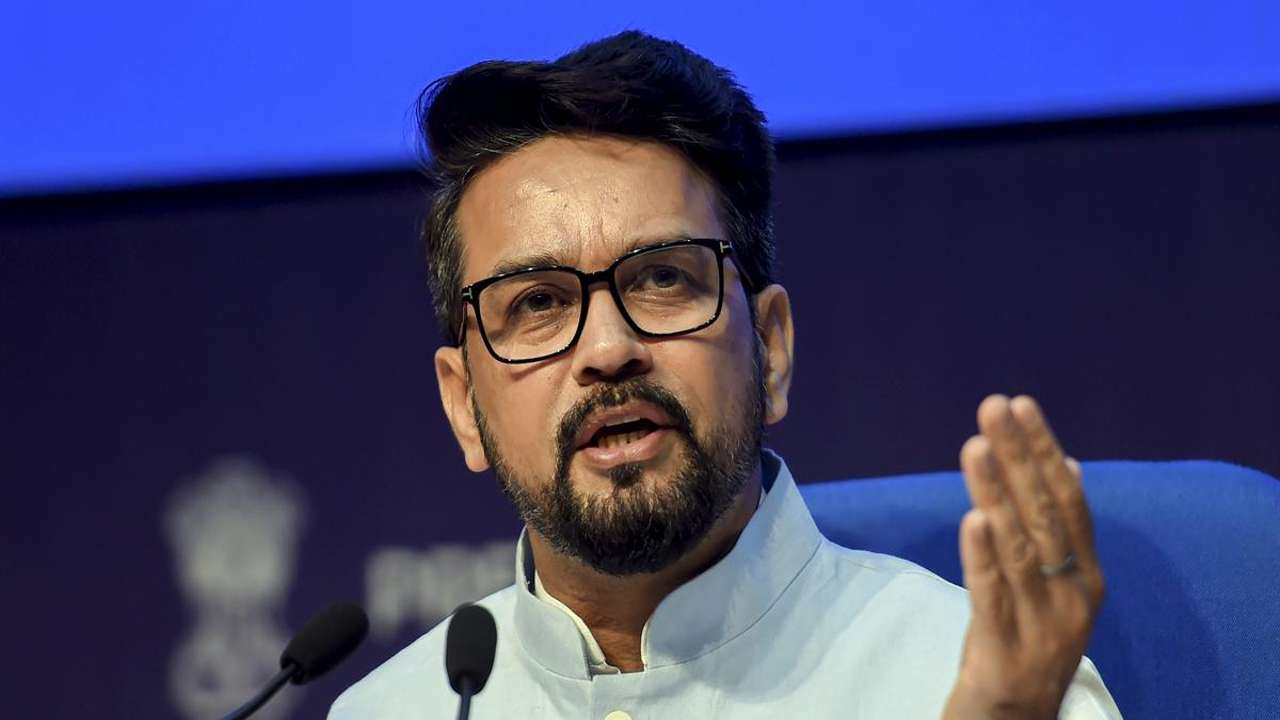
Anurag Thakur accused a Trinamool MP of vaping inside Lok Sabha, sparking protests and prompting the Speaker to remind members of the complete ban on e-cigarettes in India.

Published

on

Anurag Thakur

BJP MP Anurag Thakur on Thursday accused a Trinamool Congress member of using an e-cigarette inside the Lok Sabha during Question Hour, prompting the Speaker to warn MPs about maintaining decorum. E-cigarettes are fully banned in India under the Prohibition of Electronic Cigarettes Act, 2019.

What triggered the row in Lok Sabha

Raising the matter before Speaker Om Birla, Thakur questioned whether e-cigarettes were permitted inside the House. After Birla said they were not allowed, Thakur alleged that a Trinamool MP had been “smoking e-cigarettes in the House for the past several days” and urged an immediate inquiry. His remarks led several BJP MPs to join the protest, briefly disrupting proceedings.

Birla responded by reminding members to uphold parliamentary traditions and stressed that any such violation would invite action.

Centre reminds of complete ban on e-cigarettes

E-cigarettes are electronic or battery-operated devices that heat liquid—often containing nicotine and flavouring—into an inhalable aerosol. Their manufacture, sale, distribution, import and even possession are illegal in India.

Textiles Minister Giriraj Singh also termed the alleged incident “unfortunate”, noting that the law applies to everyone, including MPs.

Despite the nationwide ban, illegal sales continue in many parts of the country, including near educational institutions, prompting the Centre to issue fresh advisories to states in 2023.

Smoking is also prohibited anywhere within the Parliament complex, as the Parliament Rule Book explicitly states that smoking is “strictly forbidden”.

India News

TMC faces fresh turbulence as speculation grows over possible breakaway faction in Bengal

The Trinamool Congress is facing fresh internal challenges as reports of dissent and possible plans for a breakaway political formation gain attention following the party’s defeat in the West Bengal Assembly elections.

Published

on

The Trinamool Congress (TMC) is facing renewed signs of internal unrest, with political speculation mounting over the possibility of a breakaway group emerging in West Bengal after the party’s recent electoral setback. Reports of disgruntled legislators distancing themselves from the party leadership have fuelled discussions about a potential new political formation led by rebel leaders rather than by veteran leader Mamata Banerjee.

The buzz comes shortly after the expulsion of two TMC MLAs over alleged anti-party activities. According to reports, concerns within the party have intensified amid claims that several legislators are unhappy with the current leadership structure and the role of the party’s top decision-makers.

Adding to the speculation, a large number of TMC legislators reportedly skipped a scheduled meeting at Mamata Banerjee’s residence, a development that has been interpreted by political observers as a sign of growing discontent within the organisation.

Split rumours gain momentum after election defeat

The developments come in the aftermath of the 2026 West Bengal Assembly election, in which the BJP secured a decisive victory while the Trinamool Congress suffered a major setback after 15 years in power. The defeat triggered debates within the party over its future direction and leadership.

Reports suggest that discussions are taking place among some legislators regarding the possibility of forming a separate political platform. The situation has drawn comparisons with Maharashtra’s political realignments in recent years, though no formal announcement regarding a split has been made.

Meanwhile, Mamata Banerjee has publicly dismissed rebel voices, stating that the party is stronger without those working against its interests. She has also alleged that there are organised efforts to weaken the Trinamool Congress following its electoral defeat.

While speculation continues, there has been no official confirmation of a new party being launched. Political observers say the coming weeks could determine whether the current tensions remain internal disagreements or evolve into a larger organisational challenge for the Trinamool Congress.

Continue Reading

India News

TMC faces fresh turmoil as signature controversy exposes internal divisions in Bengal

A political controversy has erupted in West Bengal after two TMC MLAs alleged their signatures were used without consent on a letter endorsing Sobhandeb Chattopadhyay as Leader of Opposition, leading to their expulsion from the party.

Published

on

Mamata Banerjee

The Trinamool Congress (TMC) has found itself at the centre of a fresh political controversy after allegations emerged that signatures of some party legislators were used without their consent on a letter related to the appointment of the Leader of Opposition in the West Bengal Assembly.

The row intensified after two TMC MLAs, Ritabrata Banerjee and Sandipan Saha, reportedly objected to their signatures appearing on a letter endorsing senior party leader Sobhandeb Chattopadhyay for the post of Leader of Opposition. The legislators alleged that they had not signed the document.

Allegations trigger political confrontation

The controversy gained prominence after opposition leader Suvendu Adhikari raised the issue and questioned the authenticity of the signatures submitted to the Assembly Secretariat. The allegations have fuelled a political confrontation between the ruling party and the opposition.

Authorities are examining the matter, with the authenticity of the disputed signatures becoming a key focus of the ongoing inquiry. The investigation is expected to determine whether any procedural irregularities occurred during the submission of the endorsement letter.

TMC expels two MLAs

Amid the controversy, the Trinamool Congress expelled Ritabrata Banerjee and Sandipan Saha from the party. TMC leaders cited anti-party activities as the reason for the action, while the expulsions have further intensified debate around the signature dispute.

The development has brought internal disagreements within the party into public view and added to the political tensions surrounding the issue.

Inquiry continues

Officials are continuing to examine the allegations and related documents. The outcome of the inquiry is expected to clarify the circumstances under which the endorsement letter was submitted and whether any irregularities took place.

Continue Reading

India News

K Annamalai likely to quit BJP after declining Rajya Sabha offer, sources say

Former Tamil Nadu leader K Annamalai is set to exit the BJP after rejecting a Rajya Sabha seat offer. Sources indicate he will launch a new public movement following strategic disagreements over assembly election alliances.

Published

on

K Annamalai

Former Tamil Nadu party chief K Annamalai is expected to resign from the Bharatiya Janata Party following a scheduled meeting with party president Nitin Nabin in Delhi. According to media sources, the former Indian Police Service (IPS) officer believes that his growth and opportunities within the national party have reached a dead end.

The developments follow a reported offer by the leadership to secure a Rajya Sabha seat for him, which he chose to decline. Instead of continuing his journey within the party, he is highly anticipated to introduce a fresh public movement in the state. This grassroots initiative will focus on mobilizing a broad network of volunteers and connecting with like-minded individuals across diverse professional and social spectrums. When questioned regarding the ongoing speculation about establishing his own political platform, he responded, “Please wait. We will sit down and talk in two days.”

The root of tactical disagreements

The impending departure highlights a growing divide concerning the party’s electoral approach leading up to the 2026 state assembly polls. He had strongly advocated for the party to contest the elections independently, relying on the significant grassroots momentum built during his tenure. Conversely, the central leadership opted to resurrect its alliance with the AIADMK, seeking to unite opposition votes against the governing DMK.

This strategic pivot coincided with structural alterations in the state unit’s administration. Media reports indicate that AIADMK general secretary Edappadi K Palaniswami explicitly requested structural changes in leadership as a prerequisite for the partnership, leading to his replacement as the state president. Consequently, he did not contest the assembly elections or play an active role in the frontline campaigning. The alliance ultimately managed to secure just a single seat in the assembly elections.

A rapid political trajectory

He entered the political sphere in 2020 after stepping away from the civil services, quickly advancing through the local party hierarchy. He was appointed as the state vice-president shortly after his entry and ascended to the position of state president within a single year.

As the state chief, he became one of the most prominent faces for the party in a region traditionally dominated by regional Dravidian parties. Through extensive mass outreach programs, aggressive digital campaigns, and high-visibility public interactions, he substantially enhanced the national party’s presence in the state. Despite the momentum, his opposition to traditional alliances and subsequent exclusion from national organizational roles created friction, paving the way for his expected departure.

Continue Reading

Trending

© Copyright 2022 APNLIVE.com