English हिन्दी
Connect with us

Top Stories

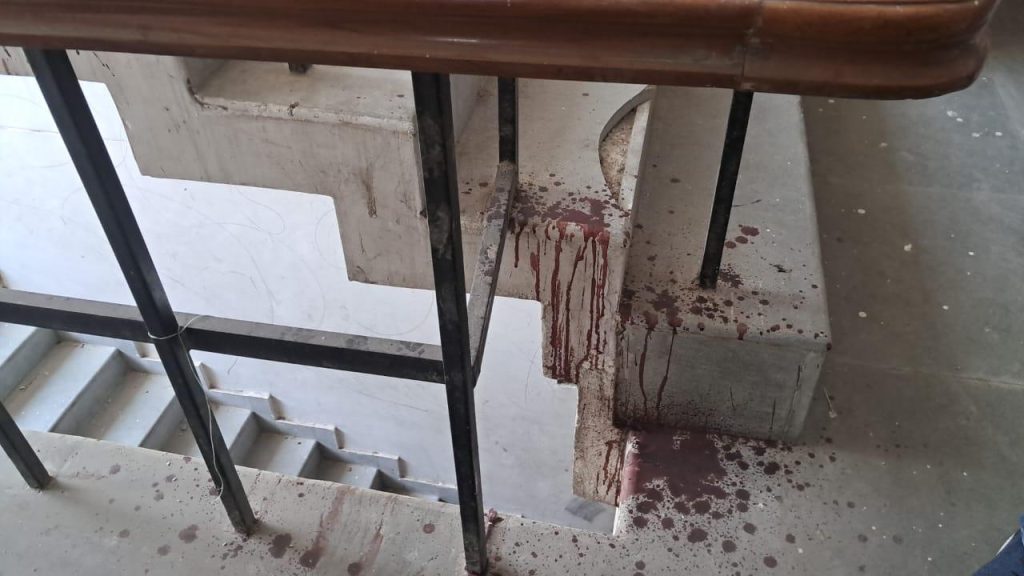
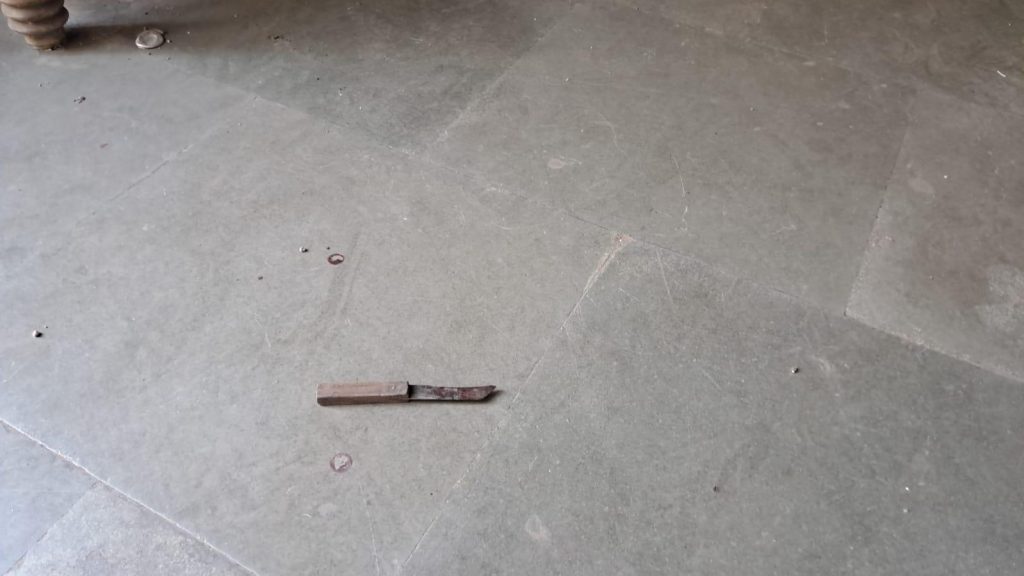
Police discovers blood stained cloth, knife at gangster Atiq Ahmed’s demolished office, see photos

A knife was also found in the demolished office covered with blood stains.

Published

on

Police discovers blood stained cloth, knife at gangster Atiq Ahmed’s demolished office, see photos

The Prayagraj Police on Monday has discovered blood stains inside the premises of gangster turned politician Atiq Ahmed’s partially demolished Prayagraj office.

Stains of blood were found splashed at the stairs inside the office, also as per the reports some stains of blood were found a white piece of cloth which lied in a couch inside the office.

A knife was also found in the demolished office covered with blood stains.
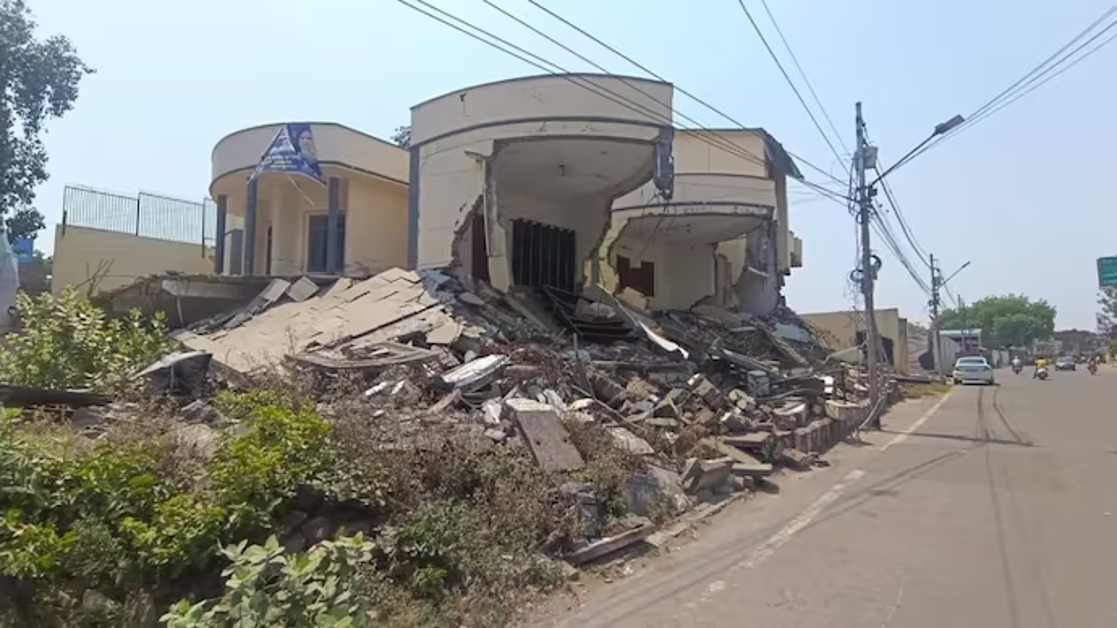
As per reports, a police investigation in the matter of the found items with blood is underway.

Atiq Ahmed was a dreaded gangster who was shot dead at point blank range on April 15 along with his brother Ashraf Ahmed while they were being taken for a medical check-up inside a medical complex in Prayagraj.

Read Also: Maharashtra man kills father for beating up his mother, arrested

Three assailants posing as media personnel, approached the gangster brothers who were in a police custody and fired several rounds at them which took down the lives of the Ahmed brothers.

Atiq and his brother Ashraf were the prime accused involved in the killing of Umesh Pal, the key witness of former BSP MLA Raju Pal murder case, 2005.

Soon after the incident of Umesh Pal murder, the administration in the Uttar Pradesh swung into its bulldozer action and demolished the residences, offices, and various other buildings that were attached to the gangster’s property.

Atiq’s son Asad ahmed, who was a key shooter in the Umesh Pal shootout case was gunned down in an encounter by the UP Special Task Force (STF) team on April 13, Asad was on a run since Umesh Pal murder and the UP Police along with the STF team were in regular action to nab Asad and his aides involved in the shootout.

The killings of Atiq and his brother Ashraf has questioned the law and order situation of the state.

Andhra Pradesh CM’s sister YS Sharmila manhandles Telangana cops during paper leak scam protest, detained | WATCH

NCP chief Sharad Pawar breaks silence over talks of Ajit Pawar joining BJP
India News

PM Modi inaugurates India’s first nature-themed airport terminal in Assam

Prime Minister Narendra Modi inaugurates the new nature-themed terminal at Guwahati airport, the largest in Northeast India, built around bamboo, orchids and regional heritage.

Published

on

PM modi in Assam

Prime Minister Narendra Modi is set to inaugurate the new terminal building of Lokapriya Gopinath Bordoloi International (LGBI) Airport in Guwahati today, marking a major milestone for aviation infrastructure in the Northeast. Built at an estimated cost of around Rs 4,000 crore, the facility is being projected as the largest airport terminal in the region and a key boost to connectivity, tourism and economic activity in Assam.

The Prime Minister is scheduled to arrive in Guwahati around 3 pm as part of his two-day visit to the state.

Northeast’s largest airport terminal takes shape in Guwahati

The newly constructed terminal is nearly seven times larger than the existing one and has been designed to cater to the region’s rapidly growing air traffic. Once fully operational, it is expected to handle up to 13.1 million passengers annually by 2032.

Officials said the terminal is planned as a regional connectivity hub, with a focus on strengthening air links between India and Southeast Asia. The airport will be capable of handling up to 34 air traffic movements per hour, the highest capacity among airports in the Northeast. The facility will also be equipped with one of the most advanced Instrument Landing Systems to support safer and more efficient operations.

Nature-inspired design rooted in Assam’s identity

What sets the Guwahati terminal apart is its distinctive nature-themed architecture. Conceptualised under the theme “Bamboo Orchids”, it is being described as India’s first airport terminal inspired entirely by natural and cultural elements.

The interiors draw from the landscapes of Northeast India, with design elements reflecting indigenous orchids, locally known as Kopou Phool, and the flow of the Brahmaputra river. The terminal incorporates more than 2,000 species of plants, includes a dedicated zone inspired by Kaziranga National Park, and features artefacts representing Majuli Island.

A key architectural highlight is the expansive bamboo vault, created using around 140 metric tonnes of locally sourced bamboo. The space has been envisioned as a multifunctional cultural centre aimed at encouraging community interaction and showcasing the region’s heritage. Design elements such as japi motifs, the iconic rhino symbol and 57 orchid-inspired columns further reinforce the cultural narrative.

Arriving passengers will also experience a unique “Sky Forest”, featuring nearly one lakh plants of indigenous species, designed to create an immersive forest-like ambience within the terminal.

Focus on digital integration and passenger convenience

Spread over nearly 1.4 lakh square metres, the integrated new terminal has been designed to handle around 1.3 crore passengers annually. It is supported by significant upgrades to the runway, airfield systems, aprons and taxiways.

The terminal places strong emphasis on digital integration, with 14 entry points, including four DigiYatra gates, aimed at easing passenger movement. Facilities such as full-body scanners for non-intrusive security checks, automated baggage handling systems, fast-track immigration and AI-driven airport operations have been incorporated to ensure smoother travel experiences.

Other engagements during PM Modi’s Assam visit

During his two-day stay, the Prime Minister will also lay foundation stones for multiple development projects and address public gatherings. He is scheduled to visit the Swahid Smarak Kshetra to pay tribute to the martyrs of the historic Assam Movement.

Later in the day, PM Modi will perform the bhoomipujan for a new brownfield Ammonia-Urea Fertiliser Project at Namrup in Dibrugarh district, within the existing premises of the Brahmaputra Valley Fertiliser Corporation Limited.

Continue Reading

India News

Assam train accident: Eight elephants killed after Rajdhani Express derailment in Hojai

Eight elephants were killed after the Rajdhani Express collided with a herd in Assam’s Hojai district, causing multiple coaches to derail and disrupting train services.

Published

on

assam train accident

At least eight elephants were killed and a calf was injured after a herd collided with the Sairang–New Delhi Rajdhani Express in Assam’s Hojai district, leading to the derailment of the locomotive and five coaches early Saturday. Railway officials confirmed that no passengers were injured in the incident.

Forest department officials said the collision occurred when the New Delhi-bound Rajdhani Express struck a herd of elephants on the tracks. The impact caused multiple coaches to derail, disrupting rail traffic on the busy route connecting the Northeast with the national capital.

Train services hit, passengers shifted to other coaches

Following the derailment, rail movement towards Upper Assam and other parts of the Northeast was affected due to damaged coaches and elephant remains scattered on the tracks. Accident relief trains and senior railway officials rushed to the site to restore services.

Passengers travelling in the affected coaches were temporarily accommodated in vacant berths in other coaches of the same train. Officials said that once the train reaches Guwahati, additional coaches will be attached to ensure all passengers can continue their journey.

Collision occurred outside designated elephant corridor

According to officials, the accident took place at a location that is not marked as a designated elephant corridor. The loco pilot reportedly applied emergency brakes after spotting the herd on the tracks, but the elephants ran into the train, resulting in the collision and derailment.

Forest authorities confirmed that eight elephants died on the spot, while one injured calf was rescued. Local residents said the herd consisted of around eight elephants at the time of the accident.

Elephant deaths in train accidents remain a concern

The incident comes amid continued concerns over wildlife deaths on railway tracks. Data shared by the Environment Ministry in Parliament earlier showed that at least 79 elephants have died in train collisions across India over the past five years, based on reports from states and Union Territories.

The ministry has said that several preventive steps are being taken in coordination with the Railways, including speed restrictions in elephant habitats, use of sensor-based detection systems, and construction of underpasses, ramps and fencing at vulnerable locations. Guidelines and capacity-building programmes have also been introduced to reduce human-animal conflict along railway lines.

Continue Reading

India News

Rahul Gandhi attacks G RAM G bill, says move against villages and states

Rahul Gandhi has criticised the G RAM G bill cleared by Parliament, alleging it dilutes the rights-based structure of MGNREGA and centralises control over rural employment.

Published

on

Rahul Gandhi

Leader of the Opposition Rahul Gandhi has launched a sharp attack on the Modi government after Parliament cleared the Viksit Bharat Guarantee for Employment and Livelihood Mission (Rural) Bill, commonly referred to as the ‘G RAM G’ bill. He described the proposed law as “anti-state” and “anti-village”, arguing that it weakens the core spirit of the Mahatma Gandhi National Rural Employment Guarantee Act (MGNREGA).

The new legislation, which is positioned as an updated version of MGNREGA, was passed amid protests by opposition parties and is expected to replace the existing scheme once it receives presidential assent.

‘Bulldozed without scrutiny’, says Rahul Gandhi

Rahul Gandhi criticised the manner in which the bill was cleared, saying it was pushed through Parliament without adequate debate or examination. He pointed out that the opposition’s demand to refer the bill to a standing committee was rejected.

According to him, any law that fundamentally alters the rural employment framework and affects crores of workers should undergo detailed scrutiny, expert consultation and public hearings before approval.

Claim of dilution of rights-based guarantee

Targeting the central government, the Congress leader said the proposed law dismantles the rights-based and demand-driven nature of MGNREGA and replaces it with a rationed system controlled from Delhi. He argued that this shift undermines the autonomy of states and villages.

Rahul Gandhi alleged that the intent behind the move is to centralise power and weaken labour, particularly impacting rural communities such as Dalits, OBCs and Adivasis.

Defence of MGNREGA’s impact

Highlighting the role of MGNREGA, Gandhi said the scheme provided rural workers with bargaining power, reduced distress migration and improved wages and working conditions, while also contributing to rural infrastructure development.

He also recalled the role of MGNREGA during the Covid period, stating that it prevented crores of people from slipping into hunger and debt. According to him, any rationing of a jobs programme first affects women, landless workers and the poorest communities.

Opposition to name change and provisions

The Congress has also objected to the renaming of the scheme, accusing the government of attempting to erase the legacy associated with Mahatma Gandhi. Opposition MPs staged a dharna within the Parliament complex, questioning provisions of the bill that they claim dilute the “soul and spirit” of the original law enacted in 2005.

Under MGNREGA, the government guaranteed 100 days of work in rural areas along with an unemployment allowance if work was not provided. The ‘G RAM G’ bill proposes to raise the guaranteed workdays to 125, while retaining other provisions. However, critics have flagged concerns over employment being linked to pre-approved plans.

The bill was cleared after a midnight voice vote in the Rajya Sabha, following its passage in the Lok Sabha amid protests and walkouts. It will become law once approved by the President.

Continue Reading

Trending

© Copyright 2022 APNLIVE.com