English हिन्दी
Connect with us

India News

Cash crunch returns to haunt Uttar Pradesh, say reports

Published

on

Cash crunch back to haunt UP

[vc_row][vc_column][vc_column_text]Bank officials claim they don’t have cash to meet the demands of account holders.

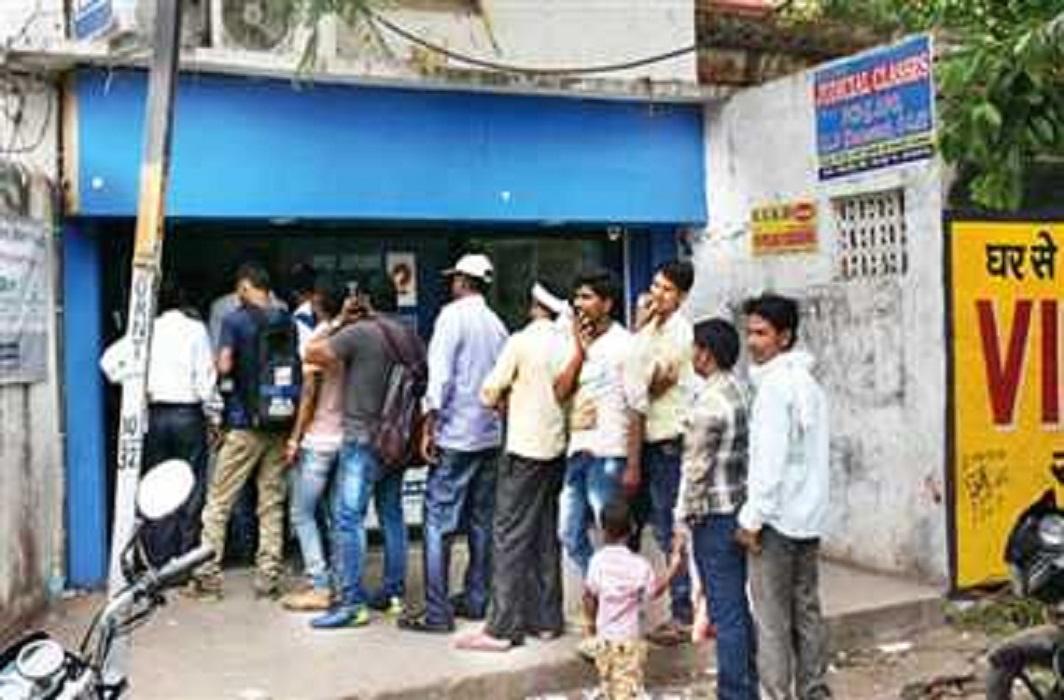
Shortage of cash seems to have returned to haunt cities in Uttar Pradesh, reminding one of the times of long queues soon after Prime Minister Narendra Modi demonetised the old Rs 500 and Rs 1000 notes. With ATMs running dry, huge queues can be seen outside them.

In Allahabad, men and women stood in serpentine queues for hours on Monday when most of the ATMs in the town were closed or were out of cash. According to a report, PSU banks that worked on Monday after the weekend had put a limit on cash withdrawals ranging from Rs 10,000 to Rs 3,000 to meet immediate needs of the customers.

The situation was no different in Gorakhpur. Apart from two or three ATMs in the district, the rest of the machines were out of order.  In Jhansi too, people have been standing in queues for long hours. A majority of ATMs in the city either have no cash or are not working.

Meanwhile, bank officials claimed the Reserve Bank of India has not supplied them with ample cash to meet the demands of the customers. “Around 33 ATMs are functioning under the main branch of SBI and another 10 in the separate branches in the city. These ATMs are dealing with a cash crunch as the RBI is not releasing enough cash. As a result we are managing with limited supply which is being distributed in small quantity,” said SK Singh, manager of currency administration cell at SBI, Lucknow.[/vc_column_text][/vc_column][/vc_row]

India News

Lok Sabha passes bill to criminalise insult to Vande Mataram

Parliament has passed the Prevention of Insults to National Honour (Amendment) Bill, 2026, extending legal protection to Vande Mataram and making insults to the national song a punishable offence.

Published

on

Parliament on Thursday approved legislation that makes insulting the national song Vande Mataram a punishable offence, with the Lok Sabha clearing the bill after it had already been passed by the Rajya Sabha. The amendment extends legal protection currently available to the national anthem, Jana Gana Mana, to the national song.

The Prevention of Insults to National Honour (Amendment) Bill, 2026 was passed by a voice vote in the Lok Sabha amid protests from the Opposition. With approval from both Houses, it becomes the first legislation cleared during the ongoing Monsoon Session of Parliament.

What the amendment changes

The existing Prevention of Insults to National Honour Act penalises acts such as intentionally preventing the singing of the national anthem or disrupting an assembly where it is being sung.

The new amendment brings Vande Mataram under the same legal framework, making insults to the national song a criminal offence. Under the existing law, such offences can attract imprisonment of up to three years, a fine, or both. Repeat convictions carry a mandatory minimum prison term of one year.

Government says bill gives due recognition to national song

Replying to the discussion in the Lok Sabha, Minister of State for Home Nityananda Rai said the amendment places Vande Mataram on par with the national anthem.

He criticised the Congress, alleging that the party failed to accord the national song the respect it deserved during its years in power and accused it of pursuing appeasement politics. Rai said the Narendra Modi government was giving the song the recognition it merits and concluded his remarks with a chant of “Vande Mataram.”

Opposition raises objections

The bill faced criticism from Opposition members during the debate.

DMK MP K Kanimozhi opposed the legislation, describing it as a “Hindutva agenda” presented in the name of nationalism. She argued that making all six stanzas of Vande Mataram compulsory and criminalising non-compliance was against the country’s secular and federal principles.

BJP MP Sambit Patra, however, defended the legislation, saying previous governments had not accorded the national song the respect it deserved.

The Opposition’s proposed amendments were rejected by the House. During the proceedings, DMK MP A. Raja tore documents and threw them towards the Well of the House amid protests before the Lok Sabha was adjourned for the day.

First bill passed in Monsoon Session

The amendment is the first bill to receive approval from both Houses during the ongoing Monsoon Session, which has witnessed repeated disruptions by the Opposition, largely over the NEET paper leak issue.

Continue Reading

India News

Nashik shaken by 3.8-magnitude earthquake, no immediate damage reported

A 3.8-magnitude earthquake struck Nashik in Maharashtra early Thursday morning. The National Center for Seismology said the tremor occurred at a depth of 5 km, with no immediate reports of damage or casualties.

Published

on

earthquake-tremors

A mild earthquake measuring 3.8 on the Richter scale struck Maharashtra’s Nashik district in the early hours of Thursday, according to the National Center for Seismology (NCS). The tremor was recorded at 2:37:41 am IST and originated at a depth of 5 kilometres beneath the surface.

NCS shares earthquake details

The National Center for Seismology said the earthquake’s epicentre was located at latitude 20.448° North and longitude 73.708° East. The agency shared the information in a post on X, confirming the magnitude, location and depth of the seismic event.

“EQ of M: 3.8, On: 30/07/2026 02:37:41 IST, Lat: 20.448 N, Long: 73.708 E, Depth: 5 Km, Location: Nashik, Maharashtra,” the NCS said in its update.

There were no immediate reports of casualties or damage to property following the earthquake.

Why shallow earthquakes can be more damaging

According to the United States Geological Survey (USGS), earthquakes can occur at depths ranging from the Earth’s surface to about 700 kilometres underground. These are generally classified into three categories based on depth: shallow, intermediate and deep earthquakes.

Shallow earthquakes are typically considered more hazardous because seismic waves travel a shorter distance before reaching the Earth’s surface. This can result in stronger ground shaking, increasing the likelihood of structural damage and casualties, depending on the earthquake’s magnitude and the affected area’s infrastructure.

Continue Reading

India News

Focus should be on preventing paper leaks, not just punishment, says Shashi Tharoor

During the Lok Sabha debate on the Public Examinations Amendment Bill, 2026, Shashi Tharoor called for systemic reforms to prevent paper leaks and reduce dependence on single high-stakes examinations.

Published

on

India’s public examination system requires structural reforms that prevent paper leaks instead of relying solely on stricter punishments after the damage is done, Congress MP Shashi Tharoor said while participating in the Lok Sabha debate on the Public Examinations (Prevention of Unfair Means) Amendment Bill, 2026.

Speaking in Parliament on Tuesday, the Thiruvananthapuram MP said millions of students and their families invest years of effort, financial resources and emotional commitment into competitive examinations, making the credibility of the examination process critical.

Tharoor says students deserve a fair and secure examination system

Tharoor said students appearing for examinations such as NEET, JEE and UGC-NET carry far more than an admit card into the examination hall.

He noted that families often spend significant savings on education, coaching and study material while students devote years of preparation in pursuit of professional opportunities. According to him, a paper leak undermines not only an examination but also the hard work and sacrifices made by candidates and their families.

While acknowledging the proposed legislation’s tougher penalties, including lengthy imprisonment and heavy financial penalties for those involved in paper leaks, Tharoor argued that punishment comes only after students have already suffered the consequences.

Calls for reforms beyond stricter penalties

The Congress leader said every paper leak points to deeper weaknesses within the country’s examination system rather than being an isolated incident.

He stressed that Parliament’s objective should be to prevent such incidents altogether through stronger safeguards instead of focusing primarily on punitive measures.

Tharoor also questioned whether the judicial system would be able to consistently deliver speedy trials under the proposed fast-track provisions included in the legislation.

Suggests multiple exam attempts through computer-based testing

Advocating long-term reforms, Tharoor proposed moving away from the existing model in which a student’s future often depends on a single high-stakes examination.

He suggested introducing continuous computer-based entrance examinations with multiple attempts during the year, allowing candidates to submit their best score for admissions. According to him, such a system could reduce stress, accommodate emergencies, strengthen examination integrity and minimise the risk of paper leaks.

Raises concern over competition and student mental health

Highlighting the intense competition for professional education, Tharoor said the large gap between the number of aspirants and available seats contributes to the pressure surrounding entrance examinations.

He also expressed concern over student suicides, saying these figures represent individual lives and families affected by the immense stress associated with competitive examinations.

Calling for broader educational reforms, Tharoor said India needs more quality institutions, increased professional education seats and multiple pathways to higher education so that a single examination does not determine a student’s future.

Concluding his remarks, he said the responsibility of students is to prepare sincerely, while the responsibility of the system is to ensure that their preparation is rewarded through a fair, credible and secure examination process. He added that although the proposed legislation is likely to be passed, broader reforms are necessary to restore confidence in India’s public examination system.

Continue Reading

Trending

© Copyright 2022 APNLIVE.com