English हिन्दी
Connect with us

India News

Delhi court convicts four accused involved in murder of journalist Soumya Vishwanathan

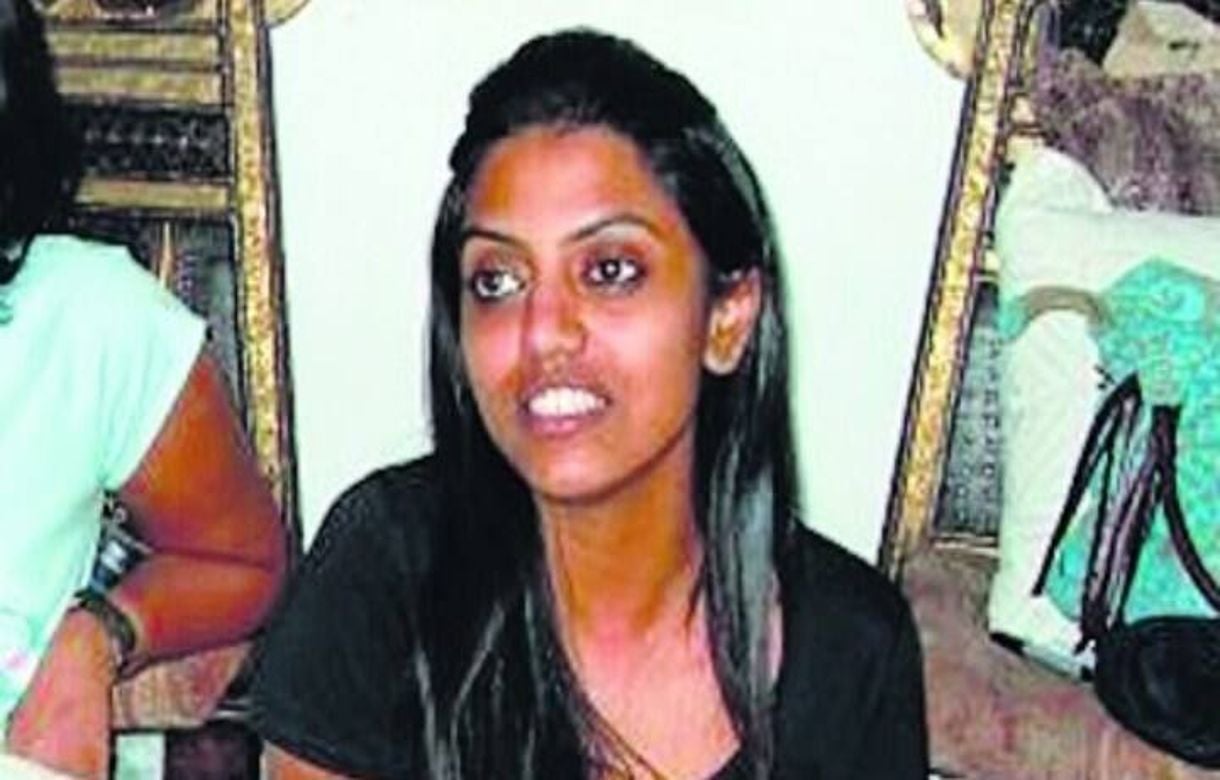
Soumya Vishwanathan was discovered dead in her car at Nelson Mandela Marg in South Delhi’s Vasant Kunj area on September 30, 2008.

Published

on

Delhi court convicts four accused involved in murder of journalist Soumya Vishwanathan

After fifteen years, all four accused involved in the 2008 murder of Delhi journalist Soumya Vishwanathan have been convicted by a Delhi court on Wednesday. The harrowing incident took place in the national capital.

Soumya Vishwanathan, who was a journalist with the Headlines Today news channel, was shot and killed in her car while driving home from office in September 2008. On Wednesday, the Saket court convicted the accused Ravi Kapoor, Amit Shukla, Ajay Kumar, Baljeet Malik, and Ajay Sethi for the 2008 murder of the journalist.

Reports stated that the young journalist Soumya Vishwanathan was discovered dead in her car at Nelson Mandela Marg in South Delhi’s Vasant Kunj area on September 30, 2008. Initially, the incident was believed to be a car accident until forensic reports disclosed her cause of death as a gunshot wound to the head.
Later, CCTV footage revealed that a car tailing Soumya Vishwanathan’s vehicle and a major moment in the investigation came when two accused, Ravi Kapoor and Amit Shukla, were arrested in connection with another case.

The Delhi Police identified similarities in the murder pattern of a call center executive and Soumya Vishwanathan’s killing. The duo Ravi Kapoor and Amit Shukla were initially arrested for the murder of a call centre executive.

Following subsequent interrogations, they confessed to the killing of Vishwanathan. The accused had described the murder as a thrilling activity. Reportedly, the charge sheet implicating them, along with Baljeet Malik and Ajay Sethi, was filed in June 2010, followed by the commencement of the trial in November 2010.

Timeline of Soumya Vishwanathan murder case:

September 30, 2008: Journalist shot dead at Nelson Mandela Marg in south Delhi’s Vasant Kunj, while returning home from work in her car around 3.30 am

March 28, 2009: All the accused Ravi Kapoor, Amit Shukla, Baljeet Malik, Ajay Kumar and Ajay Sethi were arrested after recovery of the weapon used in the call centre executive’s murder and  revealed the involvement of the same accused in Soumya’s murder.

April 2009: The Delhi police invoked the stringent Maharashtra Control of Organised Crime Act (MCOCA) against the accused in the Soumya murder case.

February 6, 2010: Accused Ravi Kapoor, Baljeet Singh, Amit Shukla, Ajay Kumar, and Ajay Sethi were slapped with charges under murder, robbery and other offences.

August 2016: A trial court sentenced Ravi Kapoor and Amit Shukla to death while Malik was sentenced to life in the 2009 call centre executive murder case.

January 2018: The Delhi High court commuted the death sentences of Kapoor and Shukla to life imprisonment. Malik’s life term was upheld.

February 27, 2019: The Delhi High Court ordered a trial court to speed up the trial of Soumya’s murder case based on a plea lodged by Malik.

September 1, 2023: Final arguments started before Additional Sessions Judge Ravindra Kumar Pandey.

October 13, 2023: Justice Pandey reserved judgment in the case after completion of arguments by the defence and prosecution. The court stated that all parties can file written submissions, if any, by October 14.

October 18, 2023: The Delhi court convicted all the four accused in the journalist’s murder case.

October 26, 2023: The Delhi court fixed the date for sentencing on October 26.

India News

New UP Congress chief Aradhana Mishra backs stronger alliance with SP 

Newly appointed UP Congress chief Aradhana Mishra said the party would strengthen its alliance with the Samajwadi Party ahead of the 2027 Assembly election.

Published

on

Newly appointed Uttar Pradesh Congress president Aradhana Mishra, also known as Mona, has said the party will take its alliance with the Samajwadi Party forward with full strength ahead of the 2027 Uttar Pradesh Assembly election.

Mishra, the daughter of Congress MP Pramod Tiwari, has been given the responsibility of leading the party’s state unit as Congress prepares for the assembly polls due in around six months, according to the report.

Speaking about Samajwadi Party chief Akhilesh Yadav, Mishra described the SP as a strong partner of the Congress in the INDIA bloc.

“The Samajwadi Party is a partner of ours in the INDIA bloc, and a strong one at that,” she said, while praising the way Akhilesh Yadav has strengthened his party.

Aradhana Mishra backs Congress-SP alliance

Mishra referred to the performance of the INDIA bloc in the 2024 Lok Sabha election in Uttar Pradesh while discussing the alliance’s prospects for the next assembly election.

The INDIA bloc won 43 of Uttar Pradesh’s 80 Lok Sabha seats in the 2024 election, according to the report.

Mishra said the alliance had stopped the BJP’s advance in Uttar Pradesh in the 2024 Lok Sabha election and expressed confidence that the partnership would produce results in the 2027 Assembly election.

“We will take this alliance forward with full strength,” she said.

The new state Congress chief will also have to advance seat-sharing discussions with the Samajwadi Party. The report said Congress wants a larger share of seats, while the SP has not indicated a willingness to give ground, arguing that it is in a stronger position in the state.

Congress announces new UP team

The leadership change is part of a wider organisational reshuffle by the Congress in Uttar Pradesh.

Along with appointing Mishra as state Congress president, the party named Rajya Sabha MP Imran Masood as working president. Chaudhary Virendra Singh was appointed Leader of the Congress Legislature Party.

Devinder Nishad and Alok Prasad were also appointed senior vice presidents of the Uttar Pradesh Congress Committee.

The new appointments bring different social groups into prominent positions in the state organisation. Mishra is a Brahmin, Masood is a Muslim and Rajendra Pal Gautam, the Congress’ AICC in-charge of Uttar Pradesh, is a Dalit, the report said.

Mishra, however, said the Congress does not practise caste or religion-based politics.

She said the party wanted to strengthen the country, protect the Constitution and build a strong alternative ahead of the 2027 election.

Mishra’s challenge ahead of 2027 polls

As the new Uttar Pradesh Congress chief, Mishra will be responsible for strengthening the party’s organisation in the state while also taking forward its alliance with the Samajwadi Party.

The Congress and SP are part of the INDIA bloc in Uttar Pradesh. With seat-sharing discussions ahead of the 2027 Assembly election, Mishra’s comments indicate that the Congress intends to continue working with the Samajwadi Party.

The appointment of Mishra comes alongside other organisational changes aimed at preparing the party for the upcoming assembly election.

Continue Reading

India News

CJP announces October 10 Delhi protest against Gyanesh Kumar

CJP leader Abhijeet Dipke has announced a protest at Jantar Mantar on October 10, demanding the resignation of Chief Election Commissioner Gyanesh Kumar.

Published

on

Cockroach Janta Party (CJP) leader Abhijeet Dipke has announced a fresh protest at Delhi’s Jantar Mantar on October 10, saying the demonstration will be held if Chief Election Commissioner Gyanesh Kumar does not resign.

Dipke made the announcement after a CJP demonstration at Mumbai’s Shivaji Park. He called on people from across the country to join the proposed Delhi protest, describing it as a peaceful agitation.

Abhijeet Dipke’s October 10 protest call

In a post on X, Dipke said CJP supporters would march to Delhi and hold a protest at Jantar Mantar if Kumar did not step down. He also said that if Delhi Police stopped the protesters, the location where they were stopped would become their protest site.

The CJP leader had earlier warned of a larger agitation while addressing the gathering at Shivaji Park. He said that if the Chief Election Commissioner did not resign, the movement would expand to Delhi.

CJP’s allegations against the Election Commission

During the Mumbai protest, Dipke alleged irregularities in electoral rolls and questioned decisions concerning the election process. He claimed that 13 crore voters had been deleted over two years and alleged that voter deletions had affected electoral outcomes in several states.

These claims were made by Dipke while addressing the protesters and were not presented in the report as independently established facts.

He also alleged that voters were deleted from constituencies in Delhi, Tamil Nadu and West Bengal and linked these alleged deletions to election results.

The CJP leader further criticised the proposed simultaneous elections framework, alleging that the ruling BJP’s objective was “One Nation, One Election, One Party”.

CJP demands Gyanesh Kumar’s resignation

CJP leaders have been demanding the resignation of Chief Election Commissioner Gyanesh Kumar and have also called for criminal proceedings against him.

The group has criticised the Election Commission over the Special Intensive Revision of electoral rolls and has demanded changes to the law governing the appointment of Election Commissioners.

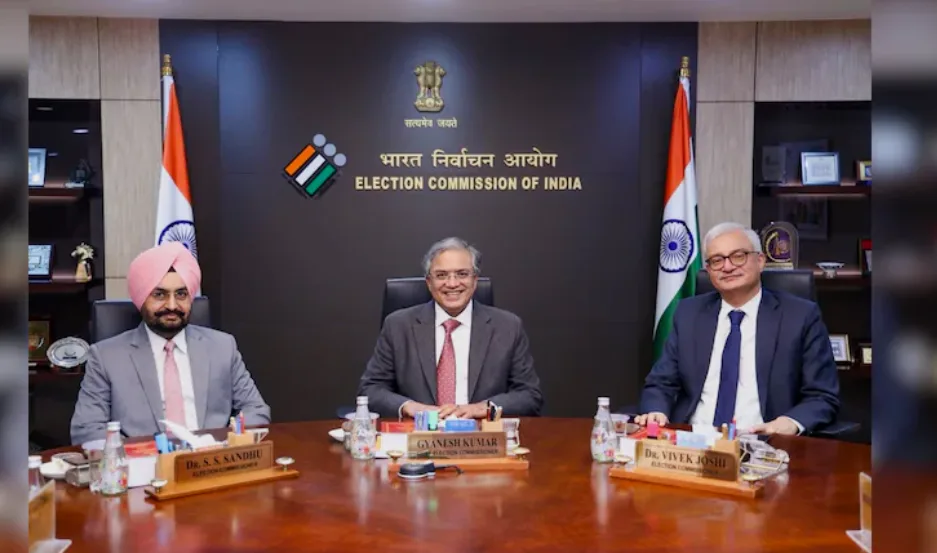
The Election Commission, however, has said that decisions of the three-member poll body, including those concerning the SIR exercise, were taken unanimously.

Protest at Mumbai’s Shivaji Park

The October 10 Delhi announcement followed a CJP demonstration at Mumbai’s Shivaji Park. The protest was held despite police denying permission for the event, according to the report.

Several groups and individuals participated in the demonstration. The Shiv Sena (UBT) had also extended support to the CJP’s agitation.

Dipke said the CJP would continue its campaign and called for the proposed October 10 demonstration in Delhi under the slogan “Chalo Delhi”.

Continue Reading

India News

MK Stalin attacks Vijay government over hindi signboard in Tamil Nadu

MK Stalin criticised the Tamil Nadu government over Hindi lettering on a State Highway signboard and warned the Vijay-led administration against interfering with the state’s two-language policy.

Published

on

MK Stalin

The use of Hindi on a highway signboard in Tamil Nadu has triggered a political row, with DMK chief MK Stalin criticising the Vijay-led Tamilaga Vettri Kazhagam (TVK) government over the issue.

The controversy centres on a State Highway signboard that displayed place names in Tamil, English and Hindi. The board was installed on the Alwarthirunagari-Valliyoor State Highway 93 route through Sathankulam in Thoothukudi district.

Stalin objected to the inclusion of Hindi, saying Tamil Nadu has long opposed what he described as attempts to impose Hindi and warning the state government against altering its established two-language policy.

He questioned whether the use of Hindi on the signboard represented the kind of change promised by the TVK government. Stalin also urged the administration not to interfere with Tamil Nadu’s language policy.

Hindi removed from signboard

Following the controversy, the Hindi lettering was removed from the signboard. The state government also suspended two officials from the Highways Department over the matter and initiated departmental action against them.

According to officials, the Assistant Divisional Engineer and Assistant Engineer associated with the project had failed to inform higher authorities about the inclusion of Hindi on the board.

The Tamil Nadu government has said that the use of Hindi on the State Highways Department signboard was against the state’s two-language policy and warned that strict action would be taken against officials violating the policy.

Stalin targets Vijay government

Stalin also stepped up his criticism of the TVK administration, describing it as a “Reels government” and alleging that it was responding to social media trends involving influencers from northern states.

His comments came amid a wider political debate in Tamil Nadu over the state’s established Tamil-English two-language policy and the use of Hindi in government-related signage.

The latest controversy has therefore brought the language policy issue back into focus, with the DMK questioning the TVK government’s handling of the Hindi signboard and the state administration taking action against the officials concerned.

MK Stalin has criticised the Vijay-led Tamil Nadu government over Hindi appearing on a State Highway signboard. The Hindi lettering was later removed, while two Highways Department officials were suspended and departmental action was initiated.

Continue Reading

Trending

© Copyright 2022 APNLIVE.com