English हिन्दी
Connect with us

India News

Haryana-Punjab water row: Plea filed in High Court against deployment of Punjab Police at Bhakra headworks

Published

on

A petition has been filed in the Punjab and Haryana High Court, challenging the alleged deployment of Punjab Police at the Bhakra headworks, which the petitioner claims is illegally blocking water releases to Haryana.

This legal action intensifies the ongoing dispute between Punjab and Haryana over water sharing, as the Aam Aadmi Party (AAP)-governed Punjab has refused to provide additional water to the Bharatiya Janata Party (BJP)-ruled Haryana, asserting that Haryana has already consumed 103% of its allocated share by March.

Advocate Ravinder Singh Dhull, the petitioner, alleged that Punjab’s government has unlawfully stationed police at the Bhakra headworks and the Lohand Khud escape channel, violating constitutional obligations.

He stated that Punjab Police control the regulator gates at Bhakra, preventing the mandated 8,500 cusecs of water from flowing to Haryana via the Lohand Khud channel to Harike.

This obstruction, Dhull argued, denies Haryana its rightful allocation, which includes 7,000 cusecs for Haryana, 1,000 cusecs for Delhi, and 500 cusecs for Rajasthan, as decided by the Bhakra Beas Management Board (BBMB) on April 23.

Dhull contended that Punjab’s actions infringe on Haryana residents’ fundamental right to water under Article 21 of the Constitution, emphasizing that Punjab lacks the legal authority to deploy police to restrict access.

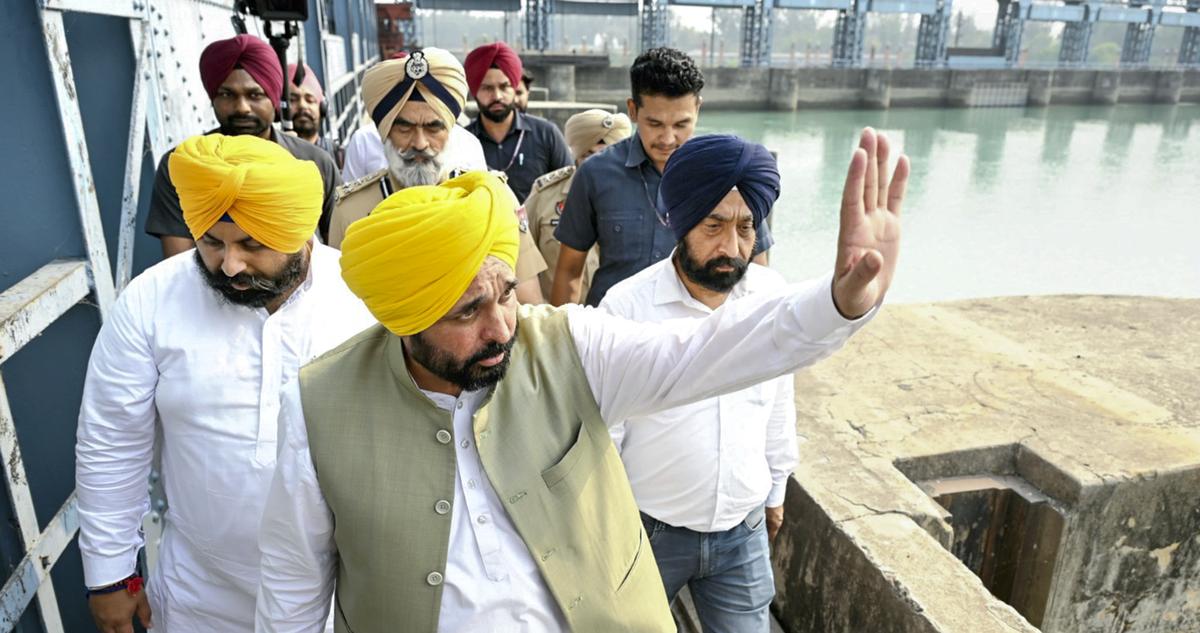
The petition highlighted heightened security measures at the Nangal dam, downstream of Bhakra, where Punjab Minister Harjot Singh Bains announced that the state had “taken control” of the dam, locking the water regulation room and entrusting the key to the police.

The Bhakra dam, a critical irrigation and drinking water source for Himachal Pradesh, Punjab, Haryana, Rajasthan, and Delhi, is managed by the BBMB, which oversees water distribution from the Bhakra, Pong, and Ranjit Sagar dams.

Despite the BBMB’s directive to release 8,500 cusecs, Punjab capped Haryana’s share at 4,000 cusecs and formally dissented, refusing compliance.

The petitioner accused Punjab of escalating tensions by deploying police to the dam area, with Chief Minister Bhagwant Singh Mann issuing provocative statements that exacerbated the law-and-order situation.

The petition described Punjab’s tactics as “inhumane” and unconstitutional, warning that blocking the Bhakra channel threatens drinking water and irrigation supplies for half of Haryana and parts of other states. It urged the High Court to intervene to protect Haryana’s rights and prevent further disruption.

On Saturday, Haryana Chief Minister Nayab Singh Saini chaired an all-party meeting in Chandigarh, attended by representatives from the BJP, Congress, Indian National Lok Dal (INLD), Jannayak Janta Party (JJP), AAP, Bahujan Samaj Party (BSP), and Communist Party of India-Marxist (CPI-M).

Punjab declined to join a concurrent BBMB meeting, citing procedural violations and requesting a postponement.

Haryana’s meeting culminated in a unanimous resolution demanding that Punjab adhere to BBMB decisions without conditions and expedite the construction of the Sutlej-Yamuna Link (SYL) canal. “We stand united to secure Haryana’s rightful water share and will pursue all legal and political measures at state and central levels,” the resolution declared.

Participants voiced alarm over an emerging drinking water crisis in Haryana, labelling Punjab’s withholding of water as “unconstitutional” and calling for the immediate lifting of restrictions.

The BBMB had recently authorized an additional 4,500 cusecs from the Bhakra Nangal dam to address urgent needs in Haryana and parts of Rajasthan, a decision endorsed by the Union government on Friday, urging Punjab’s compliance.

Addressing a press conference post-meeting, Saini condemned Punjab’s actions, accusing the AAP-led government of politicizing a national resource.

“Water is a shared asset of the nation, divided during Partition and later among states. Chief Minister Mann’s unconstitutional efforts to block Haryana’s share are deplorable,” he said.

Saini noted that Haryana is closely monitoring Punjab’s upcoming special Vidhan Sabha session on the issue and is considering options, including approaching the central government or convening a special Haryana Assembly session, to secure its water rights.

India News

Heavy rain disrupts flights, triggers flood alerts as monsoon intensifies across India

Heavy monsoon rainfall disrupted flights in Mumbai, prompted an orange alert in Delhi and led the IMD to issue heavy rain warnings for several states as a Bay of Bengal depression intensified.

Published

on

Monsoon

Heavy monsoon rainfall continued to affect several parts of the country on Sunday and Monday, disrupting air travel, inundating roads and prompting weather alerts in multiple states. The India Meteorological Department (IMD) has warned that a depression over the Bay of Bengal is likely to bring widespread heavy to very heavy rainfall across eastern India over the next 24 hours.

Mumbai bears the brunt of heavy rainfall

Mumbai experienced one of the most severe impacts of the ongoing monsoon spell after heavy overnight rain and strong winds temporarily halted runway operations at Chhatrapati Shivaji Maharaj International Airport for around an hour.

The disruption led to the cancellation of four IndiGo flights, while 13 incoming flights were diverted before operations gradually returned to normal. Flight tracking data also showed significant delays, with nearly 90 per cent of departing flights delayed by more than an hour on average and almost half of arriving flights running behind schedule.

The IMD maintained a red alert for Mumbai after several areas recorded more than 200 mm of rainfall within 24 hours, with some locations receiving close to 300 mm.

IMD forecasts widespread heavy rainfall

According to the IMD, a well-marked low-pressure area over the Bay of Bengal has intensified into a depression and is expected to cross the north Odisha coast within the next 24 hours.

The weather system is expected to bring widespread heavy to very heavy rainfall across eastern India, while several other regions continue to remain under rainfall alerts due to active monsoon conditions.

Delhi under orange alert after hottest July day in two years

The IMD has issued an orange alert for Delhi, forecasting a generally cloudy sky with moderate rainfall across the national capital.

The alert comes after Delhi recorded its hottest July day in two years on Sunday, with the maximum temperature reaching 38.6 degrees Celsius. Despite the heat, moderate showers provided temporary relief in several areas of Delhi-NCR.

Chhatarpur recorded the highest rainfall in the region, receiving 49 mm of rain by Sunday afternoon. However, waterlogging was reported in parts of the locality, affecting commuters and residents.

Heavy rain forecast for Tamil Nadu

The IMD has also forecast heavy rainfall at isolated locations in Coimbatore and the Nilgiris on Monday.

According to the Regional Meteorological Centre in Chennai, multiple weather systems, including a trough extending from south Gujarat to Kerala and the depression over the Bay of Bengal, are expected to support widespread rainfall across parts of Tamil Nadu. Other districts along the Western Ghats are also likely to receive moderate rainfall accompanied by gusty winds.

Rain-related incidents reported in Maharashtra

Heavy rainfall also led to several rain-related incidents in Maharashtra’s Thane and Palghar districts.

A 17-year-old boy drowned in the swollen Kamvari River in Bhiwandi, while two people were injured after part of a second-floor balcony collapsed in Navi Mumbai’s Vashi area. Authorities said continuous rainfall also triggered structural collapses and tree-fall incidents in several locations.

With active monsoon conditions continuing across large parts of the country, authorities have urged residents in affected regions to remain cautious and follow official weather advisories.

Continue Reading

India News

Ram Mandir Trust to hold key meeting today amid donation theft investigation

The Shri Ram Janmabhoomi Teerth Kshetra Trust is meeting in Ayodhya to deliberate on key resignations, review the ongoing donation embezzlement investigation and discuss the temple’s future administrative structure.

Published

on

The Shri Ram Janmabhoomi Teerth Kshetra Trust is scheduled to hold an important meeting on Monday in Ayodhya as investigations into the alleged embezzlement of temple donations continue. The deliberations are expected to focus on the resignations submitted by the Trust’s general secretary Champat Rai and trustee Anil Mishra, along with other administrative matters.

The meeting will be held at Mani Ram Chhawni, the monastery of Trust president Nritya Gopal Das. It will be the Trust’s first formal gathering since allegations related to the alleged theft of donations came to light.

Trust treasurer Govind Dev Giri has invited all regular and ex-officio members to participate in the meeting. The ex-officio members include Union Home Ministry Additional Secretary Prashant Lokhande, Uttar Pradesh Chief Minister’s Additional Chief Secretary Sanjay Prasad, Ayodhya District Magistrate Shashank Tripathi and former Principal Secretary to the Prime Minister Nripendra Mishra.

According to sources, Trust president Nritya Gopal Das is expected to attend the meeting after recently being discharged from hospital. The 89-year-old had been admitted in Lucknow on June 29 due to a urinary tract infection and breathing-related complications before being discharged on Friday.

Senior trustee K Parasaran, who is unable to travel because of age-related health issues, is likely to participate through video conferencing, according to sources.

Administrative changes may be discussed

The Trust is expected to consider the resignations of Champat Rai and Anil Mishra, who stepped down after their names surfaced in connection with the donation theft controversy. If the resignations are accepted, discussions may also take place on restructuring the Trust’s administrative setup.

The role of special invitee Gopal Rao is also likely to come up during the meeting. Besides leadership issues, trustees are expected to receive a briefing on the interim findings of the Special Investigation Team (SIT), which is conducting an administrative inquiry into the alleged embezzlement case.

The Trust may also review its future management framework, including the possible appointment of a chief executive officer to oversee the administration of the Ram Temple.

Financial statements to be placed before trustees

Sources said the meeting agenda also includes the presentation of the unaudited income and expenditure statement, balance sheet and other financial documents for the 2025-26 financial year for approval.

Speaking to reporters, special invitee Gopal Rao said all 14 trustees had been invited for the meeting and expressed hope that every member would attend. He added that Trust treasurer Govind Dev Giri had informed all members about the scheduled deliberations.

At present, the Trust has 11 regular members, including president Nritya Gopal Das, Vasudevanand Saraswati, Vishwaprasannatirth, Parmanand Giri, Govind Dev Giri, Krishna Mohan, Dinendra Das and K Parasaran.

Following the resignations of Champat Rai and Anil Mishra, along with the recent demise of trustee Bimlendra Mohan Pratap Mishra, the Trust currently has no vice president to chair meetings in the absence of the president.

Two parallel investigations underway

The meeting comes while two separate investigations into the alleged donation embezzlement are ongoing. The Special Investigation Team is carrying out an administrative probe, and its tenure has been extended until the end of July.

Meanwhile, the police are conducting a criminal investigation after an FIR was registered on the Trust’s complaint.

According to sources, statements of Champat Rai, Anil Mishra and special invitee Gopal Rao have been recorded by both the SIT and the police. However, no FIR has been registered against any of the three Trust functionaries so far.

Continue Reading

India News

PM Modi says India managed Hormuz crisis with minimal impact on citizens through energy diversification

Prime Minister Narendra Modi said India successfully navigated the Hormuz crisis by expanding energy imports, reducing the burden of rising fuel prices on citizens and strengthening the country’s refining capacity while inaugurating Rajasthan’s first integrated refinery.

Published

on

PM Modi

Prime Minister Narendra Modi on Saturday said India successfully managed one of the world’s most challenging energy crises by expanding its energy sourcing, strengthening diplomatic partnerships and shielding citizens from the impact of rising global fuel prices.

Addressing a public gathering after inaugurating the country’s first greenfield integrated refinery-cum-petrochemical complex in Pachpadra, Rajasthan’s Balotra district, the Prime Minister said India adopted proactive measures during the recent Middle East crisis that helped maintain energy security despite global uncertainties.

According to PM Modi, India significantly diversified its energy imports as tensions disrupted global fuel markets.

“When the crisis began, India was importing energy from around 25 to 26 countries. During the crisis, we expanded imports to more than 40 countries,” he said, crediting India’s diplomatic outreach for ensuring uninterrupted supplies.

The Prime Minister also highlighted the financial measures taken by the government to cushion consumers from soaring international crude oil prices. He said public sector oil companies absorbed losses exceeding Rs. 75,000 crore between April and June while the Centre reduced excise duty on petrol and diesel by Rs. 10 per litre to prevent a steep rise in fuel prices for consumers.

PM Modi added that despite attempts by some groups to spread rumours and create panic during the crisis, the government’s efforts ensured stability.

He said those who expected India to struggle during the crisis had been proven wrong as the country successfully overcame the challenge.

India strengthening refining capacity

Speaking about India’s energy infrastructure, the Prime Minister said the country has become the world’s fourth-largest refining hub and continues to expand its refining capabilities to meet future energy demand.

He also said the government’s long-term planning helped India deal with disruptions in fuel and fertiliser supplies triggered by the conflict involving Iran and the US-Israel alliance.

Pachpadra refinery inaugurated in Rajasthan

During the visit, PM Modi inaugurated India’s first greenfield integrated refinery-cum-petrochemical complex at Pachpadra, marking Rajasthan’s first refinery project. He launched the facility by remotely activating the project after inspecting the refinery complex.

The Prime Minister also laid the foundation stone for several development projects in the state.

Highlighting the government’s approach towards infrastructure development, PM Modi said the BJP governments focus not only on announcing projects but also on ensuring their timely completion.

He also remarked that work on the Pachpadra refinery had remained largely stalled during the Congress government’s tenure in Rajasthan between 2018 and 2023 before gaining momentum again.

Continue Reading

Trending

© Copyright 2022 APNLIVE.com