English हिन्दी
Connect with us

India News

IndiGo flight chaos deepens as over 500 services cancelled, passengers stranded for hours

Over 500 IndiGo flights were cancelled nationwide, leaving passengers stranded without food, clarity or their luggage as airports struggled to manage the disruption.


Published

on

IndiGo flight

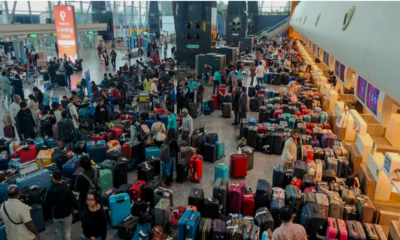
India’s largest airline continued to face massive operational breakdowns, triggering frustration among travellers at major airports across the country. From piles of unattended suitcases to passengers waiting over 12 hours without food or clarity, the disruption stretched into its fourth consecutive day.

Long delays, no communication leave passengers anguished

Several travellers at Delhi airport described the situation as “mental torture”, as thousands of unclaimed suitcases lay scattered across the terminal. Many slept on the floor, while others expressed anger over the lack of communication from airline staff.

One flier said he had been waiting for over 12 hours without any explanation: “Every time they say one-hour or two-hour delays. We were going to a wedding but don’t even have our luggage.”

A passenger in Hyderabad recounted a similar ordeal, saying the flight was delayed indefinitely with no food, water, or updates from the airline. At the airport, some travellers blocked an Air India flight in protest over the lack of arrangements.

Goa and Chennai airports also witnessed tense moments. Videos from Goa showed fliers shouting at IndiGo staff as police attempted to calm the situation. At Chennai, CISF denied entry to IndiGo passengers due to heavy congestion.

Major metro airports impacted; cascading cancellations nationwide

Flight cancellations and delays were reported across multiple airports:

  • Over 200 flights were cancelled in Delhi
  • More than 100 each in Mumbai and Bengaluru
  • Around 90 in Hyderabad
  • Dozens more in Pune, Vishakhapatnam, Chennai and Bhopal

Pune airport stated that parking bay congestion worsened the situation, as several IndiGo aircraft remained grounded due to lack of crew. Other airlines continued operations without disruption.

Airport authorities said they had mobilised additional manpower for crowd control and passenger support.

IndiGo admits planning lapses, says more cancellations expected

The airline acknowledged a “misjudgment” in assessing crew requirements under revised night-duty norms, which it said created planning gaps. Winter weather and airport congestion further aggravated the crisis.

IndiGo informed the aviation ministry and DGCA that some regulatory changes—such as the shift in night-duty timings and a cap on night landings—have been rolled back temporarily to stabilise operations.

The airline warned that cancellations may continue for another two to three days, and from December 8, schedules will be trimmed to prevent further disruption.

In a message to employees, CEO Pieter Elbers said restoring punctuality would not be an “easy target”.

Airline issues apology amid nationwide frustration

In a late-night statement, IndiGo apologised to customers and industry partners, acknowledging the widespread inconvenience caused by the disruptions. The airline said all teams were working with authorities to bring operations back to normal.

India News

India offers forensic DNA support to identify Nepal flood victims

India will make forensic laboratory facilities available for DNA profiling of first-degree relatives of people missing after Nepal’s August 26 flash floods.

Published

on

India has offered forensic laboratory support to help identify people who remain missing after the devastating flash floods in Nepal.

The Ministry of External Affairs (MEA) said central and state forensic laboratories in India will make their DNA profiling facilities available for first-degree biological relatives of people missing after the August 26 flash floods in Nepal.

DNA samples can be provided by relatives in India

According to the MEA, first-degree biological relatives living in India can have their biological samples collected and DNA profiles prepared.

The relatives can include a person’s father, mother, son, daughter or sibling. DNA profiling can be carried out at Central Forensic Science Laboratories (CFSLs), State Forensic Science Laboratories (SFSLs), laboratories of the National Forensic Sciences University (NFSU), and NABL-accredited laboratories with DNA profiling capabilities.

The initiative is intended to support Nepal’s ongoing process of identifying mortal remains recovered after the flash floods.

DNA profiles to be compared with unidentified remains

The MEA said the DNA profiling may use Autosomal STR DNA profiling, as advised by Nepal Police, subject to the technical requirements communicated by the Nepali authorities.

Once prepared, DNA profiles and the preliminary information required by Nepalese authorities can be sent to Nepal Police by email for comparison with DNA profiles obtained from unidentified mortal remains.

The Indian Embassy in Kathmandu will also facilitate coordination, with copies of the DNA profiles to be shared with the embassy for this purpose.

Nepal flood death toll rises

The death toll from the flash floods has risen to at least 1,259, according to Nepalese authorities, after rescue workers recovered additional bodies from affected areas.

More than 12,000 people have been rescued, while around 5,000 people remain missing as search and rescue operations continue.

The flash floods, which followed an ice-rock avalanche near the Nepal-Tibet border, caused extensive destruction across towns and villages in northern and central Nepal.

Continue Reading

India News

PM Modi hails ISRO after successful GSLV-F17 launch, calls it proud moment

PM Modi congratulated ISRO after GSLV-F17 successfully launched EOS-05, calling the achievement a proud moment for India.

Published

on

Prime Minister Narendra Modi on Friday congratulated the Indian Space Research Organisation (ISRO) after the successful launch of the GSLV-F17 rocket carrying the EOS-05 Earth observation satellite, describing the achievement as a proud moment for the nation.

The GSLV-F17 lifted off at 2:55 a.m. IST from the Satish Dhawan Space Centre in Sriharikota, Andhra Pradesh. The EOS-05 satellite was subsequently placed into its designated sub-geosynchronous transfer orbit.

PM Modi praises ISRO’s growing capabilities

In a post on X, PM Modi said the successful mission reflected the excellence, innovation and expanding capabilities of India’s space sector.

He also highlighted the growing partnership between ISRO and Indian industry, saying it was strengthening India’s space programme and expanding capabilities across the wider space ecosystem.

The prime minister described the successful launch of GSLV-F17 carrying EOS-05 as another outstanding achievement by ISRO and a matter of national pride.

EOS-05 strengthens earth observation capabilities

According to the report, EOS-05 is India’s first-ever imaging satellite from geosynchronous orbit. The satellite is designed to provide continuous observation of the country from an altitude of nearly 36,000 km above Earth.

The mission is expected to strengthen India’s earth observation capabilities and support advanced imaging and observation applications.

ISRO Chairman Dr V Narayanan expressed satisfaction with the mission, saying the satellite was precisely injected into its intended orbit.

Mission Director Thomas Kurian described the launch as a significant milestone for the GSLV programme. He said it was the 19th flight of the GSLV and noted that EOS-05 is the heaviest satellite the launch vehicle has placed into a geosynchronous transfer orbit or sub-GTO orbit.

GSLV-F17 launch vehicle details

The GSLV-F17 stands 51.7 metres tall and has an approximate liftoff mass of 420.5 tonnes.

Science and Technology Minister Jitendra Singh also congratulated the ISRO team following the successful mission. He described EOS-05 as a state-of-the-art Earth observation satellite capable of advanced imaging across visible, infrared, multispectral and hyperspectral bands.

Continue Reading

India News

Nagaland Assembly urges Centre to withdraw Protected Area Permit regime

Nagaland Assembly unanimously passed a resolution urging the Centre to withdraw the Protected Area Permit regime, citing concerns over tourism, investment and international engagement.

Published

on

The Nagaland Legislative Assembly has unanimously passed a resolution urging the Centre to withdraw the Protected Area Permit (PAP) regime in the state, arguing that the restrictions are affecting tourism, investment, international engagement and economic opportunities.

The resolution was moved by Deputy Chief Minister and Home Minister Yanthungo Patton and was adopted through a voice vote.

PAP regime was reimposed in 2024

The Protected Area Permit regulates the entry of foreign nationals into notified areas. The regime had been relaxed in Nagaland in 2011 but was reimposed on December 17, 2024.

During the Assembly discussion, Patton said Nagaland had emerged as a peaceful destination for tourism, culture, investment, entrepreneurship and international engagement. He said these sectors were increasingly contributing to employment and livelihood opportunities, particularly for young people.

The resolution also highlighted events and initiatives such as the Hornbill Festival and the “Land of Festivals” initiative, saying they had helped showcase Nagaland and India’s cultural diversity internationally while generating economic opportunities for local communities and entrepreneurs.

Assembly links PAP restrictions to economic concerns

The state government argued that the return of the PAP regime has complicated efforts to expand international tourism, business and investment.

The Assembly resolution said the regime was creating difficulties for international tourism, business and investment, along with cultural exchanges and overseas partnerships.

However, the state maintained that relaxing the permit regime would not mean compromising national security.

The resolution assured the Centre that foreign nationals could continue to be registered, regulated and monitored through technology-based and institutional mechanisms in coordination with central agencies.

Neiphiu Rio backs review of PAP regime

Chief Minister Neiphiu Rio also participated in the debate along with Tourism and Higher Education Minister Temjen Imna Along, Industries and Commerce Advisor Hekani Jakhalu and MLA Naiba Konyak.

The legislators maintained that Nagaland’s present circumstances warranted a different approach, stressing that the state was peaceful and seeking greater opportunities in tourism, investment and other sectors.

Rio linked the demand to Nagaland’s economic aspirations and the need to create more opportunities for young people while maintaining the state’s commitment to national security.

“Security and development can go together,” Rio said.

The resolution further argued that regulations that have outlived their developmental relevance should not become barriers to employment, economic activity and Nagaland’s participation in the wider national and global economy.

Continue Reading

Trending

© Copyright 2022 APNLIVE.com