English हिन्दी
Connect with us

India News

Iran opens airspace to facilitate evacuation of 1,000 stranded Indian students

Published

on

Iran has granted India exclusive access to its restricted airspace for emergency evacuation flights under Operation Sindhu, enabling the rescue of over 1,000 Indian students stranded in conflict-ravaged Iranian cities. The Ministry of External Affairs (MEA) announced that the first flight is set to arrive in Delhi at 11:00 PM IST tonight, with two more scheduled for Saturday morning and evening.

The unprecedented airspace corridor comes as Iran’s skies remain closed to most international flights due to ongoing missile and drone exchanges with Israel. The conflict, which intensified after Israel’s Operation Rising Lion targeted Iran’s nuclear facilities, has triggered retaliatory strikes from Tehran, including hypersonic missile attacks on Israeli military sites, with over 20 civilian deaths reported in Israel.

India launched Operation Sindhu on Wednesday to evacuate its nationals from Iran as the Israel-Iran conflict showed no signs of abating. The MEA, prioritising the safety of Indian citizens abroad, confirmed that around 4,000 Indians, half of them students, reside in Iran. The Indian Embassy in Tehran, coordinating closely with Iranian authorities, facilitated the evacuation after reports of injuries among Indian students.

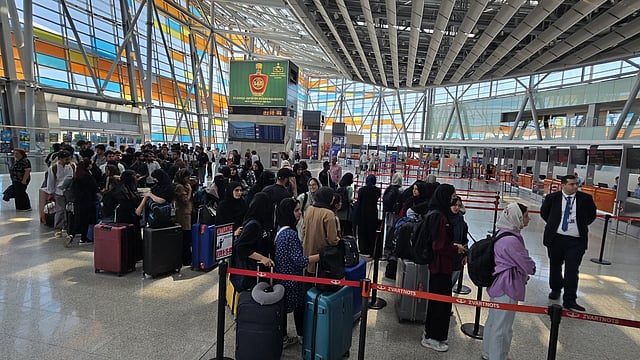
Earlier this week, 110 students from Urmia Medical University in Iran’s West Azerbaijan province, near the Turkish border, were safely transported by road to Yerevan, Armenia. They boarded a special flight on 18 June at 14:55 hrs, landing in Delhi early on 19 June. The Jammu and Kashmir Students’ Association noted that 90 of these evacuees hail from the union territory.

“The Indian government extends gratitude to Iran and Armenia for their cooperation in ensuring the safe passage of our nationals,” an MEA spokesperson said. The operation underscores India’s swift response to the crisis, with eyewitnesses reporting Israeli airstrikes near Tehran on Wednesday, targeting a nuclear facility, while Iranian state media confirmed retaliatory missile launches.

Continue Reading

India News

Assam makes Muslim marriage registration compulsory under new rules

Assam has approved rules for compulsory registration of Muslim marriages, with couples able to register through government marriage registrars.

Published

on

The Assam Cabinet has approved the Assam Muslim Marriage Registration (Compulsory) Rules, 2026, establishing the procedure for mandatory registration of Muslim marriages in the state.

The rules operationalise the Assam Compulsory Registration of Muslim Marriages and Divorces Act, 2024, which replaced the earlier Assam Muslim Marriages and Divorces Registration Act, 1935.

Who will register Muslim marriages in Assam?

Chief Minister Himanta Biswa Sarma said Muslim couples will now be able to register their marriages with government marriage registrars.

The government had earlier decided that kazis would not register Muslim marriages under the new system, but there was uncertainty over who would carry out the registration. The newly approved rules establish the registration mechanism through marriage registrars.

Sarma said that if the number of applications becomes large, the government could give marriage-registration powers to officers at the panchayat level so that applicants do not face difficulties.

What does the 2024 law say?

The 2024 Act made the registration of Muslim marriages and divorces with the government mandatory. It also prohibits registration of marriages that do not meet the legally prescribed minimum age requirements.

The law specifies the minimum marriage age as 18 years for females and 21 years for males.

The legislation was introduced by the Assam government with the stated objective of curbing child marriage and ending the earlier kazi-based registration system.

Under the previous 1935 law, marriage registration was conducted through kazis and was not compulsory. The earlier system also allowed registration involving minors in certain circumstances, while the new law does not permit such registration.

Registration timeline and penalties

The 2024 legislation provides that Muslim marriages should be registered within 30 days of the marriage. It also provides for registration of divorces within one month of their occurrence.

The law also contains penalties for violations. Producing fake or forged certificates can attract imprisonment of up to two years, a fine of up to Rs. 10,000, or both, along with action under relevant provisions of the Bharatiya Nyaya Sanhita, 2023.

Registering a marriage in violation of the law can attract imprisonment of up to one year and a fine of up to Rs. 50,000.

The Assam Cabinet’s approval of the 2026 rules provides the administrative framework for implementing the compulsory registration system.

Continue Reading

India News

Trump-Xi Summit: Trade, Taiwan and AI among key takeaways

Trade, Taiwan, artificial intelligence and strategic rivalry were among the key issues highlighted during Donald Trump’s summit with Xi Jinping in Washington.

Published

on

Trump-Xi Summit

US President Donald Trump and Chinese President Xi Jinping met at the White House amid discussions on trade, artificial intelligence and the broader strategic relationship between the United States and China.

The summit came as Washington and Beijing continued to navigate disagreements over tariffs, Chinese purchases, rare-earth supplies, technology restrictions and Taiwan.

Here are five key takeaways from the Trump-Xi summit.

Trade truce gets an extension

The United States and China agreed to extend their trade truce by two months, giving both sides additional time for negotiations.

US Treasury Secretary Scott Bessent said the extension would provide Washington and Beijing more time to work on economic issues. However, several major questions remain part of the negotiations, including tariffs, Chinese purchases, rare-earth supplies and technology restrictions.

Bessent said China was meeting its earlier commitment to buy 25 million tonnes of US soybeans but was behind its pledge to purchase $17 billion worth of other agricultural goods.

US officials have also said that Chinese rare-earth deliveries were falling short.

Taiwan remains a major point of tension

Taiwan was another important issue during the discussions.

Xi Jinping pressed Trump on Taiwan and urged the United States to handle the issue with “prudence”, according to China’s official news agency. Its English-language service also said Xi hoped Washington would oppose Taiwanese independence.

The report noted that the US has traditionally said it does not support Taiwanese independence, while avoiding an explicit statement that it opposes it.

There was no immediate White House readout of the exchange on Taiwan.

Trump and Xi differ on AI

Artificial intelligence was another area where the two leaders expressed different positions.

Trump has said he wants to avoid new AI guardrails and instead rely on the US Department of Justice. He has also maintained that China shares this approach.

Xi, however, said the United States and China have both the capability and responsibility to develop and manage AI for good.

He said AI development should remain under human control and serve people’s well-being.

The contrasting positions underline the importance of AI and technology in the broader US-China relationship.

Strategic rivalry remains a concern

Xi also referred to the “Thucydides Trap”, a theory associated with the risk of conflict between a rising power and an established one.

He argued that competition between the United States and China should be about catching up rather than a contest in which one side must defeat the other.

Xi said the risks could be overcome and called for regular military dialogue and stronger mechanisms to prevent crises.

Trump, meanwhile, highlighted areas where the two countries could cooperate, referring to their shared wartime history and common interests.

Summit also featured elaborate ceremony

The White House visit was accompanied by an elaborate display of ceremony.

The programme included military performances, fighter jets and bombers flying overhead, as well as the recently redesigned South Lawn and a large helipad bearing the presidential seal.

The highly publicised setting contrasted with the unresolved differences between Washington and Beijing on trade, Taiwan, technology and strategic issues.

The summit therefore highlighted both the effort to maintain dialogue between the two powers and the significant issues that remain unresolved.

Continue Reading

India News

 Akhilesh Yadav launches SP’s 2027 UP poll campaign from Rahul Gandhi’s seat

Akhilesh Yadav launched the Samajwadi Party’s 2027 Uttar Pradesh Assembly election campaign from Rae Bareli, represented by Rahul Gandhi in the Lok Sabha.

Published

on

Akhilesh Yadav

Samajwadi Party chief Akhilesh Yadav has formally begun the party’s campaign for the 2027 Uttar Pradesh Assembly elections, launching the outreach from Rae Bareli, the Lok Sabha constituency represented by Congress leader Rahul Gandhi.

Yadav travelled through the area on the party’s newly launched PDA Rath before addressing a public meeting. The campaign vehicle carries the Samajwadi Party’s PDA messaging, referring to its focus on backward classes, Dalits and minorities.

Akhilesh Yadav discusses alliance with Congress

During his Rae Bareli visit, Yadav said the Samajwadi Party would contest the 2027 election as part of an alliance and indicated that seat-sharing would be decided on the basis of winnability.

He said the party would give a seat to whichever alliance partner is considered capable of winning it. The remarks come against the backdrop of the SP and Congress having contested the 2024 Lok Sabha election together in Uttar Pradesh.

Rae Bareli has particular political significance for the Congress as Rahul Gandhi is its sitting Lok Sabha MP. Yadav’s decision to begin the campaign from the constituency therefore placed the SP’s alliance with the Congress in focus.

PDA Rath becomes centrepiece of campaign

The PDA Rath was rolled out as part of the SP’s mobilisation ahead of the 2027 Assembly election. The vehicle prominently carries the party’s PDA messaging, with PDA standing for Pichhde, Dalit and Alpsankhyak.

The campaign is aimed at taking the SP’s social-justice messaging to voters across Uttar Pradesh as the party prepares for the Assembly election.

During the programme, Yadav also attacked the BJP and raised issues including the Election Commission and what he described as the alleged misuse of election machinery. These are political allegations made by the SP chief and should be understood as such.

BJP reacts to Akhilesh Yadav’s campaign

The launch of the PDA Rath comes as political activity intensifies in Uttar Pradesh ahead of the 2027 Assembly election.

The BJP has responded to Yadav’s campaign and his political messaging, while the SP has continued to focus its outreach on the PDA social coalition and its alliance strategy with the Congress.

The 2027 contest is still ahead, with parties using the period before the election to strengthen their organisational networks, public outreach and alliance arrangements.

Continue Reading

Trending

© Copyright 2022 APNLIVE.com