
India News
Iranian President Rouhani arrived in Hyderabad before reaching Delhi


[vc_row][vc_column][vc_column_text]Iran’s president Hassan Rounahi has arrived in Hyderabad Thursday afternoon. He was welcomed by Minister of State for Power R. K. Singh at Begumpet airport. He will address intellectuals and clerics in Thursday evening and speak at Mecca Msjid after Friday prayer, before he arrives in the capital in the evening.[/vc_column_text][/vc_column][/vc_row][vc_row][vc_column][vc_raw_html]JTNDYmxvY2txdW90ZSUyMGNsYXNzJTNEJTIydHdpdHRlci10d2VldCUyMiUyMGRhdGEtbGFuZyUzRCUyMmVuJTIyJTNFJTNDcCUyMGxhbmclM0QlMjJlbiUyMiUyMGRpciUzRCUyMmx0ciUyMiUzRUlyYW5pYW4lMjBQcmVzaWRlbnQlMjBIYXNzYW4lMjBSb3VoYW5pJTIwYXJyaXZlcyUyMGluJTIwVGVsYW5nYW5hJTI2JTIzMzklM0JzJTIwSHlkZXJhYmFkLiUyMEhlJTIwd2lsbCUyMG9mZmVyJTIwRnJpZGF5JTIwcHJheWVycyUyMGF0JTIwTWFra2FoJTIwTWFzamlkJTIwdG9tb3Jyb3cuJTIwSGUlMjB3aWxsJTIwYWxzbyUyMHZpc2l0JTIwR29sY29uZGElMjBGb3J0JTIwYW5kJTIwU2FsYXIlMjBKdW5nJTIwTXVzZXVtLiUyMCUzQ2ElMjBocmVmJTNEJTIyaHR0cHMlM0ElMkYlMkZ0LmNvJTJGZ1lCWmliWWJZdSUyMiUzRXBpYy50d2l0dGVyLmNvbSUyRmdZQlppYlliWXUlM0MlMkZhJTNFJTNDJTJGcCUzRSUyNm1kYXNoJTNCJTIwQU5JJTIwJTI4JTQwQU5JJTI5JTIwJTNDYSUyMGhyZWYlM0QlMjJodHRwcyUzQSUyRiUyRnR3aXR0ZXIuY29tJTJGQU5JJTJGc3RhdHVzJTJGOTY0MDk5NzA4NzE2MjQwODk2JTNGcmVmX3NyYyUzRHR3c3JjJTI1NUV0ZnclMjIlM0VGZWJydWFyeSUyMDE1JTJDJTIwMjAxOCUzQyUyRmElM0UlM0MlMkZibG9ja3F1b3RlJTNFJTBBJTNDc2NyaXB0JTIwYXN5bmMlMjBzcmMlM0QlMjJodHRwcyUzQSUyRiUyRnBsYXRmb3JtLnR3aXR0ZXIuY29tJTJGd2lkZ2V0cy5qcyUyMiUyMGNoYXJzZXQlM0QlMjJ1dGYtOCUyMiUzRSUzQyUyRnNjcmlwdCUzRSUwQQ==[/vc_raw_html][/vc_column][/vc_row][vc_row][vc_column][vc_column_text]Before leaving from Tehran, President Rouhani said that during his stay in India he and his accompanying team will discuss with the Indian officials ways to enhance bilateral relations in an array of fields.
While speaking to journalists at Tehran airport before leaving for Hyderabad (India) , Rouhani said that officials of the two countries will examine development of relations in areas like economy, culture, communications and information technology, healthcare, industry and agriculture.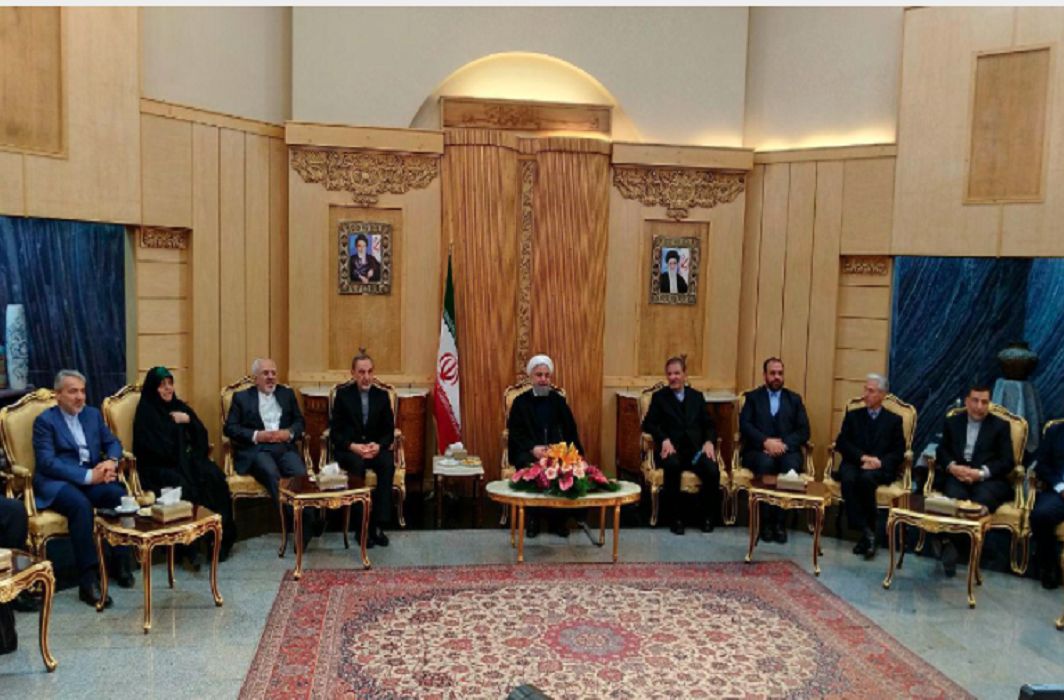
According to official IRNA, President Rouhani also said that one of the top issues expected to be discussed between the two countries, is development of transit cooperation between the two nations.
Development of the Chabahar Port city in southern Iran and connecting India to Afghanistan and Central Asia is of great importance to India based on the agreement signed by the presidents of Iran, India and Afghanistan regarding the issue, President Rouhani said.
Rouhani heading a politico-economic delegation departed Tehran for India on Thursday upon the invitation of the Prime Minister Shri Narendra Modi.
While talking about the cooperation on Chabahar port, President Rouhani said, “Recently, the developed phase of Shahid Beheshti Port in Chabahar was opened in presence of officials from 17 countries,” adding that the capacity of the port will be raised to 8.5 million tons in the next phases.
He further said that ‘Iran and India also share concerns, including terrorism, as both are members of The Non-Aligned Movement (NAM).’
“The two countries are on the same positive, right track,” Rouhani said, expressing hope that his visit to India will serve as complementary to the visit to Iran by Prime Minister Modi in May 2016.
The report from Tehran says that the accompanying dignitaries with President Rouhani include Foreign Minister Mohammad Javad Zarif, Minister of Petroleum Bijan Zanganeh, Minister of Road and Urban Development Abbas Akhundi, Minister of Industry, Mines and Trade Mohammad Shariatmadari and Chief of staff of Iran’s President Mahmoud Vaezi.
Diplomats in New Delhi say Iran’s President Hassan Rouhani will try to encourage Indian businesses to invest “billions of dollars” in the Islamic Republic during his three-day visit.
Top on the agenda of Rouhani’s visit would be the completion of Iran’s Chabahar port by India as well as discussions over a potential deal for Indian companies to develop an offshore gas field in Iran.
India is trying to develop the port of Chabahar on Iran’s east coast as a way to gain access the markets of central Asia as well as Afghanistan by by-passing arch-rival Pakistan.
The Chabahar port is about 72 km from the Pakistani port of Gwadar, which China is developing, Reuters wrote in a report on Rouhani’s visit.
India’s Prime Minister Narendra Modi earlier said his government could spend up to $500 million on the port, India’s first major overseas port venture, as it tries to offer alternatives to China’s One Belt One Road initiative to build trade and transport links across Asia.
Another key project that could be on top of Rouhani’s discussions with Indian officials during his stay would be the development of Iran’s Farzad B gas field by Indian companies.
India wants to develop the gas field discovered by Oil and Natural Gas Corp (ONGC) a decade ago. However, Iran says the terms it has offered are not profitable.
Iran’s Ambassador to India Gholamreza Ansari has recently said, “There are a number of projects for expansion of ties in the pipeline that not only will be in the interests of both nations but also in the interest of the region.,”
Iran is India’s third oil supplier. The country imported 12.5 million tonnes of crude from the Islamic Republic in the period running from April 2017 to October 2018.[/vc_column_text][/vc_column][/vc_row]










India News
Delhi Police offers 11-person limit for CJP’s Connaught Place protest
Delhi Police has offered to facilitate a group of 11 people at Central Park in Connaught Place for the Cockroach Janata Party’s October 16 protest, while warning that violations of prohibitory orders could invite legal action.


India News
Actor Imran Khan asked to leave India after CJP protest
Actor Imran Khan has been asked to leave India by October 28, days after participating in a protest called by the Cockroach Janta Party (CJP) in Mumbai.

India News
Election Commission orders voter roll revision in 17 states, UTs
The Election Commission has ordered a Special Summary Revision of electoral rolls in 17 states and Union Territories. Draft rolls are scheduled for November 12, with final rolls due on January 4, 2027.


Dhruv Rathee gets fresh summons in 2018 BJP IT cell video case

Nobody can browbeat judiciary, Chief Justice warns over Rahul Gandhi’s march

India-US trade deal first phase finalised, drafting underway

Election Commission orders voter roll revision in 17 states, UTs

Actor Imran Khan asked to leave India after CJP protest

Delhi Police offers 11-person limit for CJP’s Connaught Place protest
Actor Imran Khan asked to leave India after CJP protest
Election Commission orders voter roll revision in 17 states, UTs
India-US trade deal first phase finalised, drafting underway
Nobody can browbeat judiciary, Chief Justice warns over Rahul Gandhi’s march

Afghan Men Try To Hang With The Jet Engine Of The Aircraft in Kabul- Afghanistan News – Kabul News
Trending Top 10 News: 10000 Crore Fine on Flipkart, Apple to Launch Unique Feature, Hdfc Bank Job Ad

Trending Top 10 News: Nokia 6310, Apple sales, Bachpan ka Pyar Video Kid, Dainik Bhaskar IT Raid

Trending Top 10 News: Canada bans Indian flights, Rain in Delhi NCR, AIMIM Twitter hacked, Raj Kundra case

Trending Top 10 News: Shein India, Apple New Service, Pocket Oxygen, Oppo Launched New Phone
-
 India News15 hours ago
Dhruv Rathee gets fresh summons in 2018 BJP IT cell video case
-
 India News11 hours ago
Nobody can browbeat judiciary, Chief Justice warns over Rahul Gandhi’s march
-
 India News7 hours ago
India-US trade deal first phase finalised, drafting underway
-
 India News5 hours ago
Election Commission orders voter roll revision in 17 states, UTs
-
 India News4 hours ago
Actor Imran Khan asked to leave India after CJP protest
-
 India News3 hours ago
Delhi Police offers 11-person limit for CJP’s Connaught Place protest
