English हिन्दी
Connect with us

India News

Jammu and Kashmir parties observe August 5 as Black Day, hold protests over Article 370

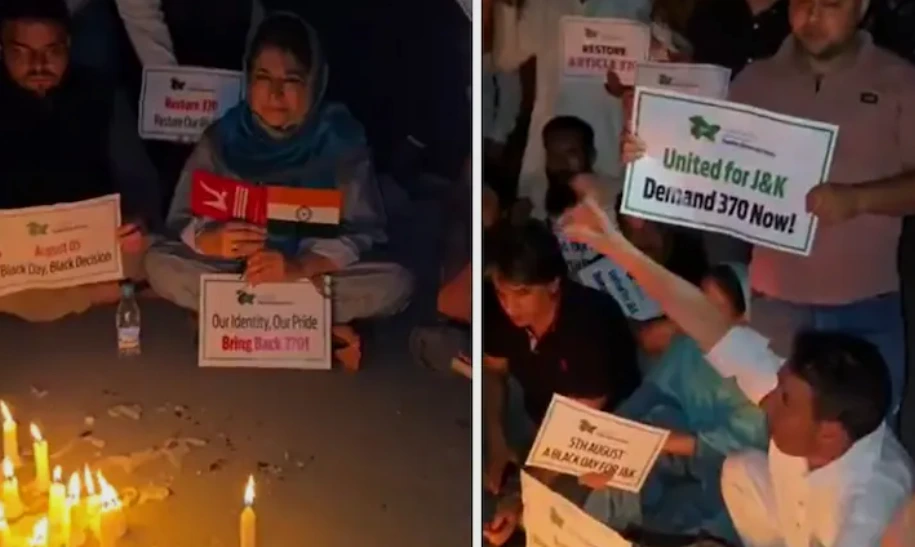
Political parties in Jammu and Kashmir observed August 5 as “Black Day” on the anniversary of Article 370’s abrogation. The National Conference and PDP held protests, renewed demands for restoration of statehood, and criticised the Centre over the continued Union Territory status.

Published

on

August 5 marked the seventh anniversary of the abrogation of Article 370, with major political parties in Jammu and Kashmir observing the day as “Black Day” and organising protests across the Union Territory.

Article 370, which granted special constitutional status to the former state of Jammu and Kashmir, was revoked through a Presidential Order on August 5, 2019. The move also led to the reorganisation of the state into the Union Territories of Jammu and Kashmir and Ladakh.

While the BJP commemorates the date as a milestone in Jammu and Kashmir’s integration with the rest of the country, regional parties including the National Conference (NC) and the Peoples Democratic Party (PDP) continue to oppose the decision.

PDP stages candlelight protest, demands Article 370 restoration

On the eve of the anniversary, the Peoples Democratic Party, led by Mehbooba Mufti, organised a candlelight march in Srinagar. Party members alleged that Mufti’s daughter, Iltija Mufti, was detained during the protest.

Addressing supporters, Mehbooba Mufti described the occasion as a “black night” for Jammu and Kashmir and said the party would continue its protests until the Jammu and Kashmir issue is resolved and Article 370 is restored.

The PDP has also announced protest programmes across various districts of the Union Territory.

National Conference calls August 5 ‘Black Day’

The ruling National Conference also organised demonstrations at its headquarters in Srinagar and in district units across Jammu and Kashmir.

Senior National Conference leader Rattan Lal Gupta said the party observes August 5 as “Black Day” to protest what it described as the unilateral abrogation of Jammu and Kashmir’s constitutional guarantees. He also criticised the Centre for not restoring statehood despite repeated assurances.

National Conference MP Chowdry Ramzan has invited members of the INDIA bloc to participate in a protest outside Parliament in New Delhi. While several opposition parties have largely remained silent on the Article 370 decision itself, many have supported the demand for the restoration of Jammu and Kashmir’s statehood.

Statehood remains a key political demand

The demand for restoring Jammu and Kashmir’s statehood has remained central to the National Conference’s political campaign.

Recently, Chief Minister Omar Abdullah and National Conference president Farooq Abdullah led a protest in Delhi seeking the restoration of statehood.

The Centre had informed the Supreme Court in 2023 that Jammu and Kashmir’s Union Territory status was temporary and that statehood would be restored after Assembly elections.

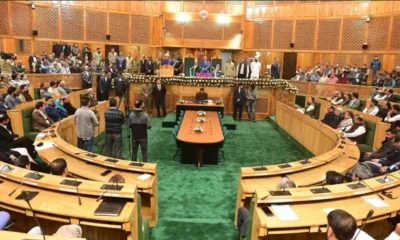
Assembly elections were held in September 2024. Following the formation of the government, the Omar Abdullah-led cabinet passed a resolution seeking restoration of statehood. The Jammu and Kashmir Assembly later also passed a resolution calling for the restoration of the region’s special status.

BJP defends 2019 decision

The BJP has consistently maintained that the abrogation of Article 370 and the reorganisation of Jammu and Kashmir have strengthened national integration, reduced terrorism and improved normalcy in the region.

However, the National Conference has questioned those claims, citing recent terrorist attacks and arguing that security concerns remain.

India News

Himanta Sarma accuses Sonia, Rahul of provoking unrest over Vande Mataram row

Assam CM Himanta Biswa Sarma criticised Sonia and Rahul Gandhi over the Vande Mataram controversy and accused Congress of provoking unrest.

Published

on

Himanta sharma

Assam Chief Minister Himanta Biswa Sarma on Monday criticised Congress leaders Sonia Gandhi and Rahul Gandhi over the controversy surrounding the rendition of Vande Mataram at the party headquarters in New Delhi on Independence Day.

Sarma questioned how the Congress would govern if it returned to power, alleging that the conduct of its senior leaders during the national song had raised concerns.

“During Vande Mataram, the way Sonia Gandhi behaved and the song was stopped midway clearly indicates that if Congress mistakenly comes to power, the country will face a worse situation,” Mr Sarma said.

The Assam Chief Minister also accused Sonia Gandhi and Rahul Gandhi of encouraging protests in the name of Gen Z.

“Sonia Gandhi and Rahul Gandhi have almost taken a decision to oppose the country in the name of Gen Z. They are provoking people to protest and trying hard to create a bad environment in the country,” he said.

Sarma further alleged that such actions could contribute to instability in the country.

“I am not bothered about these things, but these people are working against the country and provoking the people of the country to protest and bring anarchy,” he said.

What triggered the Vande Mataram controversy

The political row erupted after footage from the Congress Independence Day programme on August 15 surfaced on social media. The video showed senior Congress leaders, including Sonia Gandhi, Rahul Gandhi and Mallikarjun Kharge, during the rendition of Vande Mataram.

BJP leaders have interpreted gestures seen in the footage as an attempt to interrupt the national song. The Congress, however, has rejected that interpretation.

The issue has since become a political flashpoint, with BJP leaders accusing the Congress of disrespecting Vande Mataram.

A complaint seeking action against Sonia Gandhi and Rahul Gandhi over the alleged disruption is also being examined by the Delhi Police.

Continue Reading

India News

BJP unveils 64-member national team with 3 former CMs, 18 MPs and 10 women

The BJP’s new 64-member national team includes three former chief ministers, 18 sitting MPs and 10 women, with representation from 23 states and Union Territories.

Published

on

The BJP’s new 64-member team of national office bearers brings together former chief ministers, sitting MPs, women leaders and representatives from different social and regional groups as the party prepares for the 2029 Lok Sabha election.

The team, headed by BJP national president Nitin Nabin, includes three former chief ministers, 18 sitting MPs and 10 women leaders. More than 40 per cent of the members belong to deprived communities, according to the details of the appointments.

Northeast gets special focus

The new organisational team includes leaders from 23 states and Union Territories, giving the party’s national leadership a broad geographical representation.

The Northeast has received particular attention, with three leaders from Tripura, Assam and Nagaland included in the team. The BJP’s North-East Coordination Cell will also continue to function under the leadership of Sambit Patra.

The team includes four tribal representatives, with one each from West Bengal, Madhya Pradesh, Maharashtra and the Northeast. Two of these representatives are women.

Three members from Uttar Pradesh, Tamil Nadu and Madhya Pradesh represent the Scheduled Castes in the new team.

Representation across communities

The BJP’s national office bearers also include 10 experienced women leaders from different parts of the country.

The team has representation from different religious communities, including one Sikh, two Christians, one Muslim, one Jain and one Parsi member, alongside Hindu leaders.

Former chief ministers and MPs add experience

The organisational team brings considerable administrative and political experience, with former Rajasthan Chief Minister Vasundhara Raje, former Uttarakhand Chief Minister Tirath Singh Rawat and former Tripura Chief Minister Biplab Kumar Deb among the members.

Four leaders with previous experience in the Union government and one sitting Union minister are also part of the team.

The new national office bearers include 18 sitting Lok Sabha and Rajya Sabha members, bringing legislative experience and their connection with constituencies to the organisation.

Professionals and younger leaders add to the team

The team also brings together people from varied professional and academic backgrounds. It includes two professors, four practising doctors, as well as PhD holders, engineers, chartered accountants and lawyers.

The appointments to various Morchas are expected to bring organisational experience, fresh energy and domain expertise to the BJP’s national team.

Continue Reading

India News

Air India drug test row: 2 more pilots fail preliminary screening

Two more Air India pilots have not cleared preliminary drug tests and have been de-rostered while their final test results are awaited, sources said.

Published

on

Two more Air India pilots have not cleared the preliminary stage of drug testing ordered by the airline following the Phuket-Delhi flight incident. Their final test results are awaited, and both pilots have been de-rostered in the meantime, sources said.

The airline had directed its pilots to undergo drug testing as part of a new standard operating procedure after the pilot-in-command of the Phuket-Delhi flight failed two urine tests conducted after the aircraft landed. Marijuana was detected in his system.

More than 300 Air India pilots have undergone the testing process so far. Sources said final drug-test results generally take around 24 to 48 hours.

A cabin crew member on the Phuket-Delhi flight was also believed to have filed a complaint alleging that the pilot had previously smoked “pot”.

What happened on the Phuket-Delhi flight

The incident involved an Airbus A320neo that experienced a sudden drop of around 300 feet. The aircraft’s system data indicated a simultaneous loss of control of key flight surfaces, including the elevators and ailerons, for about four seconds.

The spoilers also lost control following the same hydraulic failure.

During the four-second period, the aircraft’s elevators and ailerons moved without pilot commands after multiple failures involving the jet’s three hydraulic systems.

The elevators control the aircraft’s pitch, while ailerons help control its roll. Spoilers reduce lift and increase drag, including during descent and landing.

Air India’s earlier statement on drug testing

The incident was initially reported as being linked to turbulence, before aircraft system data provided further information about what had occurred.

Air India had said it conducts regular drug testing of crew members in accordance with civil aviation regulations. The airline said the testing was part of its existing compliance process and was not initiated specifically because of the Phuket-Delhi flight incident.

Continue Reading

Trending

© Copyright 2022 APNLIVE.com