English हिन्दी
Connect with us

India News

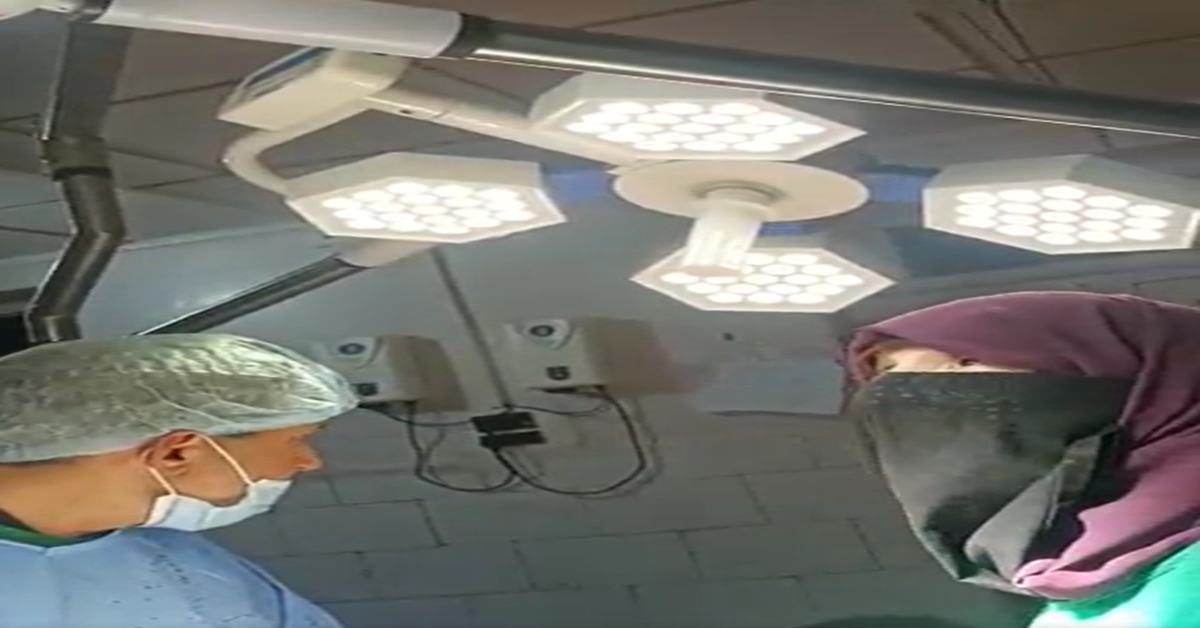
Video of doctor’s response to quake during C–section operation in Kashmir goes viral, users laud the doctor | Watch

As the earthquake continued for several seconds, the lights also went out, however, the staffers irrespective of the threat, kept reiterating that everything is okay and affirming the family and the patient throughout the operation. The family members can also be seen praying to god in a bid to not let the earthquake take an awry turn.

Published

on

operation during Earthquake in Jammu and Kashmir

As the quake shook up the nation and various parts of the country, a brave and heart-warming story has come to light from Kashmir’s hospital. The video shows the response by the brave-hearted doctors who prioritized on the patient and the baby while facing the earthquake.

In the video, the healthcare workers and doctors can be seen operating and performing a C-section just as the earthquake struck. After realizing that there is an earthquake, the doctor’s first instruction to his staffers was to protect the baby.

As the earthquake continued for several seconds, the lights also went out, however, the staffers irrespective of the threat, kept reiterating that everything is okay and affirming the family and the patient throughout the operation. The family members can also be seen praying to god in a bid to not let the earthquake take an awry turn.
Read Also: Delhi Police crackdown on anti-Modi posters, police arrest 4 including owner of printing press, 44 cases registered

Watch video here:

Twitter reactions

After the video went viral many users came forward to add their take on the incident as one user wrote and praised the staff for their response to the quake. The user praised the staff for their smooth execution during the earthquake and also lauded their professionalism and dedication to their patient care.

One user also wrote and praised the team by terming their work as brave. Another user also wrote and highlighted how composed the staff was in handling such a situation.

One user wrote and highlighted how commendable it is to witness the dedication and unwavering commitment of medical professionals toward ensuring the well-being of their patients, even in the face of unprecedented challenges.

One user also wrote and urged the authorities to reward the doctors for the way their commitment remained unwavering throughout the quake and also for safeguarding the lives of the newborn and the patient.

Punjab Police issues lookout circular, non-bailable warrant against fugitive Khalistani leader Amritpal Singh

Gurugram woman duped of Rs 20 lakh by conmen impersonating Mumbai Police

India News

Nepal flash floods: Glacial collapse, not earthquake, triggered disaster clarifies USGS

The USGS clarified that seismic activity initially reported as an earthquake was caused by a glacial collapse and debris flow that triggered deadly flash floods in Nepal.

Published

on

The tremors associated with the deadly flash floods in Nepal on Wednesday morning were caused by a powerful landslide involving ice and rock, rather than an earthquake, the United States Geological Survey (USGS) clarified.

The agency said the seismic activity initially reported as an earthquake “was instead a glacial collapse and debris flow” that caused catastrophic impacts downstream.

The USGS had initially reported seismic activity along the Nepal-China border, north of Kathmandu. It later clarified that the event was not an earthquake.

“No earthquake had occurred,” the agency said.

Landslide triggered debris-laden flood

An initial study of satellite imagery from Planet Labs indicated that a landslide involving ice and rock triggered a debris-laden flood in the Lhende River.

The landslide occurred about 20 km northeast of the Nepal-China Rasuwagadhi border crossing.

The Lhende Khola River is a tributary of the Bhote Koshi River, which flows from China into Nepal. The powerful landslide sent debris and water downstream, triggering the flash floods.

The event was later registered as seismic activity equivalent to an earthquake measuring 5.2 in magnitude.

157 bodies recovered in Nepal

Relief and rescue operations are underway in Rasuwa and other affected areas following the floods.

Nepal Police have recovered 157 bodies, while authorities are working to move families living in flood-risk areas to safer locations.

At least 403 tourists, including 341 foreigners, were reported unaccounted for several hours after the disaster, according to the tourism ministry.

The missing foreigners included 142 Indians, along with nationals from Australia, Britain, Malaysia, the Netherlands, Portugal, South Africa, South Korea and the United States, according to the tourism board.

Rescue teams are searching for survivors and bodies buried under mud and debris. Prime Minister Balendra Shah has pledged government resources for relief and rescue operations.

Floods hit several districts

The flood surged through the Bhote Koshi River at around 9 am local time after crossing over from the Tibet side.

Rasuwa and Dhading, which border Tibet, along with Nuwakot, were among the affected districts.

In Tibet, China’s state broadcaster reported that three people were killed and 265 were missing in Gyirong. It said the deaths were still being verified and rescue operations were continuing.

Security footage from the Nepal-Tibet border showed people fleeing moments before a torrent of rock, mud and water swept through the area, destroying buildings and vehicles.

Families search for missing relatives

Residents from affected areas of Nuwakot and Dhading gathered outside a Nepali Army training centre that was being used as a base for helicopter rescue operations.

People sought information about relatives who remained missing after the floods. Police were recording the names of missing people outside the barracks as the area remained without electricity because of damage to hydropower infrastructure.

Across the affected areas, houses, trees and vehicles were submerged or buried beneath mud and debris.

Helicopters continued rescue operations, bringing survivors out of the flood-hit areas.

Continue Reading

India News

Haryanvi Singer Ankit Balyan shot dead outside Gym in Shamli

Haryanvi singer and YouTuber Ankit Balyan was shot dead by unidentified assailants outside a gym in Shamli, Uttar Pradesh.

Published

on

Ankit Balyan

Haryanvi singer and YouTuber Ankit Balyan was shot dead by unidentified assailants outside a gym in Uttar Pradesh’s Shamli district on Wednesday evening, police said.

The incident took place in the Kotwali police station area when Balyan was coming out of the gym. According to police, the attackers arrived on two motorcycles and opened several rounds of fire at him. Balyan died at the spot.

Police launch probe into killing

Following the shooting, police reached the spot and began an investigation into the killing.

Shamli Superintendent of Police M P Singh said the body had been sent for post-mortem examination. Police teams have also been formed to arrest the accused.

Investigators are examining CCTV footage from the area to identify the attackers and trace their movements.

Speculation over possible motive

There has been speculation that Balyan was planning to contest the upcoming panchayat polls. However, there was no official confirmation from authorities or his associates that this was connected to the killing.

Samajwadi Party chief Akhilesh Yadav condemned the murder and called for the possibility of political rivalry to be investigated. He also criticised the law-and-order situation in Uttar Pradesh and described the incident as an attack on the Jat community.

Ankit Balyan’s YouTube presence

Balyan was a singer and YouTuber with more than 3.66 lakh subscribers. He appeared in videos as a singer and performer alongside different collaborators.

Several of his videos featured guns, firearms and SUVs. His killing has prompted police to investigate the circumstances surrounding the shooting and identify those responsible.

Continue Reading

India News

Nepal flash floods trigger flood alert in Bihar and Uttar Pradesh

Flash floods in Nepal’s Rasuwa district have prompted Bihar and Uttar Pradesh authorities to step up monitoring as a possible rise in Gandak and Narayani river levels raises flood concerns.

Published

on

Flash floods in Nepal’s Rasuwa district have prompted authorities in Bihar and Uttar Pradesh to step up monitoring and preparedness measures over the possibility of increased water flow downstream.

At least eight people were killed in the flash floods in Nepal on Wednesday, while several others, including Indian nationals, were reported missing. The flooding caused extensive damage in the affected areas.

The situation has raised concern in Bihar because several rivers flow from Nepal into the state, including the Gandak, also known as the Narayani, and the Kosi. The Gandak River has been particularly closely monitored following the flooding in its upper catchment area.

Bihar puts districts along Gandak on alert

The Bihar government has formed a high-level committee to continuously monitor the situation and assess the possible impact of a sudden increase in water flow.

Chief Minister Samrat Choudhary said the Chief Secretary and Director General of Police were monitoring the situation. He also said he was holding a meeting on the issue and would visit the affected areas if required.

Bihar Health Minister Nishant Kumar said the Health Department was also on alert and that meetings were being held so assistance could be provided quickly if necessary.

The state’s Disaster Management Department said the situation was being monitored because of the flash floods in the upper catchment area of the Gandak River in Nepal and the possibility of a sudden surge in water flow.

The administration has advised people living near the Gandak River and in low-lying areas to remain cautious and avoid going unnecessarily close to the river. Residents have also been asked not to believe rumours and to follow information issued by the administration.

Uttar Pradesh alerts Maharajganj and Kushinagar

Uttar Pradesh Chief Minister Yogi Adityanath said Maharajganj and Kushinagar districts had been put on alert following rising water levels in the Gandak and Narayani rivers.

The local administration has been instructed to remain vigilant and make the necessary preparations in case the situation worsens.

Other major rivers flowing from Nepal into Uttar Pradesh include the Ghaghara, Sharda, Gandak and Rapti.

Hundreds reported missing in Nepal

The flooding in Nepal has also raised concerns over the safety of people in the affected region.

According to the Nepal Tourism Board, 384 travellers were reported missing from the flood-hit area. This included 291 foreigners and 93 Nepali nationals. Among the missing foreign nationals were 105 Indians.

At least 26 Nepal Police personnel were also reported missing in Rasuwa, while the Armed Police Force said seven of its personnel were missing.

The floodwater reportedly entered from the Tibetan side of the border and caused extensive damage, including washing away several villages in Nepal.

What has Bihar advised residents to do?

People living along the Gandak River and in low-lying areas have been asked to remain alert, avoid unnecessary movement near the river and follow official instructions if water levels rise or a warning is issued.

Residents have also been advised to rely on official information instead of rumours.

Continue Reading

Trending

© Copyright 2022 APNLIVE.com