English हिन्दी
Connect with us

India News

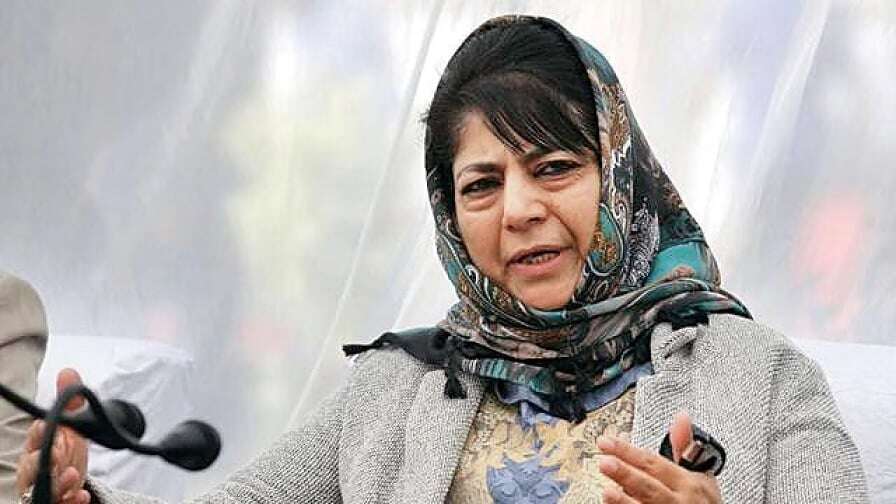
Jammu and Kashmir High Court rejects Mehbooba Mufti’s plea on undertrial prisoners, calls it politically motivated

The Jammu and Kashmir High Court has rejected Mehbooba Mufti’s PIL on undertrial prisoners, stating it was politically motivated and lacked factual basis.

Published

on

Mehbooba mufti

The Jammu and Kashmir High Court has dismissed a Public Interest Litigation (PIL) filed by People’s Democratic Party (PDP) president Mehbooba Mufti seeking the transfer of undertrial prisoners lodged in jails outside the Union Territory back to prisons within Jammu and Kashmir. The court termed the petition politically motivated, vague and unsupported by facts, observing that it was an attempt to derive political mileage rather than address a genuine public cause.

A bench headed by Chief Justice Arun Palli and Justice Rajnesh Oswal made it clear that public interest litigation cannot be used as a tool to advance political agendas or convert courts into platforms for electoral positioning.

Court says PIL cannot become a political platform

In its observations, the High Court said the plea appeared aimed at projecting the petitioner as a champion of justice for a specific section, rather than raising substantiated legal concerns. The bench underlined that while political parties are free to engage with voters through democratic means, the judiciary must remain insulated from political campaigns.

The court reiterated that PIL jurisdiction is meant to safeguard public interest and not to be misused for electoral gain or political leverage. It cautioned against attempts to draw the judiciary into political narratives.

Undertrials have legal remedies, says court

In the 15-page order passed on Tuesday, the High Court noted that the undertrial prisoners mentioned in the petition are already facing trial before competent courts. According to the bench, adequate judicial remedies are available to such undertrials to raise grievances related to their detention or place of incarceration.

The court further observed that the failure of the concerned undertrials to approach courts on their own indicated that they may not be genuinely aggrieved by their confinement in prisons outside the Union Territory.

No locus standi, petition dismissed

Dismissing the plea, the High Court held that Mehbooba Mufti was a third-party stranger to the cause and therefore lacked the locus standi to invoke the court’s jurisdiction in this matter. The petition was described as misconceived and was rejected accordingly.

India News

PM Modi predicts BJP win in Bengal, says he will return for oath-taking ceremony

PM Modi says he will return for BJP government’s oath-taking ceremony in Bengal after results, expressing strong confidence in victory.

Published

on

PM Narendra Modi

Prime Minister Narendra Modi on Monday expressed strong confidence that the Bharatiya Janata Party (BJP) will form the next government in West Bengal after the ongoing Assembly elections, stating that he plans to return for the oath-taking ceremony.

Addressing a rally during the final phase of campaigning, the Prime Minister said he would come back to the state after the declaration of results to attend the swearing-in of the BJP government.

Confidence ahead of results

The remarks came during his last campaign event, where he indicated optimism about the party’s electoral performance. The results of the West Bengal Assembly elections are scheduled to be announced on May 4.

He told the gathering that the enthusiasm and public support witnessed during his campaign tours had strengthened his belief that the BJP would secure a mandate in the state.

Campaign concludes amid high political stakes

The Prime Minister’s statement underscores the high-stakes political battle in West Bengal, where the BJP is aiming to challenge the ruling Trinamool Congress. The election has seen intense campaigning from all major parties, with voter turnout remaining high in earlier phases.

The West Bengal Assembly elections are being held in multiple phases, with counting set to determine the next government in the state.

Continue Reading

India News

Raghav Chadha defends BJP move, cites toxic work environment in AAP

Raghav Chadha says he left AAP due to a toxic internal environment and lack of freedom to work.

Published

on

Raghav Chadha

Raghav Chadha has defended his decision to leave the Aam Aadmi Party and join the Bharatiya Janata Party, stating that a “toxic work environment” within his former party forced him to take the step.

In a video shared on Instagram, the Rajya Sabha MP addressed criticism over his political switch and said the internal atmosphere in AAP had deteriorated significantly over time.

‘Stopped from working and speaking’

Chadha claimed that he and others were unable to function effectively within the party, alleging that leaders were restricted from expressing themselves or carrying out their responsibilities.

He said the environment had become increasingly difficult, adding that it was no longer possible for him to contribute meaningfully under such conditions.

Decision after years of association

The politician, who had been associated with AAP since its early days, said he had devoted a significant part of his life to the party but felt it had changed over the years. Reports indicate he highlighted that the organisation was not the same as when he joined it.

Chadha also suggested that his decision was not impulsive but taken after careful consideration of available options, including staying back or leaving politics altogether.

Response to backlash

The move has triggered strong reactions from political circles and supporters, with criticism emerging over his switch to the BJP. However, Chadha defended his choice, pointing to internal challenges and a lack of space to work within AAP.

He further argued that multiple leaders leaving the party should prompt reflection, questioning whether all of them could be wrong.

Political impact

Chadha’s exit is part of a larger development where several AAP leaders have shifted to the BJP, significantly altering the party’s strength in the Rajya Sabha.

The development has intensified political tensions between the two parties, with AAP criticising the defections and BJP welcoming the new entrants.

Continue Reading

India News

Veteran photographer Raghu Rai dies at 83, leaves behind visual legacy of India

Veteran photographer Raghu Rai, known for documenting India’s defining moments, has died at 83, leaving behind a lasting visual legacy.

Published

on

Raghu Rai, photographer death, Indian photojournalism, Delhi news, Padma Shri awardee, India culture, photography legend

Raghu Rai, one of India’s most celebrated photographers whose work chronicled the country’s social, political and cultural journey, has died at the age of 83. He passed away at a private hospital in Delhi on Sunday, according to reports.

Rai was widely regarded as a pioneer of photojournalism in India, known for capturing powerful moments ranging from political events to everyday life. His images became a visual record of modern India, reflecting its diversity and complexity.

A career that defined Indian photojournalism

Born in 1942 in Jhang, then part of British India (now in Pakistan), Rai began his photography career in the 1960s. Over the decades, he worked with leading publications and documented key moments in India’s history.

His work included coverage of major events such as the Bhopal gas tragedy and the Bangladesh Liberation War, earning him widespread recognition. He was awarded the Padma Shri in 1972 for his contribution to photography.

Rai also gained international acclaim, with his photographs appearing in global publications and exhibitions, cementing his status as one of the most influential visual storytellers from India.

Illness and passing

According to family accounts cited in reports, Rai had been battling cancer for the past two years. Though he underwent treatment, his condition worsened in recent months, along with age-related complications.

He is survived by his wife Gurmeet, son Nitin, and daughters Lagan, Avani and Purvai. His last rites were scheduled to be held at Lodhi Crematorium in Delhi.

Tributes and legacy

Tributes have poured in from across the country, with leaders and members of the photography community remembering him as a visionary who captured “the soul of India.”

His work, spanning over five decades, continues to serve as a powerful archive of India’s evolution, making him one of the most respected figures in global photojournalism.

Continue Reading

Trending

© Copyright 2022 APNLIVE.com