English हिन्दी
Connect with us

India News

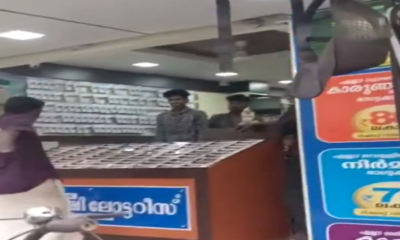
Kerala Win Win W-653 lottery result announced: First winner grabs Rs 75 lakh, check the full list here

Kerala state lottery department announced the results for Win-Win W-653 today. Check the full list of winners here.

Published

on

Kerala engineer swallows bribe money after being caught red-handed by vigilance department, admitted to hospital

On Monday, January 31, the Kerala state lottery department announced the results for Win-Win W-653. The lucky draw is being held at Gorky Bhavan, near Bakery Junction in Thiruvananthapuram. The draw is overseen by a panel of independent judges. The winner of the first prize will receive Rs 75 lakh, while the winner of the second prize will receive Rs 5 lakh. The third-place winners would receive Rs 1 lakh.

The result will be out on the official website of the lottery department at keralalotteries.com.

The winner of the first prize (Rs 75 lakh) is WP 835865

The winner of the second prize (Rs 5 lakh) is WS 935046

The winners of the third prize (Rs 1 lakh) are WN 136534 WO 331215 WP 344435 WR 242953 WS 474895 WT 339651 WU 879416 WV 693210 WW 159267 WX 549535 WY 215521 WZ 803121

The winners of the consolation prize (Rs 8,000) are WN 835865 WO 835865 WR 835865 WS 835865 WT 835865 WU 835865 WV 835865 WW 835865 WX 835865 WY 835865 WZ 835865

For the tickets ending with the following numbers.

The winners of fourth prize (Rs 5,000) are 0678 1578 1642 2823 3916 4213 4517 5189 5669 5708 5851 5990 6194 7374 7396 8296 8614 9930

The winners of fifth prize (Rs 2,000) are 0369 1265 2030 3860 3937 4180 5432 5919 6934 9049

The winners of sixth prize (Rs 1,000) are 1835 2125 2340 2951 3537 3538 6124 6182 7142 7870 8020 8239 8561 8639

The winners of seventh prize (Rs 500) are 0018 0109 0221 0259 0597 0816 0897 0922 1006 1049 1126 1194 1198 1381 1667 1996 2254 2308 2403 2410 2589 2734 2751 2984 3073 3127 3140 3172 3364 3408 3788 3821 3936 4081 4201 4374 4458 4507 4743 4789 4882 4898 4967 5289 5317 5340 5364 5421 5538 5640 5870 5872 5884 6027 6135 6591 6728 7367 7423 7469 7538 7576 7871 8089 8161 8201 8209 8248 8399 8627 8677 8679 9052 9204 9283 9380 9493 9659 9702 9793 9910 9924

The winners of eighth prize (Rs 100) are 0011 0271 0329 0417 0468 0496 0542 0685 0752 0955 1010 1096 1113 1275 1313 1363 1497 1534 1559 1626 1677 1699 1735 1783 1853 2130 2147 2251 2294 2373 2385 2391 2437 2531 2550 2563 2643 3026 3206 3290 3312 3346 3386 3451 3699 3822 3902 3919 3963 4055 4111 4227 4234 4288 4305 4442 4465 4715 4722 4758 4929 5015 5034 5101 5102 5345 5512 5531 5562 5590 5619 5685 5743 5779 5913 6032 6144 6239 6290 6399 6423 6455 6496 6510 6547 6583 6644 6710 6758 6851 6908 7570 7581 7716 7740 7910 7926 8005 8123 8132 8235 8270 8344 8351 8482 8513 8588 8629 8716 8766 8879 8891 8986 9023 9074 9205 9211 9314 9566 9591 9592 9723 9739 9868 9888 9923

The prize winners are advised to verify the winning numbers with the results published in the Kerala Government Gazette and surrender the winning tickets within 30 days.

Read Also: Economic Survey 2022: Why is it presented a day before Union Budget? What changes India will witness in this year’s Economic Survey? All you need to know

Kerala State Lotteries is a lottery conducted by the Kerala government. It is the first of its kind in India. It was founded in 1967 under the lottery department of the Kerala government.

India News

Amit Shah counters delimitation concerns, says southern states to gain Lok Sabha seats

Amit Shah assures Parliament that southern states will gain Lok Sabha seats after delimitation, countering opposition criticism during the women’s reservation debate.

Published

on

Amit Shah

Union Home Minister Amit Shah on Thursday addressed concerns over the proposed delimitation exercise, asserting in the Lok Sabha that southern states will not lose representation but instead see an increase in their number of seats.

His remarks came during a heated debate linked to the implementation of women’s reservation, where opposition parties have raised fears that population-based delimitation could reduce the political weight of southern states.

Shah rejected these claims, calling them misleading, and said the proposed framework ensures fairness while expanding the overall strength of the Lok Sabha.

Seat count to rise with expansion of Lok Sabha

The government has indicated that the total number of Lok Sabha seats could increase significantly as part of the delimitation process. In this expanded House, the combined representation of southern states is expected to rise from 129 seats at present to around 195 seats.

Shah emphasised that no state will lose seats in absolute terms, and the exercise is designed to reflect population changes while maintaining balance across regions.

State-wise projections shared in Parliament

During his address, Shah also provided indicative figures for individual southern states, suggesting notable increases in representation. According to the projections:

  • Tamil Nadu could see its seats rise substantially
  • Kerala, Telangana, and Andhra Pradesh are also expected to gain additional seats
  • Karnataka’s representation may increase as well

These figures were presented to counter the argument that delimitation would disproportionately favour northern states.

Political debate intensifies over linkage with women’s quota

The delimitation exercise has been closely linked to the rollout of women’s reservation, which proposes one-third seats for women in Parliament and state assemblies.

Opposition leaders have questioned this linkage, arguing that tying reservation to delimitation could delay its implementation and raise federal concerns. Some leaders have also warned that the move could impact national unity if apprehensions among states are not addressed.

The government, however, maintains that the reforms are necessary to ensure equitable representation and to align the electoral system with demographic realities.

Centre dismisses ‘false narrative’ on southern states

Shah reiterated that concerns about southern states losing influence are unfounded. He said the delimitation process will increase representation across regions and described the criticism as a “false narrative” aimed at creating confusion.

The issue is expected to remain a key flashpoint as Parliament continues discussions on the women’s reservation framework and related legislative changes.

Continue Reading

India News

PM Modi assures no discrimination in women’s quota, delimitation debate intensifies in Parliament

PM Narendra Modi has assured that women’s reservation will be implemented without discrimination, amid a heated debate over delimitation in Parliament.

Published

on

PM modi

Prime Minister Narendra Modi has assured that there will be no discrimination in the implementation of women’s reservation, as Parliament witnessed a sharp debate over the proposed linkage between the quota and delimitation exercise.

During the ongoing special session, the government reiterated its commitment to ensuring fair representation while addressing concerns raised by opposition parties regarding the timing and structure of the legislation.

The proposed framework aims to reserve 33 percent of seats for women in the Lok Sabha and state assemblies. However, its implementation is tied to a fresh delimitation exercise, which is expected after the next census.

Opposition questions timing and intent

Opposition leaders have raised concerns that linking the women’s quota to delimitation could delay its implementation. They argue that the process of redrawing constituencies may push the actual rollout further into the future.

The issue has triggered a broader political confrontation, with multiple parties questioning whether the move could alter representation across states.

Some critics have also alleged that the delimitation exercise could disproportionately benefit certain regions based on population, a charge the government has rejected.

Government reiterates commitment to fair implementation

Responding to these concerns, the Centre has maintained that the reforms are necessary to ensure accurate and updated representation based on population data.

Leaders from the ruling side have repeatedly emphasized that the process will be carried out transparently and without bias. The assurance that there will be “no discrimination” is aimed at addressing fears among states and opposition parties.

The debate marks a key moment in Parliament, with both sides engaging in intense exchanges over one of the most significant electoral reforms in recent years.

Continue Reading

India News

Give all tickets to Muslim women, Amit Shah says, attacking Akhilesh Yadav on sub-quota demand

A sharp exchange between Amit Shah and Akhilesh Yadav in Parliament over sub-quota for Muslim women highlights key divisions on women’s reservation implementation.

Published

on

A heated exchange broke out in Parliament during discussions on the women’s reservation framework, with Union Home Minister Amit Shah and Samajwadi Party chief Akhilesh Yadav locking horns over the demand for a sub-quota for Muslim women.

The debate unfolded as the government pushed forward key legislative measures to implement 33% reservation for women in the Lok Sabha and state assemblies.

Akhilesh Yadav argued that the proposed reservation must ensure representation for women from marginalised communities, including Other Backward Classes (OBCs) and Muslim women. He said that without such provisions, large sections could remain excluded from political participation.

He also questioned the timing of the bill, alleging that the Centre was avoiding a caste census. According to him, a census would lead to renewed demands for caste-based reservations, which the government is reluctant to address.

Government rejects religion-based quota

Responding to the demand, Amit Shah made it clear that reservation based on religion is not permitted under the Constitution.

He stated that any proposal to provide quota to Muslims on religious grounds would be unconstitutional, firmly rejecting the idea of a separate sub-quota for Muslim women within the broader reservation framework.

The government has maintained that the existing framework already includes provisions for Scheduled Castes (SC) and Scheduled Tribes (ST) women within the overall reservation structure.

Wider political divide over implementation

The issue of sub-categorisation within the women’s quota has emerged as a major flashpoint, even as most opposition parties broadly support the idea of women’s reservation.

Samajwadi Party leaders reiterated that their support for the bill depends on inclusion of OBC and minority women, while the government continues to defend its constitutional position.

The debate is part of a broader discussion during the special Parliament session, where multiple bills linked to delimitation and implementation of the women’s quota are being taken up.

Continue Reading

Trending

© Copyright 2022 APNLIVE.com