English हिन्दी
Connect with us

India News

Government permits kerosene sale through petrol pumps for 60 days amid energy concerns

The Centre has allowed kerosene sale through select petrol pumps for 60 days after relaxing petroleum rules to ensure cooking fuel availability amid global energy concerns.

Published

on

kerosene oil

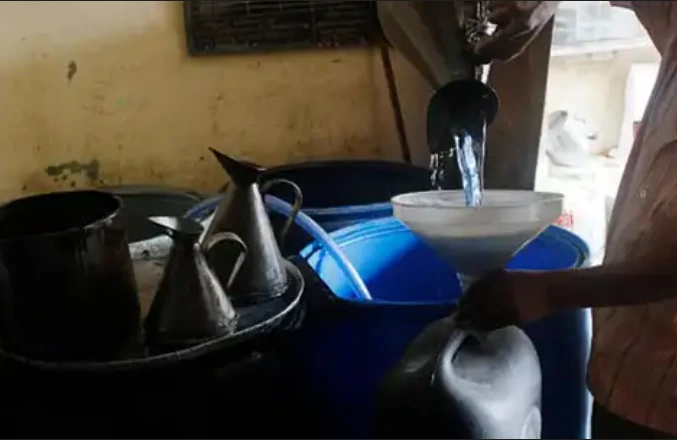
The Centre has allowed the sale of kerosene through select petrol pumps across the country for a period of 60 days, according to a notification issued by the Ministry of Petroleum and Natural Gas on March 29. The decision comes amid the ongoing Iran war and global energy supply concerns, with the government aiming to ensure the availability of cooking fuel for households.

Under the order, the government has permitted ad-hoc allocation of Public Distribution System (PDS) Superior Kerosene Oil (SKO) to all States and Union Territories, including 21 regions that had previously become PDS kerosene-free. The move is aimed at providing an alternative fuel option for cooking and lighting, especially if LPG supply or affordability becomes a concern due to global energy disruptions.

Kerosene to be sold through select petrol pumps

As part of the temporary arrangement, up to two petrol pumps per district can be designated for kerosene distribution. These outlets will be allowed to store up to 5,000 litres of PDS kerosene and will preferably be company-owned, company-operated outlets of public sector oil marketing companies.

The government has relaxed certain petroleum storage and licensing rules to enable faster last-mile delivery of kerosene. However, all safety norms and operational guidelines issued by the Petroleum and Explosives Safety Organisation will continue to apply, and authorities will maintain strict monitoring of storage and distribution.

Kerosene returns in areas where it was phased out

Over the past several years, many states and Union Territories had phased out kerosene from the public distribution system as LPG coverage expanded across the country. With the new order, these states and UTs will now receive ad-hoc kerosene allocation for cooking and lighting purposes through designated outlets, including retail fuel stations.

Temporary measure to ease LPG pressure

The 60-day measure is part of the government’s contingency planning amid global energy supply disruptions linked to the Middle East conflict. The move is intended to reduce pressure on LPG supplies by providing kerosene as an alternative household fuel during the period of uncertainty.

The order takes immediate effect and will remain in force for 60 days or until further orders are issued.

India News

Ladakh may get Article 371-like safeguards, autonomous councils

Published

on

By

Laddakh Violence

The Central government is said to be working on a proposal to grant Ladakh a special governance framework similar to Article 371 of the Constitution.

The move is aimed at addressing the long-standing demands of the people of Ladakh for greater autonomy, protection of local culture, and stronger local self-governance after the region became a Union Territory in 2019.

According to the proposal, Autonomous Hill Development Councils (AHDCs) will be established in all seven districts of Ladakh. At present, only Leh and Kargil have elected hill councils. The expansion of these councils is expected to ensure balanced development, improve local administration, and give residents of every district a greater role in decision-making.

The Centre is also planning to create a Union Territory-level elected body that will coordinate the functioning of all district councils. This institution is expected to have powers related to planning, development, finance, and administration, helping improve governance across Ladakh while maintaining coordination with the Union Territory administration.

Article 371 is a special provision in the Constitution that gives some states extra rights to protect their culture, local traditions, land, and ensure better administration based on their unique needs. While Ladakh is not expected to receive Article 371 in its existing form, the government is considering a customized framework with similar constitutional protections suited to the region’s geographical and social conditions.

The proposal comes after several rounds of discussions between the Centre, the Ladakh administration, and representatives of civil society. Local groups have been demanding constitutional safeguards to protect the region’s fragile environment, tribal identity, employment opportunities, and control over land resources.

If approved, the Ladakh Autonomous Hill Development Council Act will be amended, followed by the delimitation of constituencies before elections are held for the newly-created councils. The proposal is currently under consideration.

The initiative is expected to strengthen grassroots democracy, promote inclusive development, and provide Ladakh with greater administrative autonomy while remaining a Union Territory.

Continue Reading

India News

Omar Abdullah criticises Martyrs’ Day restrictions, calls LG administration temporary guests

Omar Abdullah criticised the LG administration after being prevented from visiting Srinagar’s Martyrs’ Graveyard, alleging the 1931 martyrs’ sacrifices are being overlooked.

Published

on

Omar Abdullah

Jammu and Kashmir Chief Minister Omar Abdullah on Monday criticised the Lieutenant Governor (LG) administration after he was prevented from visiting the Martyrs’ Graveyard in Srinagar to pay tribute to those killed during the 1931 uprising.

The area surrounding the Martyrs’ Graveyard in downtown Srinagar was sealed by the authorities, with police declaring it a no-go zone and restricting entry to the site.

Omar Abdullah questions restrictions

Unable to visit the graveyard, Abdullah, along with his ministers, MLAs and National Conference leaders, held a tribute meeting at the party headquarters in Srinagar.

Addressing party workers after the meeting, the Chief Minister said the administration’s decision to block access would not erase the memory of the 1931 martyrs.

Calling the LG administration “temporary guests”, Abdullah said those responsible for preventing political leaders from paying homage would not remain in office forever, while the martyrs’ cemetery would continue to stand. He added that he and his party would visit the site in the future to offer floral tributes and prayers.

Alleges selective treatment of history

Abdullah alleged that the sacrifices of those who fought against British-era rule in Jammu and Kashmir were being ignored because they were Muslims and had opposed the Dogra Maharaja, who ruled under British paramountcy.

He argued that the 1931 movement was not based on religion but represented a struggle for democratic rights, principles and freedom during the British period.

The Chief Minister also said attempts were being made to portray participation in the freedom movement against British rule in a negative light.

Background of the annual observance

July 13 was earlier observed as a public holiday in the erstwhile state of Jammu and Kashmir. Every year, officials, political leaders and members of the public would gather at the Martyrs’ Graveyard to pay homage to those killed during the 1931 incident, with police also offering a ceremonial gun salute.

Following the abrogation of Article 370 and the reorganisation of Jammu and Kashmir into a Union Territory in 2019, July 13 was removed from the list of official public holidays. Since then, authorities have not permitted official or public commemorative events at the graveyard.

The Lieutenant Governor continues to exercise authority over key subjects in the Union Territory, including law and order and policing.

Why July 13 is significant

July 13 commemorates the deaths of 22 civilians who were killed in police firing outside Srinagar Central Jail in 1931 while protesting against the rule of Dogra Maharaja Hari Singh during the British era.

The protesters had gathered in support of Abdul Qadeer, who had urged Kashmiris to oppose the Maharaja’s administration.

The incident led to widespread protests and prompted the Maharaja and the British administration to appoint commissions to examine the grievances of the Valley’s Muslim population. It also contributed to political reforms, with Jammu and Kashmir holding its first Assembly elections in 1934, marking the beginning of an electoral process in the region.

Changes after 2019

Since 2020, both July 13 and December 5—the birth anniversary of former Jammu and Kashmir Prime Minister and Chief Minister Sheikh Abdullah—have ceased to be official holidays in the Union Territory.

Instead, the birth anniversary of Dogra ruler Maharaja Hari Singh is now observed as a public holiday in Jammu and Kashmir.

Continue Reading

India News

Centre urged to introduce India’s first LPG efficiency policy amid global energy uncertainty

Pune Gas has proposed India’s first LPG Efficiency Policy Framework, urging the Centre to improve fuel utilisation, reduce wastage and strengthen energy security as commercial LPG prices rise amid global market uncertainty.

Published

on

LPG cylinder

As geopolitical tensions in the Middle East continue to affect global energy markets, an Indian energy company has urged the Centre to introduce a national policy focused on improving the efficient use of Liquefied Petroleum Gas (LPG).

Pune Gas has submitted a proposal to the Ministry of Petroleum and Natural Gas seeking what it describes as India’s first LPG Efficiency Policy Framework. The recommendation comes as uncertainty in global LPG markets has increased following the ongoing conflict involving Iran, contributing to higher commercial LPG prices and increasing costs for businesses that depend on the fuel.

According to the company, commercial LPG cylinder prices have risen to around Rs 3,100 from nearly Rs 1,884 earlier this year due to supply constraints. The increase has affected sectors such as restaurants, hotels, hospitals, food processing units, laundries, MSMEs and manufacturing industries that rely heavily on LPG.

While India has largely maintained uninterrupted LPG supplies through government measures, Pune Gas said improving the efficiency of LPG consumption should become the next step towards strengthening the country’s energy security.

Company proposes national LPG efficiency framework

In its representation to Petroleum and Natural Gas Minister Hardeep Singh Puri, Pune Gas has recommended a comprehensive policy framework aimed at reducing LPG wastage, promoting standardisation and encouraging the adoption of efficient LPG infrastructure across commercial and industrial establishments.

Among its key recommendations, the company has urged the government to improve LPG utilisation efficiency across industries and encourage Oil Marketing Companies (OMCs) to promote 47.5-kg LOT cylinders wherever operationally suitable.

According to Pune Gas, the larger cylinders can help reduce fuel wastage, improve safety standards, minimise pilferage and optimise available LPG supplies.

The proposal also recommends nationwide awareness campaigns on efficient LPG usage, greater collaboration between the government, OMCs and industry stakeholders to standardise practices, and policy incentives to encourage the adoption of efficient LPG systems.

CEO says efficiency should become national priority

Explaining the proposal, Jesal Sampat, Executive Director and CEO of Pune Gas, said India has traditionally focused on increasing LPG procurement and supply, but should now also emphasise efficient utilisation.

He said the country’s next step in strengthening energy security would come not only from increasing fuel availability but also by reducing avoidable wastage, adding that efficient LPG use can lower operating costs, reduce pressure on national demand and improve the resilience of India’s energy ecosystem.

Sampat also urged the Ministry of Petroleum and Natural Gas to recognise LPG efficiency as a national priority by introducing a dedicated policy framework focused on efficiency and standardisation, stating that such measures would strengthen India’s energy resilience while supporting industries dependent on LPG.

Pune Gas offers technology and implementation support

As part of its proposal, Pune Gas highlighted LPGenius, an indigenous LPG management system developed by the company under the Atmanirbhar Bharat initiative. According to the company, the system is designed to improve LPG efficiency, operational safety and cost optimisation for commercial and industrial users.

The company has also offered to support the Ministry of Petroleum and Natural Gas and Oil Marketing Companies by sharing field data, implementation insights and case studies, besides assisting with pilot projects aimed at developing a more efficient and sustainable LPG ecosystem in India.

Continue Reading

Trending

© Copyright 2022 APNLIVE.com