English हिन्दी
Connect with us

India News

Lok Sabha passes Bill allowing government to permit charges on UPI and digital payments

The Lok Sabha has passed a Bill amending the Payment and Settlement Systems Act, allowing the government to permit charges on UPI and other notified digital payment modes by removing the legal restriction on Merchant Discount Rate.

Published

on

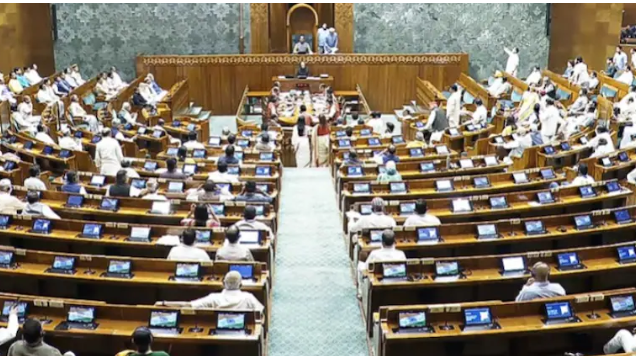
The Lok Sabha on Thursday passed the Taxation and Other Laws (Amendment) Bill, 2026, paving the way for the central government to permit banks and payment service providers to levy charges on Unified Payments Interface (UPI) and other notified electronic payment modes.

The amendment changes provisions of the Payment and Settlement Systems Act, 2007, removing the existing legal restriction that barred banks and payment system providers from charging Merchant Discount Rate (MDR) on specified electronic payment methods.

The Bill was passed by voice vote after the House resumed proceedings at 2 pm following an earlier adjournment.

What changes under the Bill?

The amendment replaces the reference to electronic payment modes prescribed under Section 269SU of the Income Tax Act with a provision allowing the central government to notify one or more electronic payment modes for which charges may be permitted.

The revised provision states that the government may specify the applicable electronic payment modes through an official notification after the law comes into force.

At present, Section 10A of the Payment and Settlement Systems Act prohibits banks and payment system providers from imposing any direct or indirect charges on prescribed electronic payment modes.

Meanwhile, Section 269SU of the Income Tax Act requires businesses with an annual turnover exceeding ₹50 crore to provide specified digital payment options, including BHIM-UPI QR codes and RuPay debit cards.

UPI remains free for now

While RTGS and NEFT transactions already attract service charges in certain cases, UPI payments have so far remained exempt from Merchant Discount Rate (MDR).

The amendment itself does not immediately introduce charges on UPI transactions. Instead, it authorises the government to notify eligible electronic payment modes and permit charges in the future.

Government cites sustainability of digital payments ecosystem

According to the government, the proposed changes aim to create a sustainable revenue model for banks, payment service providers (PSPs) and payment infrastructure companies that support India’s rapidly expanding digital payments ecosystem.

The proposal seeks to balance the interests of consumers and small businesses while ensuring adequate investment in payment infrastructure.

RBI Governor: Too early to discuss MDR rollout

A day before the Bill was passed, Reserve Bank of India Governor Sanjay Malhotra described discussions on imposing MDR on digital payments as “premature”.

He said investment in payment infrastructure must be funded either through taxation or by adopting a “user pays” model through Merchant Discount Rate.

Malhotra noted that the government is currently bringing the legislative amendment and said it would be appropriate to wait for further developments before drawing conclusions.

He also said that under the user-pays principle, the merchant or person using the service bears the cost, whereas in the absence of MDR, the expenses are effectively supported through public taxation.

Industry has long sought MDR on UPI

The question of introducing MDR on UPI has remained a key issue for banks and payment industry stakeholders, who have argued for a sustainable compensation mechanism as digital payment volumes continue to rise.

Some industry observers have suggested that, if introduced in the future, MDR could apply only to higher-value merchant transactions rather than peer-to-peer UPI transfers. However, the Bill does not specify any such threshold or implementation framework.

India News

UPI fee may push India back towards cash economy, retailers warn

The Retailers Association of India has warned that the new UPI merchant fee could encourage some small retailers to return to cash transactions.

Published

on

The Retailers Association of India (RAI) has raised concerns over the impact of the new Merchant Discount Rate (MDR) on certain UPI transactions, warning that the additional cost could encourage some small retailers to reconsider digital payments.

The concern comes after the introduction of a 0.4% MDR on select UPI transactions above Rs 2,000, with the charge applicable to merchants rather than consumers. The new framework is scheduled to take effect from October 15.

Retailers warn of shift towards cash

Kumar Rajagopalan, CEO of the Retailers Association of India, said the additional cost could make small merchants reconsider whether to accept UPI or cash for certain transactions. The association has warned that this could risk reversing some of the shift towards digital payments.

The concern is particularly relevant for smaller businesses operating on narrow margins, where even a relatively small transaction cost can add to operating expenses.

What the new UPI MDR means

Under the new framework, a 0.4% merchant discount rate applies to eligible UPI transactions above Rs 2,000, subject to a maximum charge of Rs 300 for the applicable category. The MDR is a merchant-side charge rather than a direct fee imposed on consumers.

The government has also stated that banks have been advised to ensure that merchants do not pass the MDR charge on to customers for UPI payments.

The change has prompted concerns from several industry groups, particularly ahead of the festive shopping season, over its potential impact on merchants and the continued adoption of digital payments.

Continue Reading

India News

Revanth Reddy orders probe into KCR family land holdings

Telangana Chief Minister Revanth Reddy ordered an inquiry into land linked to KCR’s farmhouse and cited alleged family holdings of around 440 acres.

Published

on

Telangana Chief Minister Revanth Reddy on Wednesday ordered an inquiry into land linked to former chief minister K Chandrashekar Rao’s farmhouse during a debate in the state Assembly.

Reddy was speaking during a discussion on the 22-A prohibited properties list when he targeted the opposition Bharat Rashtra Samithi (BRS) and alleged that the party had sought to stall the Assembly session. He said several contentious issues, including alleged government land encroachment, fee reimbursement and drought-related concerns, were expected to come up for discussion.

Revanth Reddy orders inquiry into KCR farmhouse land

Turning his attention to KCR and his extended family, Reddy said the government had identified substantial landholdings associated with members of the former chief minister’s family and their associates.

“I am ordering an inquiry into the lands of KCR’s farmhouse,” Reddy said in the Assembly. He added that if the landholdings were found to be in violation of the law, the government would take possession of the land and distribute eligible land to Dalits.

According to figures cited by Reddy in the Assembly, KCR and his extended family members allegedly hold around 440 acres across nine districts, 24 mandals and 31 villages.

Revanth Reddy targets BRS in Assembly

During his speech, Reddy also accused the BRS of trying to disrupt the Assembly session. He referred to several issues that he said were expected to be discussed, including alleged plundering of government land, fee reimbursement and drought-related matters.

Reddy also spoke about the history of Hyderabad under the Nizam and described the Nizam government as an effective administrator while discussing the region’s historical development.

KCR’s absence from Telangana Assembly

The Monsoon session of the Telangana Assembly began on September 7 and has been marked by disruptions. Twenty-two BRS MLAs were suspended for the remainder of the session.

KCR, who is the BRS chief and Leader of the Opposition, has not attended the current session. According to the report, KCR last appeared in the Assembly in December 2025, with the ruling Congress and Revanth Reddy questioning his absence.

Continue Reading

India News

PM Modi statue with Lord Ganesha at Bengal pandal triggers row

A Ganesh Puja pandal in Howrah has sparked a political row over a display featuring PM Modi and Lord Ganesha seated together.

Published

on

A Ganesh Puja organised at Belur Bazar in Howrah, near Kolkata, has sparked a controversy over its theme featuring Prime Minister Narendra Modi and Lord Ganesha together. The display has a ‘Hindu Rashtra’ theme and has attracted discussion on social media.

The display shows PM Modi and Lord Ganesha seated together, with both holding cups of tea. The arrangement represents the concept of ‘Chai Pe Charcha’, or discussion over tea.

The words ‘Hindu Rashtra’ are displayed in the background, while a map of India and a Hindu flag have also been placed nearby.

What the organiser said

The organiser, Khokan Kanra, said the theme was his personal initiative and that he has been organising the puja for a long time.

Kanra said he comes up with a different theme every year and that this year’s concept was his own idea. He also denied allegations that the theme was linked to his recent joining of the BJP.

He said his intention was not to offend any religion. According to Kanra, he portrayed Prime Minister Modi as a symbol of the nation and Lord Ganesha as a symbol of religion.

TMC criticises the theme

The theme was criticised by Trinamool Congress leader and Central Howrah MLA Arup Roy.

Roy said individuals who had recently joined the BJP were attempting to gain favour through such acts. He also said the BJP leadership and the Prime Minister might not be aware of the display and called on the district and state BJP units to take action.

BJP says there is nothing wrong

The BJP took a different position on the display.

Howrah District BJP Secretary Omprakash Singh said he saw nothing wrong with the theme. He said different kinds of pujas and themes are organised in West Bengal.

Singh also said the district BJP would discuss the matter and take action if necessary.

Row comes amid debate over puja themes

The controversy comes amid a separate debate over comments by the Vishwa Hindu Parishad regarding themes used in Durga Puja pandals.

VHP eastern region secretary Amiya Sarkar had said the organisation’s request was that Durga Puja themes should not be against Indian culture, spirituality or national morale, and that religious sentiments should not be hurt.

The Howrah Ganesh Puja display has since become a subject of discussion, with political reactions emerging from both the Trinamool Congress and the BJP.

Continue Reading

Trending

© Copyright 2022 APNLIVE.com