English हिन्दी
Connect with us

India News

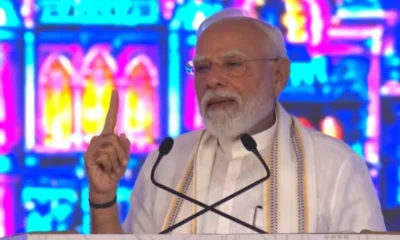
PM Modi urges people to buy handloom products, share Get Ready With Me videos on National Handloom Day

PM Narendra Modi appealed to people to purchase handloom products and share ‘Get Ready With Me’ videos on social media to support weavers and promote India’s handloom heritage ahead of National Handloom Day.

Published

on

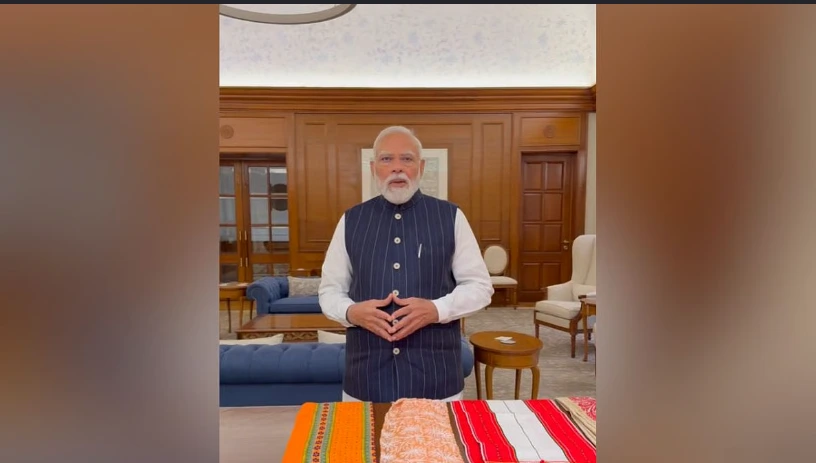
Prime Minister Narendra Modi has urged people to purchase handloom products and share videos on social media to promote India’s traditional weaving industry ahead of National Handloom Day.

In a video message posted on his Instagram handle on the eve of National Handloom Day, the Prime Minister said celebrating the occasion would provide support to the country’s weavers and small traders.

He encouraged people to showcase their favourite handloom products by creating short videos, including “Get Ready With Me” videos, and sharing them online to help popularise India’s diverse handloom traditions.

PM recalls Swadeshi Movement’s legacy

Highlighting the historical significance of August 7, PM Modi said it was on this day in 1905 that the Swadeshi Movement against British rule began, bringing people across the country together.

Referring to the recent Friendship Day celebrations, he appealed to citizens to celebrate National Handloom Day with enthusiasm and participate in promoting Indian handloom products.

The Prime Minister said the campaign aims to attract people from across the world to India’s handloom products while strengthening the country’s journey towards self-reliance. He added that buying handloom products and sharing videos online would financially support weavers and small enterprises.

India News

Rahul Gandhi backs Ranchi student protesters, says every government must hear students

Rahul Gandhi has backed students protesting in Ranchi over alleged recruitment exam irregularities, urging every government to listen to students and reform the education system.

Published

on

Rahul-Gandhi

The Congress on Thursday extended its support to students protesting in Ranchi against alleged irregularities in recruitment examinations, with Leader of Opposition in the Lok Sabha Rahul Gandhi saying that every government should listen to students’ concerns and work towards reforming the education system.

The party, which is part of the Jharkhand Mukti Morcha (JMM)-led government in the state, also said it would continue working to ensure students receive justice.

Rahul Gandhi calls for education reforms

During an interactive ‘Ask Me Anything’ session on Instagram, Rahul Gandhi was asked to support the ongoing student protest in Jharkhand.

Responding to the request, Gandhi said the student movements taking place across the country reflect growing dissatisfaction with the education system. He described the current system as unaffordable and oppressive, adding that meaningful reforms are needed.

He further said that every government—whether at the Centre, in Jharkhand, or a Congress-led state—must listen to students and take steps to improve the education system.

Congress says it stands with students

Congress president Mallikarjun Kharge said the party would support students irrespective of which party is in power. He said Congress leaders would raise the matter with the Jharkhand government and seek answers on the concerns raised by students.

Earlier in the day, AICC Jharkhand in-charge K. Raju and state Congress leaders met Chief Minister Hemant Soren and submitted a memorandum highlighting the students’ demands.

Raju later said the delegation appreciated the chief minister’s decision to constitute a ministerial committee to consult with the protesting students and recommend practical solutions.

He also reiterated that the Jharkhand Congress, along with the Indian Youth Congress (IYC) and the National Students’ Union of India (NSUI), stands firmly with the agitating students.

Protest enters 13th day

The protest over alleged irregularities in Jharkhand Public Service Commission (JPSC) and Jharkhand Staff Selection Commission (JSSC) recruitment examinations entered its 13th day on Thursday.

Six protesters continued their hunger strike, while students and job aspirants formed an 11-member delegation to hold discussions with the government.

The agitation began on July 25 under the banner of the JPSC-JSSC Reforms Manch at Jaipal Singh Munda Stadium in Ranchi and has emerged as one of the state’s largest student-led movements in recent years.

The protesters are demanding cancellation of the 14th Jharkhand Public Service Commission Civil Services Examination and an independent investigation into the alleged irregularities by either the Central Bureau of Investigation (CBI) or a panel of retired high court judges from outside Jharkhand.

Hemant Soren assures action

A day before the proposed talks, Chief Minister Hemant Soren said his government’s doors were open for discussions with the students.

In a post on X, Soren said the concerns raised by the students were being taken seriously and that investigative agencies were working continuously to identify those responsible for the alleged irregularities.

He said the government’s objective was not only to investigate the matter but also to provide a long-term solution to students’ concerns. Soren assured that every demand and suggestion would be carefully examined before announcing concrete measures.

Continue Reading

India News

Chhattisgarh High Court denies bail to ex-IAS officer in CGPSC paper leak case

The Chhattisgarh High Court has denied bail to retired IAS officer Jeevan Kishore Dhruv in the alleged CGPSC paper leak case, saying competitive exam paper leaks have a devastating impact on the careers of lakhs of aspirants.

Published

on

paper Leak

The Chhattisgarh High Court has rejected the bail plea of retired IAS officer Jeevan Kishore Dhruv, who was arrested by the Central Bureau of Investigation (CBI) in connection with the alleged Chhattisgarh Public Service Commission (CGPSC) recruitment scam.

The court observed that leaking question papers of competitive examinations is “more heinous than murder” because it destroys the careers of lakhs of young aspirants and damages the integrity of the public recruitment process.

High Court cites seriousness of allegations

Justice Bibhu Datta Guru, while rejecting Dhruv’s bail application, noted that the alleged offence had a far-reaching impact on society and could not be treated as an ordinary crime.

The court observed that people involved in leaking competitive examination question papers jeopardise the future of candidates who spend years preparing for government recruitment examinations.

According to the order, the prosecution has, at the prima facie stage, collected material indicating that Dhruv, while serving as Secretary of the CGPSC during the 2020-2022 recruitment process, allegedly retained confidential question papers of the 2021 Main Examination and supplied them to his son.

The High Court also noted that the investigation pointed to the applicant’s alleged involvement through witness statements, documentary evidence and recoveries made during searches.

Considering the gravity of the allegations and their impact on the credibility of the recruitment process, the court said it was not inclined to grant bail.

Defence argues false implication

During the hearing, Dhruv’s counsel argued that the retired IAS officer had been falsely implicated only because he served as the CGPSC Secretary and was not named in the original FIR.

The defence submitted that no incriminating electronic devices or documents, apart from a mobile phone, were recovered from him. It also contended there was no evidence proving that he leaked confidential question papers or shared them with his children.

The counsel further argued that after learning both his sons were candidates in the examination, Dhruv informed the competent CGPSC authorities and requested to be relieved of all confidential work related to the recruitment process. According to the defence, official records showed he was subsequently assigned no confidential examination duties.

The defence also maintained that allegations of favouritism were weakened by the fact that one of Dhruv’s sons failed to qualify, while the other secured a rank below the top position.

CBI opposes bail

Opposing the plea, the CBI argued that the case involved large-scale irregularities that undermined public confidence in the recruitment system.

The agency alleged that Dhruv, along with the then CGPSC chairman, controller of examinations and other accused persons, entered into a criminal conspiracy to leak confidential question papers of the 2021 Main Examination, giving his son an unfair advantage.

According to the CBI, copies of questions and answers related to General Studies Paper VII and the Question-cum-Answer Booklet of the Essay paper were recovered during searches conducted at Dhruv’s residence.

The investigating agency also argued that the retired IAS officer could not claim parity with a co-accused who had received bail from the Supreme Court, as Dhruv was a senior public servant responsible for maintaining the secrecy and integrity of the examination process.

Several others also arrested

Apart from Jeevan Kishore Dhruv, those arrested in the alleged recruitment scam include former CGPSC chairman Taman Singh Sonwani, his nephews Nitesh Sonwani and Sahil Sonwani, former Deputy Controller of Examinations Lalit Ganvir, industrialist Shravan Kumar Goyal, his son Shashank Goyal, and daughter-in-law Bhumika Katiyar.

Continue Reading

India News

Lok Sabha passes Bill allowing government to permit charges on UPI and digital payments

The Lok Sabha has passed a Bill amending the Payment and Settlement Systems Act, allowing the government to permit charges on UPI and other notified digital payment modes by removing the legal restriction on Merchant Discount Rate.

Published

on

The Lok Sabha on Thursday passed the Taxation and Other Laws (Amendment) Bill, 2026, paving the way for the central government to permit banks and payment service providers to levy charges on Unified Payments Interface (UPI) and other notified electronic payment modes.

The amendment changes provisions of the Payment and Settlement Systems Act, 2007, removing the existing legal restriction that barred banks and payment system providers from charging Merchant Discount Rate (MDR) on specified electronic payment methods.

The Bill was passed by voice vote after the House resumed proceedings at 2 pm following an earlier adjournment.

What changes under the Bill?

The amendment replaces the reference to electronic payment modes prescribed under Section 269SU of the Income Tax Act with a provision allowing the central government to notify one or more electronic payment modes for which charges may be permitted.

The revised provision states that the government may specify the applicable electronic payment modes through an official notification after the law comes into force.

At present, Section 10A of the Payment and Settlement Systems Act prohibits banks and payment system providers from imposing any direct or indirect charges on prescribed electronic payment modes.

Meanwhile, Section 269SU of the Income Tax Act requires businesses with an annual turnover exceeding ₹50 crore to provide specified digital payment options, including BHIM-UPI QR codes and RuPay debit cards.

UPI remains free for now

While RTGS and NEFT transactions already attract service charges in certain cases, UPI payments have so far remained exempt from Merchant Discount Rate (MDR).

The amendment itself does not immediately introduce charges on UPI transactions. Instead, it authorises the government to notify eligible electronic payment modes and permit charges in the future.

Government cites sustainability of digital payments ecosystem

According to the government, the proposed changes aim to create a sustainable revenue model for banks, payment service providers (PSPs) and payment infrastructure companies that support India’s rapidly expanding digital payments ecosystem.

The proposal seeks to balance the interests of consumers and small businesses while ensuring adequate investment in payment infrastructure.

RBI Governor: Too early to discuss MDR rollout

A day before the Bill was passed, Reserve Bank of India Governor Sanjay Malhotra described discussions on imposing MDR on digital payments as “premature”.

He said investment in payment infrastructure must be funded either through taxation or by adopting a “user pays” model through Merchant Discount Rate.

Malhotra noted that the government is currently bringing the legislative amendment and said it would be appropriate to wait for further developments before drawing conclusions.

He also said that under the user-pays principle, the merchant or person using the service bears the cost, whereas in the absence of MDR, the expenses are effectively supported through public taxation.

Industry has long sought MDR on UPI

The question of introducing MDR on UPI has remained a key issue for banks and payment industry stakeholders, who have argued for a sustainable compensation mechanism as digital payment volumes continue to rise.

Some industry observers have suggested that, if introduced in the future, MDR could apply only to higher-value merchant transactions rather than peer-to-peer UPI transfers. However, the Bill does not specify any such threshold or implementation framework.

Continue Reading

Trending

© Copyright 2022 APNLIVE.com