English हिन्दी
Connect with us

India News

Amid massive protests, Mamata Banerjee calls for UN referendum on Citizenship Act

Continuing her attack against the BJP led-government at the Centre for amending the Citizenship Act, West Bengal Chief Minister Mamata Banerjee asked how a party formed in the 80s could ask for the proof of citizenship from people born in the 1950s, 60s, and 70s.

Published

on

MAMATA BANERJEE

Continuing her attack against the BJP led-government at the Centre for amending the Citizenship Act, West Bengal Chief Minister Mamata Banerjee asked how a party formed in the 80s could ask for the proof of citizenship from people born in the 1950s, 60s, and 70s.
“Suddenly after 73 years of independence we have to prove that we are Indian citizens. Where was BJP’s head and tail at that time?” asked Banerjee during a protest today.

Banerjee has called for referendum on Citizenship Amendment Act to be conducted by UN “Let there be an impartial organisation like United Nations or Human Rights Commission form a committee to see how many people are in favour or against,” she said.

The Trinamool chief has been leading protests against the new citizenship law and the National Register of Citizens for the last four days across Kolkata.

The law has been described as “unconstitutional” by opposition parties and Human Rights activists who claim that it excludes Muslims from being a part of the law that provides citizenship to refugees from Afghanistan, Bangladesh and Pakistan.

Rebutting the BJP’s claim that only Muslims are protesting against the law, she said that the protests were spread across the country. She said, “This is not a Hindu-Muslim issue. This is a movement for the country. This is a struggle for restoring democracy”.
The Trinamool chief has already stalled the process of National Population Register, which is considered the first step before rolling out the citizens’ list, meant to weed out illegal migrants, across the country.

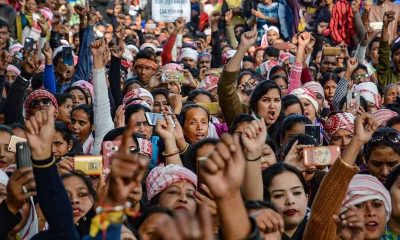
Massive protests were planned for the day where several activists, politicians and others were detained. The police used tear-gas and used force at certain locations to control the crowd.

India News

Vijay meets PM Modi for second time as Tamil Nadu Chief Minister during Delhi visit

Tamil Nadu Chief Minister Vijay met Prime Minister Narendra Modi in New Delhi during his latest visit to the capital, marking their second interaction since Vijay became Chief Minister.

Published

on

Actor vijay

Tamil Nadu Chief Minister C. Joseph Vijay met Prime Minister Narendra Modi in New Delhi on Thursday, marking their second meeting since Vijay assumed office last month.

The meeting took place during Vijay’s visit to the national capital, where he has also been scheduled to attend the Governing Council meeting of NITI Aayog. Reports indicate that the interaction between the two leaders lasted around 20 minutes.

This follows Vijay’s first official meeting with the Prime Minister on May 27, shortly after taking charge as Tamil Nadu Chief Minister. During that meeting, Vijay submitted a memorandum on several issues concerning the state, including the Mekedatu dam project, Tamil Nadu fishermen detained in Sri Lanka, and other matters related to the state’s interests.

Vijay’s latest Delhi visit has included meetings with several national leaders as he continues engagements with the Centre and leaders from different political parties. Reports said he also met senior Congress leaders during the trip.

The Tamil Nadu Chief Minister took office on May 10 after his party, Tamilaga Vettri Kazhagam (TVK), emerged as a key force in the 2026 Assembly elections and formed the government with support from alliance partners.

While details of the latest discussion between Vijay and the Prime Minister were not immediately disclosed, the meeting is being viewed as part of ongoing Centre-state consultations on issues concerning Tamil Nadu.

Continue Reading

India News

Abhishek Banerjee gets three-week interim protection in Bengal signature forgery case

TMC MP Abhishek Banerjee has secured three weeks of interim protection from coercive action in the Bengal signature forgery case while the CID probe continues.

Published

on

Abhishek Banerjee

Trinamool Congress MP Abhishek Banerjee has received interim protection from coercive action for three weeks from the Calcutta High Court in connection with the alleged signature forgery case being investigated by the West Bengal CID. The relief comes amid an ongoing legal challenge by the senior party leader against repeated summons issued by investigators.

The case relates to allegations that signatures of several Trinamool Congress MLAs were forged on a party resolution submitted to the West Bengal Assembly during a leadership dispute. The complaint led to the registration of a case and a CID investigation, with the agency seeking to question Banerjee regarding the disputed document.

Court grants temporary relief

During the hearing, the court granted Banerjee protection from arrest and other coercive measures for three weeks while the matter remains under judicial consideration. The interim order provides temporary relief as the legal proceedings continue and the CID investigation moves forward.

Banerjee had approached the High Court challenging the CID summons and seeking protection from any adverse action. He had also requested additional time to appear before investigators, citing legal proceedings and other commitments.

CID probe and summons

The West Bengal CID has issued multiple notices to Banerjee in the alleged forgery case and has maintained that his statement is important for the investigation. Investigators have also questioned several MLAs and carried out searches linked to the probe.

According to investigators, the inquiry focuses on allegations that signatures appearing on a party communication submitted to the Assembly did not match those of some legislators. The authenticity of the document and related records remains under examination.

The matter is expected to return to court after the expiry of the interim protection period, while the CID investigation continues.

Continue Reading

India News

Centre waives excise duty on higher ethanol-blended petrol to boost biofuel adoption

The Centre has removed excise duty on petrol blended with 22-30 per cent ethanol, a move aimed at encouraging higher ethanol adoption and reducing dependence on imported crude oil.

Published

on

Fuel Rate

The central government has exempted petrol blended with higher levels of ethanol from excise duty, extending fiscal support beyond the existing E20 fuel standard. The move applies to fuel variants containing between 22 per cent and 30 per cent ethanol, including E22, E25, E27 and E30 blends.

The decision marks one of the first major tax incentives aimed specifically at encouraging the use of ethanol blends above E20. It comes as India continues to expand its biofuel programme to reduce dependence on imported crude oil and promote cleaner fuel alternatives.

New standards and tax support pave way for higher blends

The excise-duty exemption follows the recent notification of fuel-quality standards for E22, E25, E27 and E30 petrol blends by the Bureau of Indian Standards (BIS). The standards came into effect on May 15, 2026, and outline specifications related to ethanol content, octane ratings, sulphur limits and testing procedures.

Industry observers view the combination of technical standards and tax incentives as an important step towards the future adoption of higher ethanol-blended fuels across the country.

Ethanol blending programme gathers pace

India’s ethanol blending initiative has expanded rapidly in recent years. Under the National Policy on Biofuels, the government advanced its target of achieving 20 per cent ethanol blending in petrol from 2030 to the Ethanol Supply Year 2025-26.

According to government data, public sector oil marketing companies achieved 10 per cent blending in June 2022 ahead of schedule. Blending levels subsequently increased to 12.06 per cent in 2022-23, 14.60 per cent in 2023-24 and 17.98 per cent in 2024-25 up to February 2025.

Government highlights economic and environmental benefits

The government sees ethanol as a strategic tool for reducing India’s dependence on imported fossil fuels. India remains one of the world’s largest crude oil importers, making fuel imports a significant burden on the economy.

Union Minister for Road Transport and Highways, Nitin Gadkari, has repeatedly argued that higher ethanol use can lower pollution, support domestic agriculture and help retain money within the country that would otherwise be spent on fuel imports.

The policy is also expected to create additional demand for ethanol feedstocks and support farmers involved in supplying raw materials for biofuel production.

Debate over higher ethanol blends continues

The expansion of ethanol-blended fuel has generated discussion among vehicle owners regarding compatibility and fuel efficiency. Concerns linked to E20 fuel previously reached the Supreme Court, which dismissed a petition challenging its nationwide rollout in 2025. The government maintained that the transition had been thoroughly evaluated and would deliver broader economic benefits.

Industry groups have stated that while some older vehicles may experience a slight reduction in mileage with higher ethanol content, E20 fuel does not present a safety risk.

The latest tax exemption suggests policymakers are preparing for a future in which ethanol blends beyond E20 play a larger role in India’s fuel ecosystem.

Continue Reading

Trending

© Copyright 2022 APNLIVE.com