English हिन्दी
Connect with us

India News

Meenakshi Lekhi apologises for her remarks on farmers, says her statement was misinterpreted

Referring to the protesting farmers, Lekhi had said they are hooligans, not farmers. These are criminal acts. What happened on January 26 was also shameful criminals activities. Opposition promoted such activities, she added.

Published

on

Meenakshi Lekhi

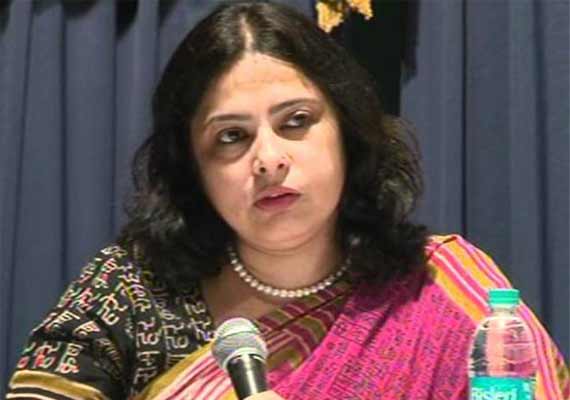
Union Minister Meenakshi Lekhi on Thursday apologized for her remarks on farmers protesting at Jantar Mantar on Thursday. She said that her statement on the attack on media person during farmers’ Parliament at Jantar Mantar was misinterpreted.

Referring to the protesting farmers, Lekhi had said they are hooligans, not farmers. These are criminal acts. What happened on January 26 was also shameful criminals activities. Opposition promoted such activities, she added.
A senior video journalist of a leading media channel was allegedly attacked during the protest organized by farmers against the three farm laws at Jantar Mantar in Delhi.

However, in her defense, Lekhi said during a press conference that her comment was sought on the Red Fort violence on January 26 and the attack on a media person (at Farmers’ Parliament). In response, I said only hooligans, not farmers can indulge in such activities,” the newly inducted Union Minister of State for External Affairs said Thursday.

My words have been distorted, if it has hurt farmers or anyone else, then I apologize and take back my words,” the minister told news agency ANI.

Bharatiya Kisan Union (BKU) leader Rakesh Tikait took cognizance of the comment and said that farmers are “annadatas” (providers of food) and not “hooligans”.

Hooligans are those who have nothing. It is wrong to make such remarks for farmers. We are farmers, not hooligans. Farmers are ‘anndatas’ of the land,” Tikait said.

Delhi Police had permitted the farmers to hold a protest at Jantar Mantar on Wednesday, subject to following all Covid-19 guidelines.

Permission was granted to limited numbers not exceeding 200 persons for Samyukt Kisan Morcha (SKM) and six persons for Kisan Mazdoor Sangharsh Committee (KMSC) from 11 am upto 5 pm daily.

Farmers have been protesting on the different borders of the national capital since November 26 last year against the three newly enacted farm laws: Farmers’ Produce Trade and Commerce (Promotion and Facilitation) Act, 2020; the Farmers Empowerment and Protection) Agreement on Price Assurance and farm Services Act 2020 and the Essential Commodities (Amendment) Act, 2020.

The government has projected the new laws as major reforms in the agriculture sector that will remove the mandi system and middlemen and allow farmers to sell their produce anywhere in the country. However, the protesting farmers argue that the new laws have no mention of minimum support price (MSP) and the mandis that will leave them at the mercy of big corporates. 

Read Also: Delhi man arrested for blackmailing women with nude pics, videos

In other India news, Karnataka Chief Minister BS Yediyurappa, who strongly denied the reports of resignation, on Thursday said he is not sure if he will continue as the chief minister after July 26

India News

New VB G RAM G Bill set to replace MGNREGA in Parliament

The government has introduced the VB G RAM G Bill in Parliament to replace MGNREGA, proposing higher employment guarantees and time-bound payments.

Published

on

The Central government has introduced a new legislation in Parliament that seeks to replace the Mahatma Gandhi National Rural Employment Guarantee Scheme (MGNREGA), setting the stage for a political confrontation during the ongoing Winter Session.

The proposed law, titled The Viksit Bharat Guarantee For Rozgar And Ajeevika Mission (Grameen), has been abbreviated as VB G RAM G. To ensure its passage, a whip has been issued, asking ruling party MPs to remain present in the House.

According to the government, the Bill introduces a fresh framework aligned with the Viksit Bharat 2047 vision, aimed at strengthening employment and livelihood support in rural areas.

What changes under the new Bill

MGNREGA, launched in 2005 under the previous UPA government, guarantees 100 days of employment to rural households and has remained a key rural welfare programme for nearly two decades.

Under the new VB G RAM G Bill, the government has proposed increasing the guaranteed employment period from 100 days to 125 days. The legislation also seeks to streamline wage payments, mandating that workers receive payments within seven to 15 days after completing assigned work.

The Bill further includes a provision for unemployment allowance if payments are not released within the stipulated timeframe, adding an accountability mechanism to the payment process.

Political implications

The introduction of the Bill during the Winter Session is expected to trigger intense debate, given MGNREGA’s long-standing role in rural employment and poverty alleviation. The government maintains that the new legislation is designed to modernise and expand the scope of employment guarantees under a restructured mission framework.

Continue Reading

India News

Chaos mars Lionel Messi’s Kolkata GOAT Tour event as fans protest poor arrangements

Lionel Messi’s brief appearance in Kolkata was overshadowed by chaos as fans alleged mismanagement, prompting an apology and an official enquiry by the state government.

Published

on

Messy event Chaos kolkata

Lionel Messi’s much-anticipated appearance in Kolkata turned chaotic on Saturday after thousands of fans alleged mismanagement at the Yuva Bharati Krirangan, leaving many unable to even see the Argentine football icon despite holding high-priced tickets

Fans express anger over limited access

The Kolkata leg of the G.O.A.T. Tour was billed as a special moment for Indian football fans, with ticket prices ranging between Rs 5,000 and Rs 25,000. However, discontent grew rapidly inside the stadium as several attendees claimed their view of Messi was obstructed by security personnel and invited guests positioned close to him.

As frustration mounted, some fans resorted to throwing chairs and bottles from the stands, forcing organisers to intervene and cut the programme short.

Event cut short amid disorder

Messi reached the venue around 11:15 am and remained there for roughly 20 minutes. He was expected to take a full lap of the stadium, but that plan was abandoned as the situation deteriorated soon after he emerged from the tunnel.

The disorder also meant that prominent personalities, including actor Shah Rukh Khan, former India cricket captain Sourav Ganguly and West Bengal Chief Minister Mamata Banerjee, could not participate in the programme as scheduled.

Organisers whisk Messi away

With fans breaching security and some vandalising canopies set up at the Salt Lake Stadium, the organisers, along with security personnel, escorted Messi out of the venue to prevent further escalation.

Several attendees described the event as poorly organised, with some fans calling it an “absolute disgrace” and blaming mismanagement for spoiling what was meant to be a celebratory occasion.

Mamata Banerjee apologises, orders enquiry

Chief Minister Mamata Banerjee later issued a public apology to Messi and the fans, expressing shock over the mismanagement. She announced the formation of an enquiry committee headed by retired Justice Ashim Kumar Ray, with senior state officials as members.

The committee has been tasked with conducting a detailed probe, fixing responsibility and suggesting steps to ensure such incidents are not repeated in the future.

Continue Reading

India News

Delhi enforces new law to regulate fees in private schools

Delhi has notified a new law to regulate private school fees, capping charges, banning capitation fees and mandating transparent, committee-approved fee structures.

Published

on

Delhi School fees

The Delhi government has officially brought into force a new law aimed at regulating fees in private schools, notifying the Delhi School Education (Transparency in Fixation and Regulation of Fee) Act, 2025. The notification was issued on Wednesday, nearly four months after the Bill was cleared by the Delhi Assembly and received approval from Lieutenant Governor V K Saxena.

The Act establishes a comprehensive framework to govern how private unaided schools fix and collect fees, with a clear emphasis on transparency, accountability and relief for parents facing repeated fee hikes.

What the new Act provides for

Under the legislation, private unaided recognised schools can charge fees only under clearly defined heads such as registration, admission, tuition, annual charges and development fees. The law caps registration fees at Rs 25, admission charges at Rs 200 and caution money at Rs 500, which must be refunded with interest. Development fees have been restricted to a maximum of 10 per cent of the annual tuition fee.

Schools have also been directed to disclose all fee components in detail and maintain separate accounts for each category. Any fee not specifically permitted under the Act will be treated as an unjustified demand.

The law strictly prohibits the collection of capitation fees, whether direct or indirect. It further mandates that user-based service charges must be collected strictly on a no-profit, no-loss basis and only from students who actually use the service.

Accounting norms and restrictions on surplus funds

To ensure financial transparency, schools are required to follow prescribed accounting standards, maintain fixed asset registers and make proper provisions for employee benefits. The transfer of funds collected from students to any other legal entity, including a school’s managing society or trust, has been barred.

Any surplus generated must either be refunded to parents or adjusted against future fees, according to the notification.

Protection for students and parents

The Act also places restrictions on punitive action by schools in fee-related matters. Schools are prohibited from withholding results, striking off names or denying entry to classrooms due to unpaid or delayed fees.

The law applies uniformly to all private unaided schools in Delhi, including minority institutions and schools not built on government-allotted land.

School-level committees to approve fees

A key feature of the legislation is the mandatory formation of a School-Level Fee Regulation Committee by July 15 each year. The committee will include five parents selected through a draw of lots from the parent-teacher association, with compulsory representation of women and members from Scheduled Castes, Scheduled Tribes and socially and educationally backward classes.

A representative from the Directorate of Education will also be part of the panel, while the chairperson will be from the school management.

Schools must submit their proposed fee structure to the committee by July 31. The committee can approve or reduce the proposed fees but cannot increase them. Once finalised, the fee structure will remain fixed for three academic years.

The approved fees must be displayed prominently on the school notice board in Hindi, English and the medium of instruction, and uploaded on the school website wherever applicable.

The Delhi government had earlier described the legislation as a significant step towards curbing arbitrary fee hikes after widespread complaints from parents at the start of the academic session.

Continue Reading

Trending

© Copyright 2022 APNLIVE.com