English हिन्दी
Connect with us

India News

Padma Awards 2020: Here is the full list of 141 recipients this year

The President of India approved 141 names for this year’s Padma Awards – one of the highest civilian Awards of the country. The awards conferred in three categories – Padma Vibhushan, Padma Bhushan and Padma Shri are given in various disciplines/ fields of activities.

Published

on

Padma Awards

The President of India approved 141 names for this year’s Padma Awards – one of the highest civilian Awards of the country. The awards conferred in three categories – Padma Vibhushan, Padma Bhushan and Padma Shri are given in various disciplines/ fields of activities, viz. art, social work, public affairs, science and engineering, trade and industry, medicine, literature and education, sports, civil service, etc. This year seven prominent personalities have been chosen for Padma Vibhushan, 16 personalities for Padma Bhushan and 118 people for Padma Shri awards.

Padma Vibhushan, the second-highest civilian award of the Republic of India, second only to the Bharat Ratna, is awarded for exceptional and distinguished service. This year former union ministers Arun Jaitley, Sushma Swaraj and George Fernandes have been awarded the Padma Vibhushan posthumously. Olympian boxer Mary Kom, former Mauritius Prime Minister Anerood Jugnauth have also been honoured with the Padma Vibhushan.

Padma Bhushan, the third-highest civilian award, is given for “distinguished service of a high order…without distinction of race, occupation, position or sex.” This year’s recipeints include – Former defence minister Manohar Parrikar, industrialists Anand Mahindra and Venu Shrinivasan, Olympian badminton player P V Sindhu, former Nagaland chief minister S C Jamir and Jammu and Kashmir politician Muzaffar Hussain Baig.

The Padma Shri awarded for distinguished service in any field has been awarded to 117 people this year. Activist Abdul Jaffar who fought for the victims of the 1984 Bhopal gas tragedy, was conferred the Padma Shri posthumously. Jagdish Lal Ahuja, who serves free food to patients and attendants outside PGI hospital in Chandigarh; Mohammed Sharif from Faizabad, who has performed last rites of over 25,000 unidentified bodies and veterinarian from Assam Kushal Konwar Sarma who is known for treating elephants have been given the Padma Shri this year.

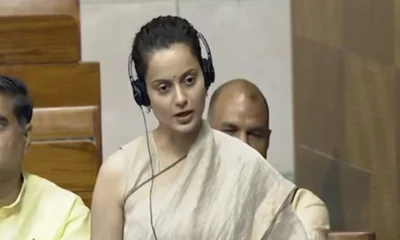
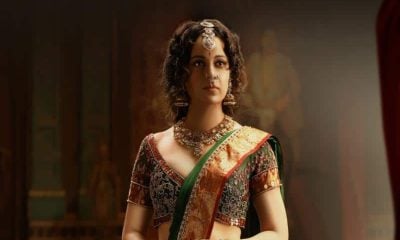
Bollywood personalities Kangna Ranaut, Karan Johar and Ekta Kapoor have also been conferred the the Padma Shri for their contribution to the field of art.

These awards are conferred by the President of India at ceremonial functions which are held at Rashtrapati Bhawan usually around March/ April every year.

Here is the full list of this year’s Padma Awards:

Padma Vibhushan

  • George Fernandes (Posthumous)
  • Arjun Jailtley (Posthumous)
  • Sushma Swaraj (Posthumous)
  • Sir Anerood Jugnauth
  • M.C Mary Kom
  • Chhannulal Mishra
  • Sri Vishveshateertha Swamiji Sri Pejavara Adhokhaja Matha Udipi

Padma Bhushan

  • M. Mumtaz Ali
  • Syed Muazzem Ali
  • Muzaffar Hussain Baig
  • Ajoy Chakravorty
  • Manoj Das
  • Balkrishna Doshi
  • Krishnammal Jagannathan
  • S.C Jamir
  • Anil Prakash Joshi
  • Dr. Tsering Landol
  • Neelakanta Ramakrishna Madhava Menon (Posthumous)
  • Manohar Gopalkrishna Prabhu Parrikar
  • Prof. Jagdish Sheth
  • P V Sidhu
  • Venu Srinivasan

Padma Shri

  • Guru Shashdhar Acharya
  • Dr. Yogi Aeron
  • Jai Prakash Agarwal
  • Jagdish Lal Ahuja
  • Kazi Masum Akhtar
  • Ms. Gloria Arieira
  • Khan Zaheerkhan Bakhtiyarkhan
  • Dr. Padmavathy Bandopadhyay
  • Dr. Sushovan Banerjee
  • Dr. Digambar Behera
  • Dr. Dayamanti Beshra
  • Pawar Papatrao Bhaguji
  • Himmata Ram Bhambhu
  • Sanjeev Bikhchandani
  • Gafurbhai M. Bilakhia
  • Bob Blackman
  • Indira P.P Bora
  • Madan Singh Chauhan
  • Usha Chaumar
  • Lil Bahadur Chettri
  • Lalitha & Ms. Saroja Chidambaram (Duo)
  • Dr. Vajira Chitrasena
  • Dr. Puroshattam Dadheech
  • Utsav Charan Das
  • Prof. Indra Dassanayake
  • H.M Desai
  • Manohar Devadoss
  • Oinam Bembem Devi
  • Lia Diskin
  • M.P Ganesh
  • Dr. Bangalore Gangadhar
  • Dr. Raman Gangakhedkar
  • Barry Gardiner
  • Chewang Motup Goba
  • Bharat Goenka
  • Yadla Gopalarao
  • Mitrabhanu Gountia
  • Tulsi Gowda
  • Sujoy K Guha
  • Harekala Hajabba
  • Enamul Haque
  • Mandhu Mansuri Hasmukh
  • Abdul Jabbar
  • Bimal Kumar Jaim
  • Meenakshi Jain
  • Nemrath Jain
  • Shanti Jain
  • Sudhir Jain
  • Benichandra Jamatia
  • K.V Sampath Kumar & Ms. Vidushi Jayalaxmi K.S (Duo)
  • Karan Johar
  • Dr. Leela Joshi
  • Sarita Joshi
  • C Kamlova
  • Dr. Ravi Kannan R.
  • Ekta Kapoor
  • Yazdi Naoshirwan Karanjia
  • Narayan J. Josji Karayal
  • Dr. Narindar Nath Khanna
  • Naveen Khanna
  • S.P Kothari
  • V.K Munuswamy Krishnapakthar
  • M.K Kunjol
  • Manmohan Mahapatra
  • Ustad Anwar Khan Mangniyar
  • Kattungal Subramaniam Manilal
  • Munna Master
  • Prof. Abhiraj Rajendra Mishra
  • Binapani Mohanty
  • Dr. Arundoy Mondal
  • Dr. Prithwindra Mukherjee
  • Sathyanarayan Mundayoor
  • Manilal Nag
  • N. Chandrasekharan Nair
  • Dr. Tetsu Nakamura(Posthumous)
  • Shiv Datt Nirmohi
  • Pu Lalbiakthanga Pachuau
  • Moozhikkal Pankajakshi
  • Dr. Prasant Kumar Pattanaik
  • Jogendra Nath Phukan
  • Rahibai Soma Popere
  • Yogesh Praveen
  • Jitu Rai
  • Tarundeep Rai
  • S. Ramakrishnan
  • Rani Rampal
  • Kangana Ranaut
  • Dalavai Chalapathi Rao
  • Shahbuddin Rathod
  • Kalyan Singh Rawat
  • Chintala Venkat Reddy
  • Dr. Shanti Roy
  • Dr. Radhammohan and Ms. Sabarmatee (Duo)
  • Batakrushna Sahoo
  • Trinity Saioo
  • Adnan Sami
  • Vijay Sankeshwar
  • Dr. Kushal Konwar Sharma
  • Sayed Mehboob Shah Qadri
  • Mohammed Sharif
  • Shyam Sunder Sarma
  • Dr. Gurdip Singh
  • Ramjee Singh
  • Vashishtha Narayan Singh(Posthumous)
  • Daya Prakash Sinha
  • Dr. Sandra Desa Souza
  • Vijayasarathi Sribhashyam
  • Kalee Shabi Mahaboob & Sheikh Mahaboob Subani (Duo)
  • Javed Ahmad Tak
  • Pradeeo Thalappil
  • Yeshe Dorjee Thongchi
  • Robert Thurman
  • Angus Indra Udayana
  • Harish Chandra Verma
  • Sundaram Verma
  • Dr. Romesh Tekchand Wadwani
  • Suresh Wadekar
  • Prem Watse

India News

Congress, BJP attack Bhagwant Mann over remarks on Punjab blasts

Congress and BJP have jointly criticised Punjab CM Bhagwant Mann after he linked recent blasts near defence sites to political motives, triggering a controversy.

Published

on

Bhagwant Mann

A political row has erupted in Punjab after Chief Minister Bhagwant Mann linked recent blast incidents to political motives, drawing sharp criticism from both the Congress and the Bharatiya Janata Party (BJP).

The controversy follows two low-intensity explosions reported within a short span of time — one near the Border Security Force (BSF) headquarters in Jalandhar and another close to an army cantonment area in Amritsar. The incidents raised concerns over security, particularly given the sensitive nature of the locations.

In response, Mann suggested that the blasts could be part of a larger political strategy. His remarks triggered a strong backlash, with opposition parties accusing him of politicising a serious security issue.

Leaders from the Congress criticised the Chief Minister’s statement, calling it inappropriate and alleging that such comments undermine the gravity of the situation. They stressed that matters related to national security should be handled with caution and responsibility.

The BJP also joined the criticism, questioning the basis of Mann’s claims and urging the state government to focus on investigation and law enforcement instead of making political allegations.

The developments have led to an unusual moment where both Congress and BJP appear aligned in their criticism of the Aam Aadmi Party-led government in the state.

Meanwhile, the blasts themselves have intensified concerns over safety in border regions, with authorities continuing their investigation into the incidents. No casualties were reported, but the proximity to defence establishments has made the issue particularly sensitive.

The episode has further escalated political tensions in the state, with security and accountability emerging as key points of debate.

Continue Reading

India News

Himanta Biswa Sarma resigns as Assam chief minister, oath ceremony likely after May 11

Himanta Biswa Sarma resigns as Assam Chief Minister after BJP-led NDA’s victory. He will continue as caretaker CM until the new government is sworn in after May 11.

Published

on

Himanta sharma

Assam Chief Minister Himanta Biswa Sarma resigned from his post on Wednesday, paving the way for the formation of a new government after the BJP-led NDA secured a decisive victory in the 2026 Assembly elections.

Sarma submitted his resignation to Governor Lakshman Prasad Acharya at Lok Bhawan in Guwahati. The Governor accepted the resignation and asked him to continue as the caretaker Chief Minister until the new government takes charge.

The resignation comes after the NDA’s strong electoral performance, where the alliance won a clear majority in the 126-member Assembly, ensuring its return to power for another term.

Oath ceremony expected after May 11

Speaking to reporters after submitting his resignation, Sarma said the swearing-in ceremony for the new government is likely to be held after May 11.

He indicated that Prime Minister Narendra Modi has been invited to attend the ceremony but is unavailable until May 11, which has influenced the tentative schedule.

Decision on next chief minister soon

Sources suggest that central observers, including senior BJP leaders, are expected to arrive shortly to oversee the selection of the legislature party leader. The newly elected MLAs will then decide on the next Chief Minister.

Despite the formal resignation, party sources indicate that Sarma is likely to continue in the role for another term, given the BJP’s strong mandate in the state.

The move marks the beginning of the government formation process in Assam following the election results declared earlier this week.

Continue Reading

India News

Rahul Gandhi and Vijay alliance took shape through backchannel talks, early signals from Congress leaders

Congress outreach and political calculations led to Rahul Gandhi and Vijay coming together after the Tamil Nadu 2026 election results.

Published

on

The coming together of Rahul Gandhi and actor-politician Vijay in Tamil Nadu after the 2026 Assembly elections was not sudden, but the result of behind-the-scenes political manoeuvring and early signals within the Congress.

According to media reports, some leaders in the Tamil Nadu Congress had already sensed the scale of Vijay’s surge during the campaign, anticipating what was later described as a “wave” in favour of his party.

After the results, where Vijay’s Tamilaga Vettri Kazhagam (TVK) emerged as the single largest party but fell short of a majority, communication channels between the Congress leadership and Vijay quickly became active.

A key moment in this evolving political equation was a phone call from Rahul Gandhi to Vijay, congratulating him on the party’s strong performance. The conversation was seen as more than a courtesy, signalling the possibility of cooperation at a time when government formation required additional support.

Reports indicate that discussions within Congress weighed the political benefits of supporting Vijay, especially given the shifting dynamics in the state where traditional dominance by major Dravidian parties has been challenged.

With TVK needing allies to cross the majority mark, Congress emerged as a potential partner, leading to a broader political realignment in the state. This development also triggered tensions within opposition alliances, highlighting the strategic importance of the decision.

The evolving partnership reflects a mix of electoral pragmatism and changing voter sentiment, particularly the growing influence of younger voters, which leaders acknowledged as a key factor in the election outcome.

Continue Reading

Trending

© Copyright 2022 APNLIVE.com