As the Delhi High Court orders that over 16,500 trees not be cut for a redevelopment project to house government officers, residents heave a sigh of relief
~By Ramesh Menon
Choked with dust storms and pollution, there was good reason for residents of Delhi to heave a sigh of relief last week. The Delhi High Court last week extended its prohibition order on the axing of over 16,500 trees in upmarket areas of south Delhi.
The Environment Ministry had given clearance in one sitting to cut nearly 16,500 trees spread over 571 acres. This was to make way for seven housing projects for central government officers costing around Rs. 32,835 crore.
A bench of acting Chief Justice Gita Mittal and Justice C. Hari Shankar said, “The damage to the environment cannot be undone. We cannot compromise on the environment, no matter the cost. The damage to the environment is irreplaceable.”
The bench demanded that deliberations made before the environmental clearance was given be placed before it and remarked that it was clear that application of the mind was not done before such a decision was taken.
Clearly, the central government wanted to build these multistoried flats in the heart of tony Delhi which is what top officers would love and lobby for.
It was also an attractive commercial option as it could sell or rent out shops created as a part of the infrastructure.
Instead, it could easily have identified areas in the National Capital Region where large tracts of land are available. Apart from being cheaper, it would not damage the environment.
Delhi has emerged as one of the most polluted cities in the world with its exploding population. And, the cutting of thousands of trees will make it worse.
The Union Cabinet had in July 2016 granted an approval for expanding housing facilities to government officials saying it was to ease the pressure of having many demanding accommodation which was not available.
Kanchi Kohli, environmental researcher, Centre for Policy Research, told India Legal: “While felling of the trees sent off the first set of alarms, the issue of the ‘redevelopment’ in Delhi has thrown open several issues. These projects have been approved without proper assessments including what is going to be the implications on air quality, fresh water use or traffic congestion. Moreover, there are some serious legal and procedural violations that citizens have pointed out.”
The court was hearing several public interest litigations that challenged the terms of reference and the environmental clearance granted to these housing saying that it would lead to the axing of thousands of trees that were today functioning as Delhi’s lungs.
These projects were to come up in projects in Sarojini Nagar, Nauroji Nagar, Netaji Nagar, Thyagaraja Nagar, Kasturba Nagar, Mohammadpur, and Sriniwaspuri where real estate is expensive.
DESTROYING LUNGS
It’s a worrisome scenario. If the redevelopment plan goes through, 96.8 per cent of trees will be cut in Nauroji Nagar; 83.8 per cent will be cut in Sarojni Nagar and 77.6 per cent will be cut in Netaji Nagar.
Already, thousands of trees have been axed due to development projects in Delhi and also because of the building of the Delhi Metro.
Environmentalist Vimlendu Jha told India Legal: “Delhi already has a deficit of nine lakh trees and cutting down another 16,500 will make it worse. The government cannot just go about changing the master plan just because it has commercial interests.”
The court has also sought response of the authorities on a contempt plea filed by Jha alleging that there was deliberate and willful default of an undertaking given to the court by the NBCC not to cut trees till July 4 for housing projects. “I fear that a lot of damage has already been done,” said Jha.
The project is being executed by the National Buildings Construction Corporation Limited (NBCCL) and the Central Public Works Department.
Trying to shield itself, the NBCCL told the court that the proposal was sanctioned by the Union Cabinet which considered the master plan before giving its nod. The bench responded by saying that it was high time for the authorities to decide to have a green master plan for Delhi.
RELOOK NEEDED
Environmental expert Gautam Bhan who had been asked by the court for his opinion of the project and its impact on the environment, said that the entire clearance needed a relook on the basis of the “precautionary principle”. What the precautionary principle essentially means is that when human activities may lead to morally unacceptable harm, actions should be taken to avoid or diminish that harm before it occurs. These actions should be proportional to the seriousness of the potential harm.
Mann pointed out to the court that compensatory afforestation or transplantation was unviable. Instead, standing trees should be included in the redevelopment plan, he suggested. Environmentalists have all along cautioned that most saplings die as they are not looked after in the initial years.
In its order, the court observed that it was worrying to see that the Delhi Development Authority was trying to increase the floor area ratio on the basis of increasing population density without applying its mind to the services that would need to be provided if that happened.
Earlier, the court in the same case had asked the state-owned real estate company, NBCCL whether Delhi could even afford to cut trees for development of roads and buildings.
REDESIGN AND NOT DESTROY
Chandra Bhushan, deputy director general of the Centre for Science and Environment, told India Legal that as Delhi’s green cover was already low, new development plans must be made around the green cover and not end up removing it. “A lot of environmental clearances are now being contested in court as it was done hastily and carelessly without taking into consideration crucial environment issues,” he said.
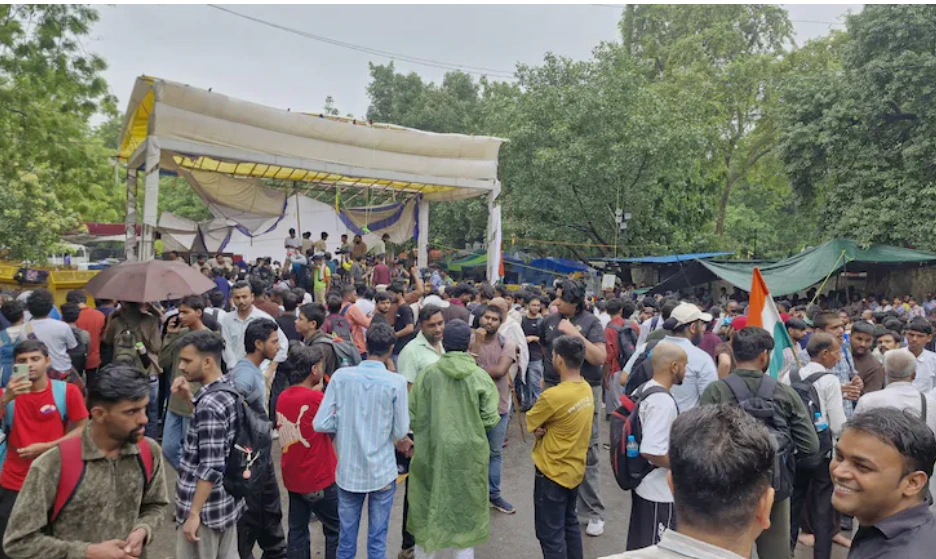
Saving Delhi’s trees has become a citizens’ movement. Thousands of residents near the Sarojini Nagar metro station waved placards saying, “Save Trees Save Delhi, Don’t Cut Down life Cut Your Greed”, to protest against the redevelopment plan. Residents embraced trees rekindling memories of the famous Chipko movement in the early seventies led by legendary Sunderlal Bahuguna in what is now Uttarakhand. Among them was Delhi’s environment minister Imran Hussain.
Pointed out Kohli, “Large real estate development like the present one in Delhi need thorough scrutiny without exemptions. The environment ministry must consider reinstating the requirement for public hearings for these projects. As on date, construction and township development projects require much less environmental scrutiny and are exempt from any form of public consultations.”
The contention of the government that more trees would be planted to compensate hardly helps as most samplings die. If they survive, it will take decades for it to grow. Most of the trees are of a native variety that support and allow bio-diversity to flourish as it is a home to insects, birds and other types of vegetation. All this will vanish if trees are removed.
More importantly, it also functions as a good dust cover in summer when the capital faces the onslaught of dust storms from the Rajasthan desert and from the increasing construction debris that is just dumped and not disposed in a scientific manner.
Anumita Roy Chowdhury, executive director, research and advocacy, Centre for Science and Environment, highlights the fact that the country’s cities are being built as concrete jungles. It ends up generating more heat and also produces more sulphur and nitrogen oxides disrupting the ecosystem. So, new construction strategies and designs should incorporate sustainable methods and not get rid of the existing green cover, she said.
BLAME GAME
Ironically, it triggered off name blaming by political parties with Delhi’s Aam Aadmi Party and the BJP trading charges against each other. The AAP spokesperson Saurabh Bharadwaj pointed out that the environment clearance for the project was cleared in 2017 by the Union Environment Ministry and was given final approval by Anil Baijal, the Lieutenant Governor. The BJP said that AAP’s environment minister Imran Hussain had approved it.
In a press conference organized by AAP, Hussain said, “The redevelopment should be shifted to such a place where there is not so much harm to the trees. We will not less this happen, I will request Delhi’s LG Anil Baijal and Union minister Hardeep Puri to not turn this area into a concrete jungle.”
For millions of residents who live in India’s capital and the surrounding areas like Gurgoan, Noida and Faridabad, the judiciary seems to be the last hope.