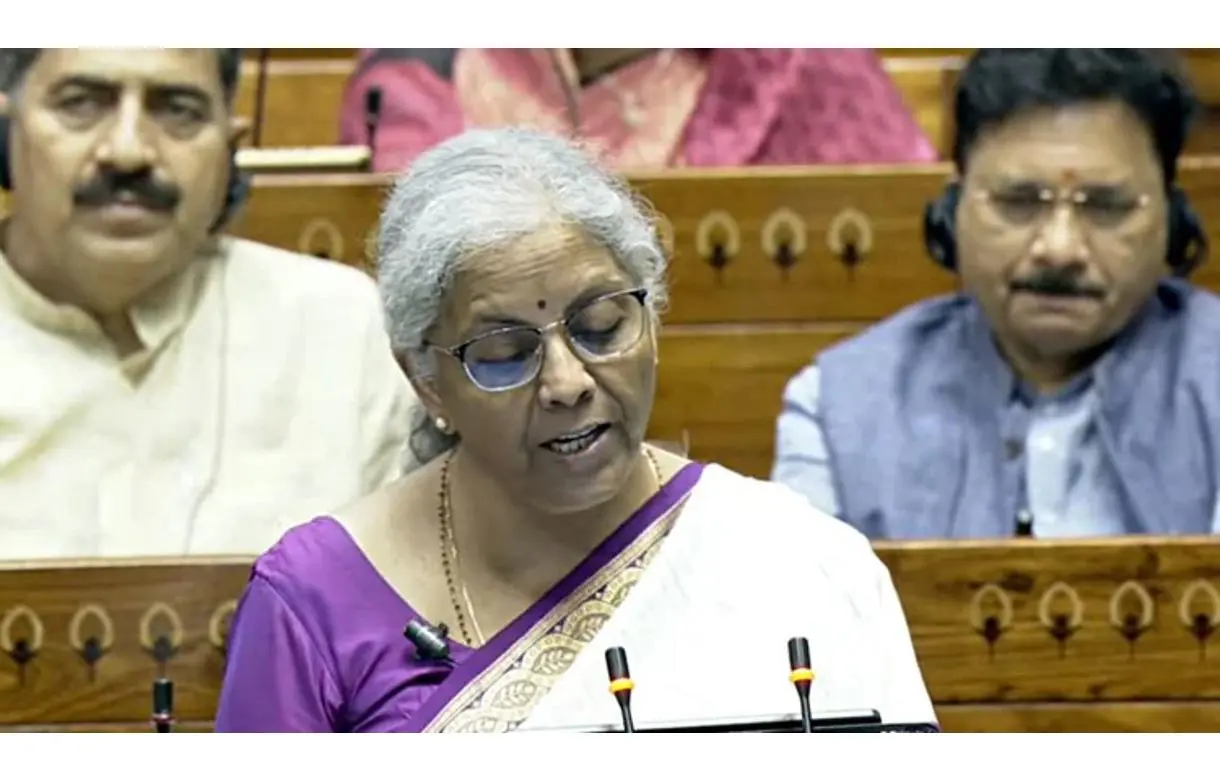
Nirmala Sitharaman presents the Union Budget 2024
Finance Minister Nirmala Sitharaman today started presenting the Union Budget 2024. She said the people of India have reposed their faith in the government led by Prime Minister Narendra Modi and re-elected it for the historic third term.
Sitharaman says, “India’s economic growth remains the shining exception and will continue to be so. India’s inflation continues to remain low.”
Finance Minister highlighted the four main focus points of the first budget under the Modi 3.0 government. It includes: ‘Garib’ (Poor), ‘Yuva’ (Youth), ‘Annadata’ (Farmer) and ‘Nari’ (Women).
Sitharaman says, “As mentioned in the interim Budget, we need to focus on 4 different castes, the poor, women, youth and the farmer/ For farmers, we announced higher Minimum Support Prices for all major crops delivering on the promise for at least a 50% margin over cost. PM Garib Kalyan Anna Yojana was extended for 5 years benefitting more than 80 crore people.”
“India’s economic growth continues to be the shining exception and will remain so in years ahead. India’s inflation continues to be low and stable moving towards the 4% target”, says Finance Minister.
Sitharaman says she is happy to announce the Prime Minister’s package of 5 schemes and initiatives to facilitate employment, skilling and other opportunities for 4.1 crore youth over 5 years with a central outlay of Rs 2 lakh crores. “This year we have made a provision of Rs 1.48 lakh crores for education, employment and skilling”, she adds.
In her Budget speech, she highlighted that this year’s Budget envisages sustained efforts on nine priorities: productivity & resilience in agriculture, employment & skilling, inclusive human resource development & social justice, manufacturing & services, urban dev, energy securities, infra, innovation, R&D, next gen reforms.
Sitharaman said her government will implement three schemes for employment-linked incentives as part of the Prime Minister’s package. These will be based on enrollment in the EPFO and focus on recognition of the first time employees and support to employees and employers, she added.
“109 new varieties will be brought into horticulture” says Sitharaman. The emphasis on storage and marketing of oil seeds, she added.
Sitharaman said that the coordination in agriculture sector between Center and State. National Corporation Policy for Cooperative Sector, she added.
She says, “DBT 15 thousand per month for new employees. Government will fund all additional employees. Coordination with states and private enterprises for skilling programs. Social justice for farmers, young women.”
She emphasised on development of eastern regions like Bihar, Jharkhand.
She says, “Amritsar-Kolkata corridor will be built.”
Andhra will get Rs 15 thousand crores, says Finance Minister.
Additional funds for capital investment, she says. Three crore houses will be built under PAM housing scheme and Rs 3 lakh crore for women’s development. She emphasised on development focused on 63 thousand villages. There will be a special attention on MSME, she asserts.
10 lakh crore, under PM Awas Yojana, for urban poor and middle class families to be addressed, says FM Sitharaman.
Sitharaman says Govt to launch scheme for internship opportunities to 1 crore youth in 500 top companies
She announces a scheme for providing internship opportunities to one crore youths in 500 top companies across the country in a span of five years. This opportunity will come with an internship allowance of Rs 5000 per month along with one-time assistance of Rs 6000. She further says, “about 12 Industrial parks have been sanctioned under National Industrial Corridor Development Programme.”
Sitharaman announces one month wage to all persons newly entering the workplace in all formal sectors. Direct Benefit Transfer of one month salary in 3 instalments to first-time employees as registered in the EPFO will be up to Rs 15,000, she says. The eligibility limit will be a salary of Rs 1 lakh per month. The scheme will benefit 210 lakh youth.
On the Amritsar-Kolkata industrial corridor, Sitharaman says that her government will support the development of an industrial nod at Gaya in Bihar. It will catalyse the development of the easter region.
The government will also support the development of road connectivity projects- Patna -Purnea expressway, Buxar- Bhagalpur highway, Bodhgaya- Rajgir-Vaishali- Darbhanga and an additional two-lane bridge over river Ganga in Buxar for Rs 26,000 crores, she emphasises.
On Andhra Pradesh Reorganisation Act, she says that her government has made efforts to fulfil the commitments in Andhra Pradesh Reorganisation Act. Recognising the state’s need for capital, she added that the government will facilitate special financial support through multilateral agencies. In the current FY, Rs 15,000 crore will be arranged with additional amounts in future years, she says.
ON MSMEs, the Finance Minister says for facilitating term loans to MSMEs, a credit guarantee scheme will be introduced. The scheme will operate on the cooling of credit risks of such MSMEs. A self-financing guarantee fund will provide to each applicant cover of up to Rs 100 crore while loan amount may be larger.
The Finance Minister emphasises on power projects including setting up of a new 2400 MW power plant at Pirpainti will be taken up at the cost of Rs 21,400 crores. New airports, medical colleges and sports infrastructure in Bihar will be constructed, she adds.
The requests of Bihar Govt for external assistance from multilateral development banks will be expedited, she says.
Sitharaman says, “Working women hostels will be set up. Higher participation of women in workforce to be promoted through hostels and creches. Our government will bring National Cooperation Policy for overall development. Our government will provide financial support for loans upto 10 lakhs for higher education in domestic institutions”
On free solar electricity scheme, Sitharaman says PM Suryaghar Muft Bijli Yojana has been launched to install rooftop solar panels to enable 1 crore households to obtain free electricity upto 300 units each month. This scheme will further encourage it.
On development of small and modular nuclear reactors in the country, she says the govt will partner with the private sector for setting up Bharat small reactors, research and development of Bharat small modular reactors & research and development of newer technologies for nuclear energy.
Sitharaman said that the integrated technology platform will be set up for improving the outcomes under Insolvency & Bankruptcy Code. Debt recovery tribunals will be strengthened & additional tribunals will be established to speed up recovery, she added.
Nitish Kumar’s Janata Dal (United) and BJP’s second biggest ally in the NDA, has been asking for special status for Bihar for the past several years. Following the formation of the new Narendra Modi government the party’s national executive passed a resolution seeking special status or special package for Bihar.
PM Gram Sadak Yojana Phase 4 will be launched to provide all-weather roads to 25,000 rural habitats. Bihar has frequently suffered from floods. Plans to build flood control structures in Nepal are yet to progress. The government will provide financial support with an estimated cost of Rs 11,500 crore.
Assam, which grapples with floods every year, will receive assistance for flood management and related projects. Himachal Pradesh, having suffered extensive losses due to floods, will also receive support for reconstruction through multilateral assistance. Additionally, Uttarakhand, which faced significant damage from landslides and cloudbursts, will be provided with necessary assistance.
The government endeavours to maintain strong fiscal support for infrastructure over the next 5 years. Capital expenditure to be Rs 11,11 lakh crore at 3.4% of the GDP. Total receipts – 32.07 lakh crore; total expenditure 48.21 lakh crore; fiscal deficit – 4.9% of GDP.
Tourism has always been a part of our civilisation. The government efforts to position India as a global destination will also create jobs and unlock opportunities in other sectors. Sitharaman proposes Vishnupath temple at Gaya, and Mahabodhi temple in Bodhgaya are of immense spiritual importance.
She said that the government will develop corridors there on the model of the successful Kashi Vishwanath corridor to make them a world-class tourist destination. A comprehensive development initiative for Rajgir and Nalanda, in Bihar will be pursued.
The government will support tourism in Odisha that has scenic beauty, temples, craftsmanship, natural landscapes, wildlife sanctuaries and pristine beaches.
Sitharaman said that government has proposed to set up a venture capital fund of ₹1000 crore for the space economy.
Nirmala Sitharaman proposes to reduce the BCD on mobile phones and mobile PCBS and mobile chargers to 15%.
Powering Innovation, Research & Development: Anusandhan National Research Fund will be set up for basic research and prototype development. Financing pool of Rs 1 lakh crore to spur private sector-driven research and innovation at commercial scale will also be done.
Sitharaman announces to reduce customs duties on gold and silver to 6% and 6.5% on platinum.
Three cancer treatment medicines to be exempt from basic customs duty, she emphasises.
The Finance Minister announces a comprehensive review of the Income Tax Act 1961. This will reduce disputes and litigation. It is proposed to be completed in 6 months.
The TDS rate on e-commerce operators reduced from 1% to 0.1%.
A comprehensive review of the customs duty structure over the next 6 months. TDS rate on e-commerce to be reduced to 0.1%. Sitharaman proposed that two tax exemption regimes for charities merge into one. She also proposed to decriminalize TDS delay up to the filing of tax date.
25 critical minerals to be exempted from customs duties & BCD on two of them to be reduced, says FM Sitharaman.
Employment, agricultural productivity, manufacturing among nine priorities outlined by government in Union Budget.