English हिन्दी
Connect with us

Latest Politics News

The Russians are back, the Russians are back!

Published

on

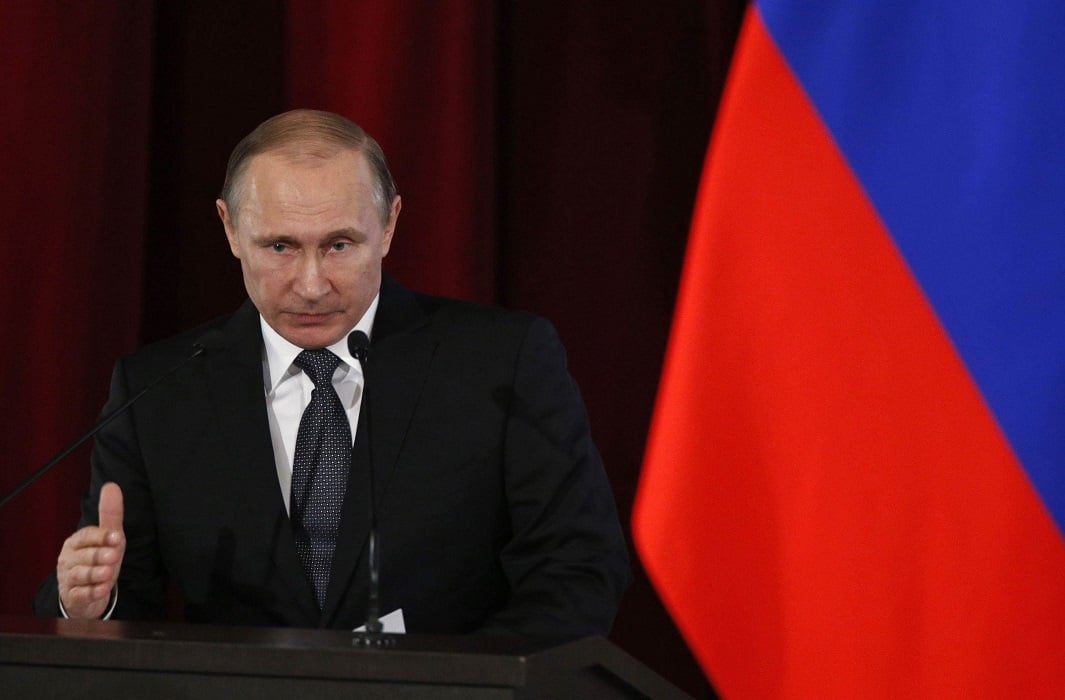
It is perhaps his contempt for liberals that ties Russian president Vladimir Putin to US president-elect Donald Trump, and vice versa. Photo: UNI

[vc_row][vc_column][vc_column_text]There was a sentimental 1966 movie, The Russians Are Coming, The Russians Are Coming. In 2017, the Russians reappear in American imagination in darker shades

Parsa Venkateshwar Rao Jr

It is a strange situation, to say the least. US President-elect Donald Trump is at loggerheads with the country’s intelligence agencies—the Federal Bureau of Investigation (FBI) and the Central Intelligence Agency (CIA). And in the battle between Trump and intelligence agencies, the bone of contention is the old enemy—Russia. FBI and CIA are playing true to expectations when they think that Russia, the old enemy and villain is the new enemy and villain after the post-Cold War interregnum of a quarter century.

The surprising thing is Trump is not at all harsh on Russia or the Russian president, Vladimir Putin. Putin expressed his liking for Trump, and the Russian president’s aversion for Democrat presidential candidate is quite unconcealed. So, the inference being drawn is that Putin used Russian intelligence agencies and its hackers to spread “fake news” about Hillary and contributed to her defeat in the election. Many of the American politicians, and especially the liberal media, believe that there was a Russian hand behind Hillary’s fall. They are all looking for unimpeachable proof to confront Trump, to prove that he won thanks to the devilish Russians.

Has the New Cold War begun, a 2017 Rhett Butler would be tempted to ask. It seems it has, but it may not develop into a full-fledged ideological contest that it was during the old Cold War. Putin is no communist thought he was the protégé of his communist boss, Yuri Andropov, the second last one before reformist Mikhail Gorbachev took office in 1985 after the death of the last communist general secretary, Konstantin Chernenko. But he is a Russian ruler made in the image of the long-forgotten pre-communist Tsars/Czars. He is not trusted by the liberal West, and he even wants not to be trusted by the liberals because he has no use for liberals. It is perhaps this contempt for liberals that ties Putin to Trump and vice versa.

Ex-Exxon CEO Rex Tillerson is known to be a friend of Putin and the Russians, and Trump’s nominee for the post of secretary of state. At the senate hearings on Wednesday, the Senate Foreign Relations Committee, especially former Republican presidential nomination aspirant, Marc Rubio grilled Tillerson about his views on Putin. But Tillerson held out, refusing to make a negative assessment about the Russian president with incomplete information. Trump too held out from saying anything against Putin at the press conference on Wednesday. Both Tillerson and Trump were willing to believe that Russia could be a possible villain. But as to Putin, not yet is their answer.

Why are Trump and Tillerson not willing to judge Putin? The reason is that they are not wedded to the liberal rhetoric of democracy and human rights. They seem to believe that if trade with Russia were to benefit the US business, then it should be okay to sup with the proverbial devil. And at least in the case of Trump, he seems to be harping on the point that Russia could be an American ally in the war against the Islamic State (IS). But his opposition to IS is not firm either because he blames Barak Obama and Hillary Clinton for the creation of IS because Obama pulled out American troops from Iraq much too soon. Of course, it looks more like off-the-cuff political riposte on the part of Trump rather than a careful thought-out assessment. It should not come as a surprise if Trump would not find partnering with the IS to fight some other enemy. That flows from his non-ideological and amoral position in matters of trade.

It is turning out to be dark comedy, in complete contrast to a 1966 Hollywood movie, The Russians Are Coming, The Russians Are Coming, directed by Norman Jewison, and starring Alan Arkin and Eva Marie Saint among others, where a Russian submarine runs aground near New England, off the eastern coast of America, and the flutter it causes. But it ends on a sentimental Hollywoodish note, with flowers and tears and love. That was liberal Hollywood loving the ordinary Russian folk and hating the dark powers symbolised by the communists in the Kremlin. In 2017, it appears that the non-liberal Trump and Tillerson seem to like the dark Russian ‘prince’ while remaining suspicious of Russia!

Lead picture: It is perhaps his contempt for liberals that ties Russian president Vladimir Putin to US president-elect Donald Trump, and vice versa. Photo: UNI[/vc_column_text][/vc_column][/vc_row]

India News

Congress Dismisses Karnataka Leadership Transition Rumors After Six-Hour Delhi Meet

The Congress party has rejected ongoing rumors regarding a leadership change or a rotating Chief Minister formula in Karnataka, stating that a recent six-hour meeting in Delhi focused strictly on the upcoming Rajya Sabha and MLC elections.

Published

on

The Congress party has strongly downplayed the intense political buzz surrounding a potential leadership transition or a change in the Chief Minister’s post in Karnataka. Following a marathon six-hour meeting with the state’s top leadership in New Delhi, the party explicitly rejected the ongoing speculation, labeling it as having “no reality.”

A brief statement issued to the media after the high-level meeting advised against spreading rumors, clarifying that the discussions were entirely centered on upcoming electoral strategies rather than structural changes within the state government. The party stated that the deliberations solely revolved around the state’s three vacant Rajya Sabha seats and the upcoming Member of Legislative Council (MLC) elections.

Rajya Sabha and MLC Polls Take Center Stage

The high-stakes meeting was attended by Congress President Mallikarjun Kharge, senior leader Rahul Gandhi, and party General Secretary KC Venugopal, alongside Karnataka Chief Minister Siddaramaiah and Deputy Chief Minister DK Shivakumar.

Briefing the media post-meeting, KC Venugopal stated that conversations were strictly confined to the Rajya Sabha and MLC elections, emphasizing that there is no truth to any other political speculation. Chief Minister Siddaramaiah also confirmed that the agenda of a potential cabinet expansion or a leadership shift did not come up during the six-hour-long discussion.

Background of the Power Struggle

The question of leadership in Karnataka has remained a recurring theme for over a year. Supporters of Deputy Chief Minister DK Shivakumar have consistently maintained that the central leadership promised a rotating Chief Ministership arrangement when the government was formed after the 2023 assembly elections.

Speculation had intensified recently as the ruling government faced local anti-incumbency pressures alongside renewed political activity from the opposition bench. Some internal reports had even indicated a push from within certain sections of the high command, including Priyanka Gandhi Vadra, for a leadership revamp.

Balancing Caste Equations and Party Structure

The central leadership has navigated the situation cautiously to maintain political stability. Chief Minister Siddaramaiah, 80, commands a powerful “Ahinda” support base—a coalition comprising minority communities, backward classes, and Dalits. This social alliance was crucial in helping the party navigate the traditional Vokkaliga and Lingayat caste dynamics during the 2023 elections.

Although the rotation issue had previously gained significant momentum when the government completed two years in office, the party high command had chosen to maintain the status quo to avoid any adverse electoral impact in neighboring assembly elections, such as in Tamil Nadu. With those elections concluded, supporters of the 64-year-old Deputy Chief Minister had expressed optimism for a transition. Shivakumar currently holds the dual responsibility of being the Deputy Chief Minister as well as the state Congress chief, signaling his critical organizational value to the party. However, for the time being, the party high command has firmly signaled that the current leadership structure will remain unchanged.

Continue Reading

India News

Congress high command steps in to resolve Karnataka leadership impasse with crucial Delhi meeting

The Congress leadership, including Mallikarjun Kharge and Rahul Gandhi, is holding a vital meeting in Delhi with Karnataka Chief Minister Siddaramaiah to find a definitive solution to the state’s prolonged leadership impasse.

Published

on

The top leadership of the Congress party is scheduled to hold a high-level meeting at its headquarters in the national capital today morning to address the long-standing leadership dispute in Karnataka. Senior leaders, including party president Mallikarjun Kharge and MP Rahul Gandhi, will lead the discussions aimed at resolving the continuous friction between Chief Minister Siddaramaiah and Deputy Chief Minister DK Shivakumar.

The ongoing power struggle over the state’s top position has persisted since the party’s electoral victory in 2023. For the current session, only Chief Minister Siddaramaiah has been called to join the discussions in Delhi. When questioned about the agenda by reporters, the Chief Minister stated that he was unaware of the specific subjects to be discussed, noting that political speculation is inevitable.

Background of the internal division

The internal friction intensified significantly in November 2025 when the state government completed its two-and-a-half-year mark in office. Supporters of the Deputy Chief Minister pointed to a purported unacknowledged internal arrangement suggesting a rotational chief ministership split equally across the five-year term. Despite multiple prior interventions by central party leadership to manage the internal friction, a permanent resolution has remained elusive.

While Deputy Chief Minister DK Shivakumar has not been invited to this morning’s initial session, indications suggest that separate individual discussions and a potential joint meeting involving both leaders are planned as part of the broader resolution process. Observers note that several state ministers and legislators have also traveled to the national capital as the party leadership aims to settle the administrative roadmap and finalise leadership plans before the next assembly elections.

Continue Reading

India News

No uniform civil code provisions will be imposed on tribals, clarifies Amit Shah

Union Home Minister Amit Shah has assured tribal communities that the proposed Uniform Civil Code will not interfere with their customs, urging them not to be misled by misinformation.

Published

on

Union Home Minister Amit Shah on Sunday declared that the proposed Uniform Civil Code (UCC) will not impact tribal populations in any manner. He called upon the community to stay vigilant against “conspiracies” and misinformation circulating on the subject.

Addressing the Janjati Sanskritik Samagam—a tribal conclave organized by the Janjati Suraksha Manch at the Red Fort grounds to mark the 150th birth anniversary year of Birsa Munda—Shah stated that specific provisions have been implemented in states ruled by the ruling party to exclude tribal communities from the scope of the code.

Clarification on customs and traditions

The Home Minister highlighted that a deliberate narrative has emerged suggesting the proposed legislation would strip tribal societies of their distinct culture, traditions, and customary lifestyles.

He explicitly clarified that the central government has no intention of forcing UCC regulations upon tribal or Vanvasi communities. Shah pointed out that where regional administrations have initiated the code, care has been taken by the leadership to ensure that indigenous populations remain fully outside its jurisdiction. He requested attendees to disseminate this assurance deeply into forest zones and rural villages to erase lingering apprehensions.

Focus on security and community development

Beyond the legislative framework, Shah detailed the progress made toward curbing internal security threats, stating that the nation is steadily advancing toward eradicating Naxalism entirely. He noted that violent disruptions had severely restricted progress in these belts for decades, leading to the loss of thousands of tribal lives. According to the minister, regional stability will now pave the way for accelerated development across remote hills and forests.

The address also covered constitutional rights regarding personal faith. Shah mentioned that the original framework of the Constitution grants every citizen the dignity to practice their traditional beliefs without facing coercion, temptation, or material inducement for religious conversion.

Reflecting on financial allocations, the minister criticized earlier political administrations for keeping tribal welfare funding low. He underscored that the current administration under Prime Minister Narendra Modi significantly elevated the dedicated tribal budget from a previous Rs 28,000 crore to Rs 1.54 lakh crore. Terming the vast gathering a historical movement for cultural preservation, Shah described the societal awakening as a major step toward safeguarding tribal heritage for future generations.

Continue Reading

Trending

© Copyright 2022 APNLIVE.com