English हिन्दी
Connect with us

Latest Politics News

Mamata Banerjee says she weathered many attacks by CPM earlier, it’s the BJP’s turn now

The Chief Minister has been hitting the campaign trail in a wheelchair since she sustained injuries. At every rally, she has been speaking of her injuries and asserting that though her wounds are painful, they would not stop her.

Published

on

Mamata Banerjee

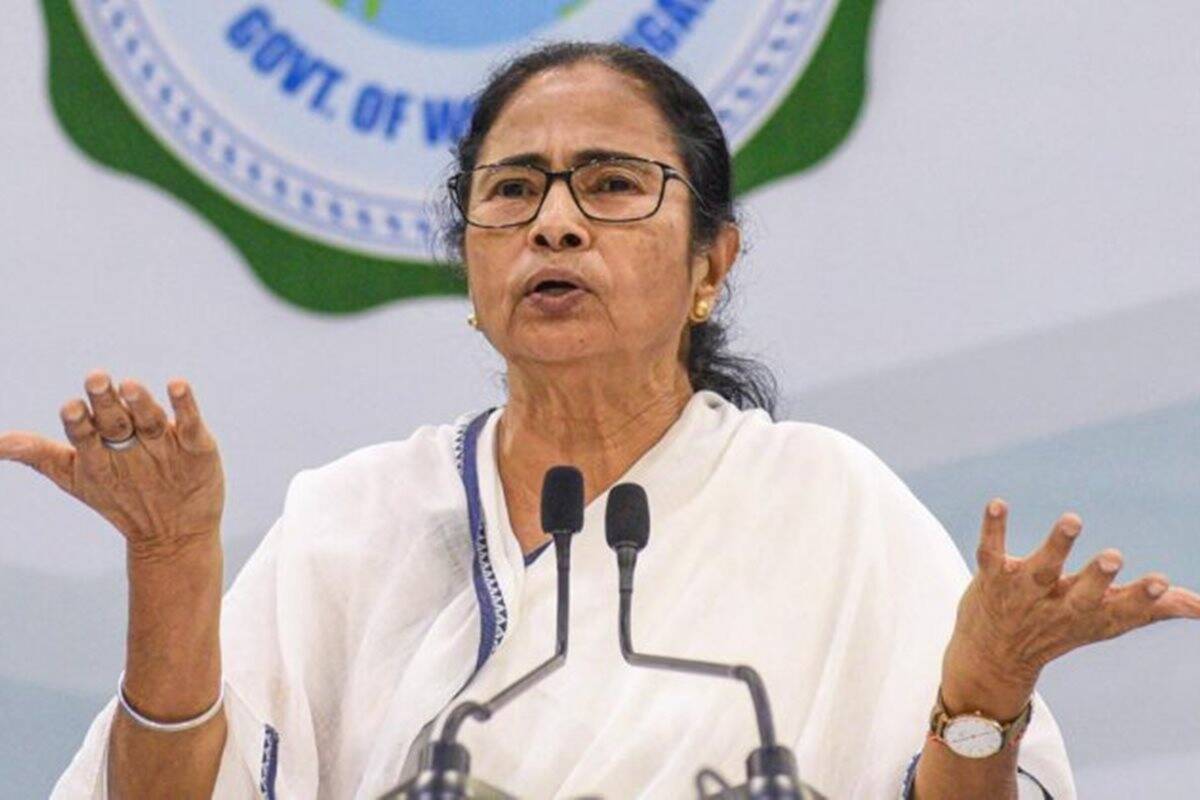
West Bengal Chief Minister Mamata Banerjee on Wednesday alleged that the BJP wanted to keep her indoors ahead of the Assembly elections in the state. She was referring to the injuries she suffered in the Nandigram incident during a poll campaigning rally.

The Bengal CM was addressing a rally in Gopiballavpur in Jhargram district on a wheelchair where she alleged that earlier it was CPI (M) which used to physically attack her. She said she has been beaten up many times in her life. Earlier the CPM used to beat her up and now the BJP has started doing the same. However, the people of CPM have now become BJP. Some of the traitors, greedy people have also joined the BJP, she added.

Launching a scathing attack at the saffron party, Banerjee said the BJP wanted to keep her indoors so that she cannot go out during the elections. They have injured her leg. They cannot throttle her voice, the party will defeat BJP, she further said.

The TMC chief had suffered injuries in her left leg and shoulder March 10 at Nandigram while she was campaigning for the upcoming Assembly polls in the state. Even though TMC claimed the incident was a deep-rooted conspiracy, the Election Commission rubbished the claims and said there was no evidence of an attack on the Bengal CM.

The Chief Minister has been hitting the campaign trail in a wheelchair since she sustained injuries. At every rally, she has been speaking of her injuries and asserting that though her wounds are painful, they would not stop her.

Meanwhile, in another attack on the BJP, Banerjee raked up the issue of the citizenship debate, asking people to beware of the saffron party’s twin agendas of the National Register of Citizens (NRC) and National Population Register (NPR).

Read Also: The return of clothing police: Uttarakhand CM Tirath Singh Rawat says women wearing ripped jeans can’t provide good atmosphere at home for kids

She said the BJP will impose NPR and NRC. They will ask for her father’s birth certificate, where will she get it from? This is how things were in the past. Births took place at homes. People did not get certificates, she said

Continue Reading

India News

MK Stalin announces major DMK organisational Changes in Tamil Nadu

MK Stalin has announced a major DMK organisational overhaul, introducing age and term limits and expanding party districts from 77 to 110.

Published

on

DMK chief MK Stalin has announced a major overhaul of the party’s organisational structure, months after the party lost the Tamil Nadu assembly election.

Acknowledging the defeat, Stalin said the party must openly recognise its mistakes. He also pointed to the functioning of party office-bearers as one of the factors behind the electoral loss.

“Although there are several reasons for our defeat, the functioning of our party office-bearers is also one of them,” Stalin said, stressing that the party must acknowledge its shortcomings and ensure better performance at every level.

Stalin also described the DMK as a “specialist” in making comebacks and said the party would return stronger.

Age and term limits for party posts

Among the major changes announced by Stalin are age and tenure limits for party positions.

Stalin said the changes would involve a significant restructuring of the DMK’s administrative system, with priority being given to new faces. He said the measures were intended to make the party sustainable for the next 100 years and help restore the trust of young people and women.

Under the new rules, branch secretaries must be aged 45 or below and can hold the position for a maximum of two terms.

District secretaries, meanwhile, must be below 70 years of age and can serve for a maximum of three terms.

DMK to increase party districts from 77 to 110

The DMK executive committee has approved increasing the number of party districts from 77 to 110.

The expansion will be implemented as part of the party’s 16th organisational elections. Revenue districts will generally be reorganised so that each party district covers two assembly constituencies.

Where only one constituency remains after the reorganisation, it will be attached to another suitable party district within the same revenue district as a third constituency.

Stalin has been authorised to determine and announce the constituencies that will form the 110 party districts.

New branch structure planned in urban areas

The DMK will also introduce a new branch-level structure in urban areas, along with the post of branch secretary.

The new system will initially be implemented in Chennai, Coimbatore, Madurai, Tiruchirappalli and Salem. It may subsequently be extended to other corporations.

Once the new party districts are announced, district executive committees will have to meet and establish the union, city, area, town, ward and branch-level units within 15 days.

The organisational changes come as the DMK seeks to restructure its party machinery and prepare for its political comeback following its assembly election defeat.

Continue Reading

India News

Jharkhand students, JMM workers clash over Hemant Soren effigy burning

Clashes broke out in Ranchi, Hazaribag and Giridih as protesting students attempted to burn effigies of Hemant Soren and Rahul Gandhi.

Published

on

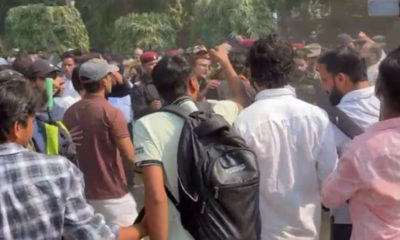
Clashes broke out between protesting students and police in Ranchi and several other parts of Jharkhand on Friday evening as students attempted to burn effigies of Chief Minister Hemant Soren and Congress leader Rahul Gandhi, officials said.

Similar incidents were reported in Hazaribag and Giridih, where workers of the ruling Jharkhand Mukti Morcha (JMM) clashed with students who were trying to burn effigies of Soren.

The protesting students are affiliated with the JPSC-JSSC Reforms Manch. They have accused the Jharkhand government of deceiving and betraying job aspirants following the High Court’s intervention in cases concerning recruitment examinations and appointments.

In Ranchi, a large number of students gathered at Albert Chowk to burn the effigies. Police said a scuffle broke out when they tried to control the situation.

Ranchi DSP KV Raman said the protesters changed the designated route of their march and went towards the JPSC office, where traffic was brought to a halt.

According to Raman, police repeatedly asked the protesters to follow the designated route for the march and effigy burning, but the students did not comply.

Student leaders, however, alleged that police and JMM workers attempted to prevent them from holding a peaceful march.

“They cannot stop us from holding peaceful and democratic protests,” JPSC-JSSC Reforms Manch leader Ravindra Paswan said.

Another student leader, Piyush Kumar Singh, alleged that a core committee member of the Manch, Kunal, was detained by police. He claimed that Kunal fainted and was subsequently taken to Sadar Hospital.

The protesters also alleged that female participants were assaulted by JMM workers during the scuffle.

Why are Jharkhand students protesting?

The students had earlier called off their agitation after the Hemant Soren government decided to cancel JPSC examinations where irregularities had been alleged.

However, the Jharkhand High Court subsequently intervened in several matters related to the recruitment process.

On Friday, the court stayed notifications cancelling the appointments of Child Development Project Officers (CDPOs) and those recruited through the JSSC-CGL examination.

A day earlier, the court had stayed notifications cancelling the 11th and 13th JPSC examinations. It had also stayed the order cancelling the appointments of food safety officers.

The developments have renewed the students’ concerns over the government’s handling of recruitment-related cases.

JLKM announces recruitment reforms yatra

Meanwhile, JLKM leader Devendra Nath Mahto announced that his party would launch a ‘Recruitment System Reforms Yatra’ from August 24.

Mahto alleged that the Jharkhand government was not strongly defending cases concerning the cancellation of several recruitment examinations before the High Court.

He warned that if the government failed to effectively present its case before the Jharkhand High Court on September 15, when the matters are scheduled for hearing, they would plan to gherao the Chief Minister’s residence.

Continue Reading

India News

BJP eyes Akali Dal alliance in Punjab after Bengal victory

The BJP and Shiromani Akali Dal have held talks on a possible alliance for the Punjab Assembly election, with seat-sharing expected to be discussed soon.

Published

on

Punjab BJP

Buoyed by its victory in West Bengal, the BJP is stepping up preparations for the Punjab Assembly election, with the party holding talks with the Shiromani Akali Dal (SAD) on a possible alliance.

According to sources, the BJP is expected to contest the election in alliance with the Akali Dal. One round of discussions has already taken place, while another round is expected soon. The next talks are likely to focus on seat-sharing and the constituencies that each party would contest.

BJP leaders believe an alliance could offer political gains to both parties and strengthen their cooperation. The party also believes a combined effort could improve its prospects in Punjab’s four-way electoral contest.

BJP and Akali Dal vote share

The BJP is drawing confidence from the 2024 Lok Sabha election, when it and the Akali Dal contested separately.

The BJP did not win any of Punjab’s 13 Lok Sabha seats but secured 18.56 per cent of the vote. The Akali Dal won one seat with a 13.42 per cent vote share. Together, the two parties accounted for approximately 32 per cent of the vote.

The BJP believes that adding further support to this combined base could pose a strong challenge to the ruling Aam Aadmi Party (AAP), which the party says is facing anti-incumbency.

The previous Punjab Assembly election presented a different picture. The Akali Dal won three of the state’s 117 seats with 18.38 per cent of the vote, while the BJP won two seats with a 6.60 per cent vote share.

The BJP’s vote share in the Lok Sabha election was therefore significantly higher than in the Assembly election, strengthening the argument within the party for contesting a larger number of seats if the alliance is finalised.

BJP sees strong position across Punjab

The BJP’s assessment is also based on its performance across Assembly segments during the Lok Sabha election.

The party led in 23 Assembly segments, while the Akali Dal was ahead in nine. The BJP finished second in around 17 segments, compared with 14 for the Akali Dal.

The BJP also lost five seats by margins of less than 5,000 votes and 10 seats by margins of less than 10,000 votes. The party therefore believes it has demonstrated a strong position on its own in 38 Assembly seats.

According to the assessment, contesting together could give the BJP and Akali Dal a stronger electoral position.

BJP, Akali Dal have history of alliance

The BJP and Akali Dal maintained an alliance from 1996 to 2020 and recorded several major victories together.

In the 1997 Assembly election, the Akali Dal won 75 seats and the BJP won 18, giving the alliance a landslide victory.

The alliance also won the 2007 election, with the Akali Dal securing 49 seats and the BJP winning 19. In 2012, the two parties created history by winning a second consecutive term, with the Akali Dal winning 56 seats and the BJP 12.

Against this backdrop, the proposed alliance is being viewed within the BJP as a potentially formidable combination.

BJP targets AAP government

The BJP is preparing to target the AAP government over allegations of corruption, governance failures and unfulfilled promises.

The party is also expected to highlight financial assistance and schemes provided to Punjab by the Centre under Prime Minister Narendra Modi.

The BJP may present a comprehensive vision document focused on employment and economic growth, along with measures aimed at rebuilding Panthic and social trust.

The party has alleged that the AAP government, which came to power promising to fight corruption, has failed to deliver on that front.

According to the BJP, 144 government officials were arrested in corruption cases last year, while 43 Punjab Police personnel were caught in bribery traps. The party has also cited the dismissal of then Cabinet Minister Vijay Singla over corruption allegations and Vigilance Bureau raids involving MLA Raman Arora in connection with a corruption case.

The BJP has further alleged that the AAP’s senior leadership in Delhi controls the functioning of the Punjab government and extracts undue benefits from contractors.

BJP raises health and education concerns

The BJP has also accused the Punjab government of shortcomings in health, education and social justice.

According to figures cited by the BJP, Punjab’s primary-level dropout rate is 2.5 per cent, compared with a national average of 0.3 per cent.

The party has also highlighted health infrastructure figures, claiming that only 52.5 per cent of Punjab’s 3,699 health centres meet Indian Public Health Standards. It further claims that 4.3 per cent of district hospitals and 4.9 per cent of Community Health Centres meet prescribed national quality standards, while 15.7 per cent of Primary Health Centres meet the standards.

The BJP has also raised the issue of teacher vacancies in government schools while questioning the state’s education model.

The party has pointed to a promise to establish 16 medical colleges in Punjab and alleged that none has been set up.

BJP highlights central schemes in Punjab

Alongside its criticism of the state government, the BJP plans to highlight financial assistance provided by the Centre.

According to the BJP, Rs. 7,596.84 crore was provided under PM-KISAN to 18 lakh farmer beneficiaries.

It also said Rs. 8,144.11 crore was allocated for rural development and the generation of 8.14 lakh person-days of work under MGNREGA.

Under the Pradhan Mantri Gram Sadak Yojana, the BJP said Rs. 1,722.68 crore was provided for rural roads and 415 bridges. Another Rs. 359.56 crore was allocated for individual and community toilets under the Swachh Bharat Mission (Gramin).

The BJP also cited the Jal Jeevan Mission, under which 32 lakh households were provided tap water connections, and the Amrit Sarovar Mission, under which 816 water bodies were developed.

The party is also expected to highlight central support for railway and airport projects in Punjab.

BJP considers employment-focused promises

The BJP is considering several election promises as it prepares its campaign.

The party is weighing proposals aimed at moving Punjab’s economy away from what it describes as a freebies-based approach towards employment and wealth creation. Financial assistance for women and the establishment of medical colleges are among the proposals under consideration.

The broader strategy is to combine criticism of the AAP government with an alternative political model focused on Punjab’s economy, health, education and Panthic concerns.

Continue Reading

Trending

© Copyright 2022 APNLIVE.com