English हिन्दी
Connect with us

India News

INDIA bloc releases manifesto for Bihar polls; promises govt jobs, free power, OPS restoration

Published

on

india bloc

The INDIA bloc on Tuesday released its manifesto for the Bihar assembly polls, promising, among other things, a government job to one member of every household, restoration of old pension scheme and 200 units of free power.

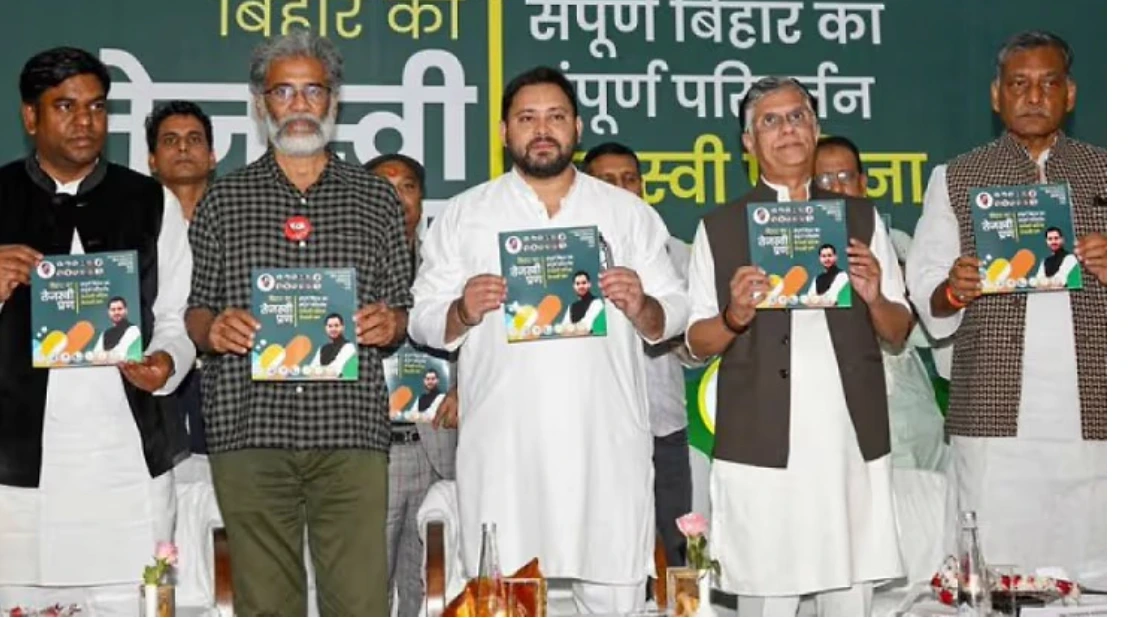
The 32-page-long ‘Bihar ka Tejashwi Pran’ (Tejashwi’s resolve) was released at a crowded press conference where the 35-year-old RJD leader was joined by alliance partners.

The INDIA bloc manifesto for the Bihar polls has 25 major points assuring practical solutions, Yadav said at the manifesto release.

“A new law guaranteeing employment would be introduced within 20 days of the INDIA bloc forming the government in Bihar,” he said.

An employment guarantee scheme will be implemented across Bihar within 20 months of the INDIA bloc government formation, he added.

All contractual workers in the Bihar government departments will be made permanent. Also, all ‘Jeevika Didis’ will be made permanent and given a monthly salary of Rs 30,000, the manifesto said.

The manifesto also promised IT parks, SEZs, dairy and agro-based industries, an education city and five new expressways in the state.

“People of Bihar want a crime-free and scam-free regime… they will teach a lesson to NDA in the polls,” Yadav said.

People want a government that would provide ‘padhai’ (better education), ‘dawai’ (better health facilities), ‘kamai’ (employment) and ‘sichai’ (better irrigation facilities), he said.

“The NDA has no vision for Bihar… they have not released the manifesto for the polls so far… BJP leaders and corrupt officials have made Chief Minister Nitish Kumar a puppet… The BJP is using Nitish Kumar to further its interest… Union Home Minister Amit Shah has already made it clear that Nitish will not be the CM face,” he alleged.

“The Bihar Prohibition and Excise Act has completely failed. If the INDIA bloc is voted to power, we will remove the ban on toddy (tari),” Yadav said.

“The INDIA bloc manifesto is the roadmap for the development of Bihar. It is a resolution to make the state number one,” he added.

A banner was put at the manifesto release venue featuring the photographs of all prominent INDIA bloc leaders.

A press conference of the INDIA bloc leaders held in Patna on October 23 triggered a controversy as the banner featured only the photograph of Tejashwi Yadav and no other leader of the alliance.

All prominent leaders of the INDIA bloc were present at the release of the manifesto. While senior Congress leader Pawan Khera represented his party, CPI(ML) Liberation general secretary Dipankar Bhattacharya, VIP party chief Mukesh Sahni and other INDIA bloc leaders were also present.

Leader of Opposition in Lok Sabha, Rahul Gandhi, will join the INDIA bloc campaign for the Bihar polls on Wednesday, said Khera and Yadav.

—PTI

India News

Chandrashekhar Azad to be CM candidate of alliance with Owaisi for Uttar Pradesh elections

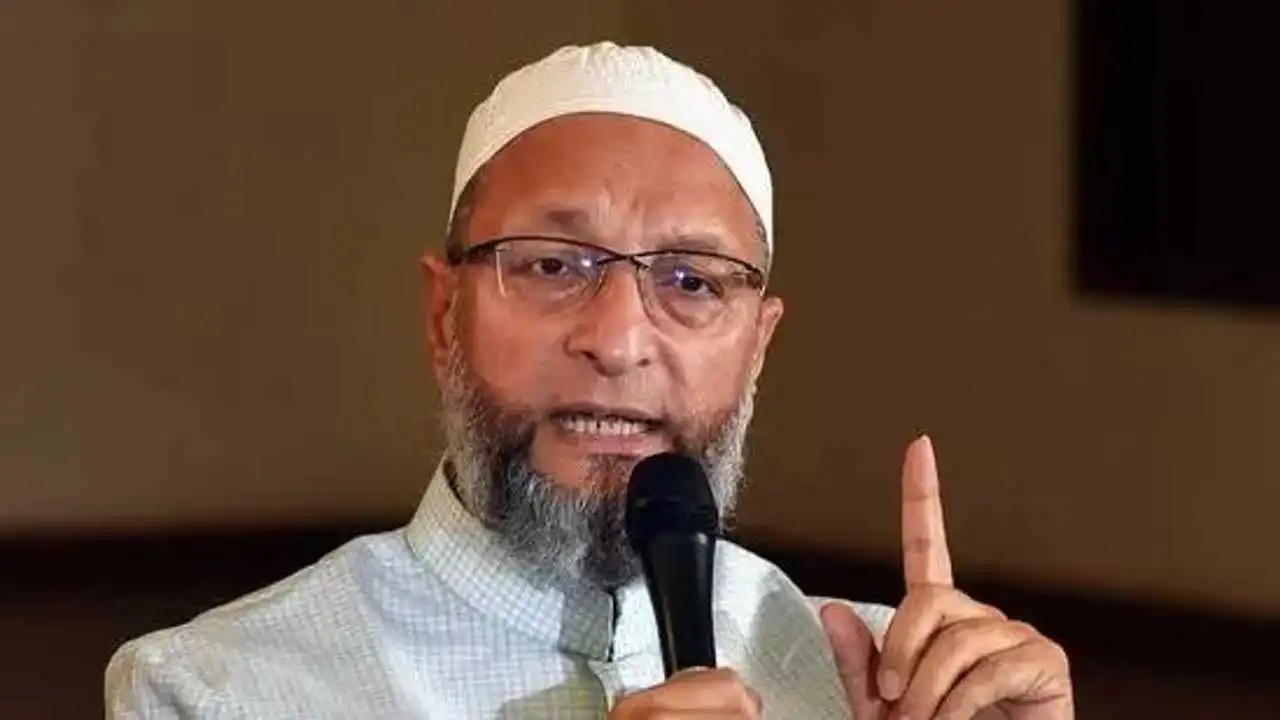
Asaduddin Owaisi and Chandrashekhar Azad have joined hands ahead of the 2027 Uttar Pradesh Assembly elections, bringing together the AIMIM and Azad Samaj Party in an effort to consolidate Dalit and Muslim voters.

Published

on

Asaduddin Owaisi’s All India Majlis-e-Ittehadul Muslimeen (AIMIM) and Chandrashekhar Azad’s Azad Samaj Party (Kanshi Ram) have joined hands ahead of the 2027 Uttar Pradesh Assembly elections, seeking to emerge as a third political force and draw support from sections of Muslim and Dalit voters.

As part of the alliance, Owaisi declared Chandrashekhar Azad as the alliance’s Chief Ministerial face for the 2027 Uttar Pradesh Assembly elections.

Owaisi had been seeking a place in the Opposition alliance for months and had even issued ultimatums to the Samajwadi Party and Congress. However, his efforts did not find takers.

The alliance brings together AIMIM’s focus on Muslim political representation and the Azad Samaj Party’s outreach among Dalit voters. Both parties are seeking to establish a political formation outside the BJP-led NDA and the Samajwadi Party-led opposition.

Why Owaisi and Chandrashekhar Azad joined hands

Uttar Pradesh AIMIM president Shaukat Ali said the party approached Chandrashekhar Azad after its efforts to reach an understanding with the Samajwadi Party, Congress and Bahujan Samaj Party did not succeed.

Ali said AIMIM wanted a broader alliance to prevent the BJP from returning to power in Uttar Pradesh for a third consecutive term.

He also criticised the Samajwadi Party-Congress alliance, questioning its prospects in the next Assembly elections.

Chandrashekhar Azad, the Lok Sabha MP from Nagina, said the partnership would focus on empowering young people, farmers and weaker sections of society.

He also raised concerns over employment opportunities, demonetisation and issues affecting educated youth from Dalit and backward communities.

What the alliance means for Akhilesh Yadav’s PDA strategy

Muslims account for around 20 per cent of Uttar Pradesh’s population, while Dalits constitute approximately 21 per cent.

Samajwadi Party chief Akhilesh Yadav has used the PDA formulation to bring together backward classes, Dalits and minorities. The AIMIM-Azad Samaj Party alliance is seeking support among two important sections of this broader social grouping.

Muslims account for around 20 per cent of Uttar Pradesh’s population, while Dalits constitute approximately 21 per cent.

What the parties’ previous election performance shows

Both AIMIM and the Azad Samaj Party have struggled to establish a significant presence in Uttar Pradesh Assembly elections.

In the 2022 Assembly elections, AIMIM contested more than 90 seats but secured less than 0.5 per cent of the total votes. The Azad Samaj Party contested more than 100 seats and received approximately 0.13 per cent of the votes.

Chandrashekhar Azad, however, won the Nagina Lok Sabha constituency in 2024, giving his party its first elected representative in Parliament.

The alliance is now attempting to combine AIMIM’s support among sections of Muslim voters with Azad’s outreach among Dalit communities.

Its electoral prospects will depend on the seat-sharing arrangement, local leadership and whether the two parties can translate their combined social outreach into electoral support.

SP leaders respond to the alliance

Samajwadi Party MP from Ayodhya, Awadhesh Prasad, dismissed the electoral significance of the AIMIM-Azad Samaj Party alliance. He said that people in Uttar Pradesh had lost faith in the BJP government and described Akhilesh Yadav as the only leader capable of removing the BJP from power in 2027.

The alliance’s formation could therefore become an important factor in the political discussions ahead of the 2027 Assembly elections, particularly because both leaders are seeking support among communities that the Samajwadi Party also hopes to bring together through its PDA formulation.

Continue Reading

India News

Mother Dairy raises milk prices by Rs 2-4 per litre from November 12

Mother Dairy has increased milk prices by Rs 2-4 per litre from November 12. Full cream milk will now cost Rs 76 per litre, while toned milk will be priced at Rs 62.

Published

on

mother dairy

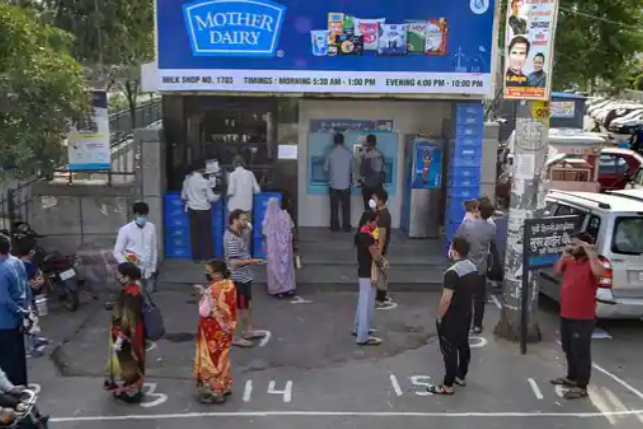
Mother Dairy has increased the prices of its liquid milk variants by Rs 2 to Rs 4 per litre, with the revised rates coming into effect from Thursday, November 12. The price revision will affect consumers in the Delhi-NCR market, where the dairy company is a major milk supplier.

The increase comes amid rising input costs, particularly higher procurement prices paid to farmers. According to sources, the company has decided to pass on part of the additional cost to consumers.

A spokesperson for Mother Dairy declined to comment on the latest price revision.

Check new Mother Dairy milk prices

The revised rates cover several liquid milk variants sold in the NCR market. Full cream milk has seen the highest increase of Rs 4 per litre.

Here are the revised prices:

Milk variantOld priceNew price
Toned milk (bulk vended)Rs 58Rs 60
Full cream milk (pouched)Rs 72Rs 76
Toned milk (pouched)Rs 60Rs 62
Double toned milkRs 54Rs 56
Cow milkRs 62Rs 65

The new prices will be applicable from November 12.

Why Mother Dairy has increased milk prices

The latest revision follows an increase in the procurement prices of milk from farmers. Sources said the higher procurement costs have prompted Mother Dairy to partly transfer the additional input expenses to consumers.

The company passes on around 75-80 per cent of its milk sales realisation to farmers.

Mother Dairy had last increased milk prices on May 14, 2026. Before that, its previous price revision took place in April 2025.

Mother Dairy’s daily milk sales

Mother Dairy sells approximately 35 lakh litres of milk every day in the Delhi-NCR market through its own outlets, general trade channels and e-commerce platforms.

Its overall daily milk sales exceed 50 lakh litres.

The company recorded a 17 per cent increase in turnover to Rs 20,300 crore in the last financial year. The growth was supported by improved demand for its milk products and cooking oils.

About Mother Dairy

Commissioned in 1974, Mother Dairy is a wholly owned subsidiary of the National Dairy Development Board (NDDB).

The company sells milk and milk products under the Mother Dairy brand. It markets edible oils under the Dhara brand, while fresh fruits and vegetables, frozen vegetables, snacks, pulps and concentrates are sold under the Safal brand.

Mother Dairy operates nine milk processing plants and four horticulture processing plants. Its edible oil operations are supported by 16 associated plants.

Continue Reading

India News

Air pollution as big a health emergency as COVID, says former WHO chief Soumya Swaminathan

Former WHO Chief Scientist Dr Soumya Swaminathan said air pollution should be treated with the same urgency as COVID, highlighting its effects on children, pregnancy and multiple organs.

Published

on

air pollution

Air pollution should be treated as a major public health emergency requiring an urgent and coordinated response, former World Health Organisation (WHO) Chief Scientist Dr Soumya Swaminathan has said.

In an exclusive interview, Dr Swaminathan compared the scale of the air pollution health crisis with COVID and said its effects can extend across the body, including the brain, lungs and cardiovascular system. She also highlighted links between pollution exposure and conditions such as asthma and diabetes.

Why air pollution needs a COVID-like response

Dr Swaminathan said COVID triggered an immediate public response because it was sudden, visible and associated with an unknown virus. Air pollution, by contrast, is often less visible and its effects accumulate over time.

She said people may become accustomed to pollution because it is not always visible, particularly outside the winter months. But she stressed that prolonged exposure can still cause serious health damage.

She called for the issue to receive an “equal, urgent, coordinated and scientific” response, similar to the approach taken during the COVID crisis.

PM2.5 poses risks from pregnancy to childhood

Dr Swaminathan also highlighted concerns about exposure to fine particulate matter, particularly PM2.5, among pregnant women and children.

According to her, these tiny particles can enter the lungs and bloodstream and may also reach the placenta. She pointed to higher rates of premature births and low birth weight among babies born in areas where mothers are exposed to high levels of air pollution.

She also said children are particularly vulnerable because their brains and other organs are developing rapidly. Children breathe faster than adults, and those growing up in heavily polluted areas can have smaller lungs, she said.

Why AQI may not tell the full health story

Dr Swaminathan suggested moving beyond the conventional Air Quality Index (AQI) towards an Air Quality Health Index (AHQI).

The proposal would place greater emphasis on how individual pollutants affect different groups of people. She noted that the dominant pollutant can vary from one city to another, while its health impact may also differ for groups such as pregnant women and children.

The current AQI uses eight major pollutants as parameters: PM10, PM2.5, ozone, sulphur dioxide, nitrogen dioxide, carbon monoxide, lead and ammonia. The overall AQI is determined by the highest pollutant sub-index.

Swaminathan does not favour shutting schools

On protecting children from polluted air, Dr Swaminathan said she was not in favour of simply closing schools.

She argued that children from poorer families may continue breathing polluted air at home, while also losing access to education, social interaction and midday meals.

Instead, she suggested making school environments cleaner. Her proposals included installing air purifiers in classrooms, providing pick-and-drop bus facilities and encouraging older children to wear masks when outdoors.

Five measures suggested to tackle pollution

Dr Swaminathan outlined five key measures for addressing the pollution crisis:

  1. Launch a national clean air programme, which she suggested could be called the “Swachh Vaayu Abhiyan”.
  2. Prepare a costed, long-term plan with sustained investment and study lessons from countries such as China.
  3. Establish empowered leadership and accountability for tackling air pollution.
  4. Create a panel of experts to develop a science-based, multi-sectoral and multi-year plan.
  5. Put health at the centre of air pollution policy.

She also supported treating the right to clean air as a basic public health entitlement, linking it to the constitutional right to life.

Dr Swaminathan’s central argument was that air pollution should no longer be treated as a slow-moving or routine environmental problem, but as a serious health crisis requiring sustained action.

Continue Reading

Trending

© Copyright 2022 APNLIVE.com