English हिन्दी
Connect with us

India News

BJP likely to get chief minister in Bihar as Nitish Kumar plans Rajya Sabha move

Bihar may see a BJP chief minister for the first time as Nitish Kumar prepares to contest the Rajya Sabha elections. JD(U) is likely to receive 15 cabinet positions in the new government.

Published

on

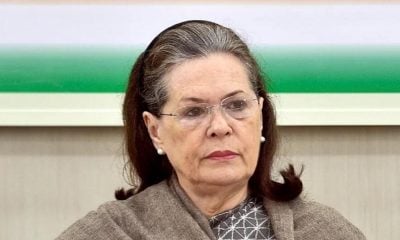
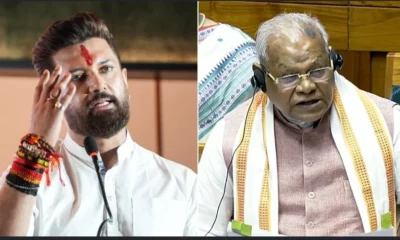
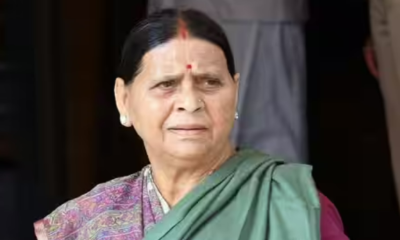
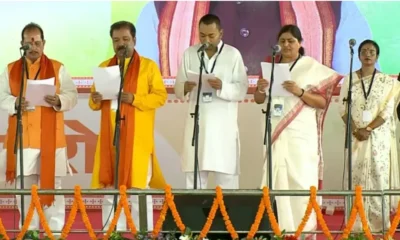
BJP Leaders

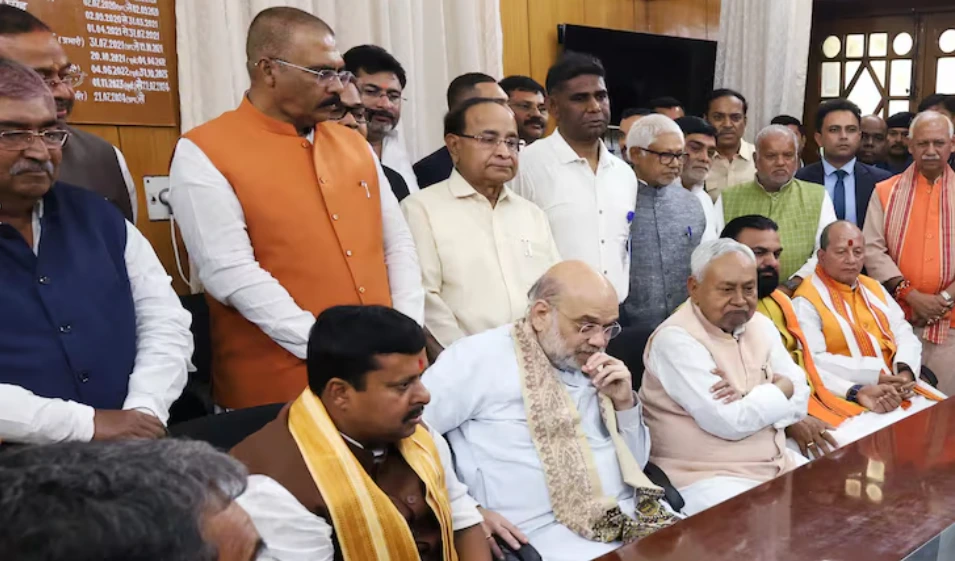
Bihar may soon witness a major political transition as a leader from the Bharatiya Janata Party is likely to become the state’s chief minister, following Nitish Kumar’s decision to step down and contest the Rajya Sabha elections, according to sources.

Nitish Kumar, who has served as Bihar’s chief minister for more than two decades and held the post a record ten times, filed his nomination papers for the Rajya Sabha on Thursday. His move comes only four months after he was sworn in for his tenth term as chief minister.

If the reported arrangement goes ahead, it would mark the first time that the BJP occupies the chief minister’s post in Bihar, a state where leadership has largely alternated between the Janata Dal United and the Rashtriya Janata Dal.

Possible cabinet structure being discussed

Sources indicated that the proposed government structure may include one deputy chief minister. Nitish Kumar’s son Nishant Kumar is likely to be given that role, which would mark his entry into electoral politics.

The Janata Dal United is expected to receive 15 ministerial positions in the new cabinet.

Apart from the JD(U), coalition partners may also get representation. Two ministers from the Lok Janshakti Party Ram Vilas, and one each from the Rashtriya Lok Morcha and the Hindustani Awam Morcha are likely to be included, sources said.

The Speaker of the Bihar Assembly is expected to remain from the BJP.

Nitish Kumar has also called a meeting of all JD(U) Members of Parliament and senior party leaders to discuss the developments.

Rajya Sabha elections scheduled for March 16

Announcing his decision to contest the Rajya Sabha elections, the 75 year old leader wrote on X that he intends to continue contributing to Bihar’s development.

“I seek to become a member of the Rajya Sabha in the elections being held this time. I want to assure you with complete honesty that my relationship with you will continue in the future as well, and my resolve to work together with you to build a developed Bihar will remain steadfast,” he said.

He added that the new government would have his full cooperation and guidance.

Along with Nitish Kumar, several leaders also filed their nominations for the Rajya Sabha elections. These include BJP leader Nitin Nabin, Union minister Ram Nath Thakur from the JD(U), Rashtriya Lok Morcha chief Upendra Kushwaha, and BJP state general secretary Shivesh Kumar.

Polling for the Rajya Sabha elections will be held on March 16 to fill 37 seats across 10 states. The counting of votes is scheduled to take place the same day at 5 pm.

India News

Bank holiday today: Banks closed in Odisha, Uttarakhand and Manipur on July 16 for regional festivals; check details

Banks will remain closed in Odisha, Uttarakhand and Manipur on July 16 for regional festivals, while banking operations continue normally in the rest of India. Here’s the complete holiday schedule.

Published

on

Rath Yatra

India’s banking services will remain partially affected on Thursday, July 16, as banks in select states are closed to observe regional festivals, according to the Reserve Bank of India’s (RBI) holiday calendar for the financial year 2026-27.

Customers in most parts of the country can continue to access banking services as usual, while branches in Odisha, Uttarakhand and Manipur will remain shut for local celebrations.

Banks closed today in these states

Banks will remain closed on July 16 in the following states:

  • Odisha – Rath Yatra
  • Uttarakhand – Harela
  • Manipur – Kang festival

Apart from these states, bank branches across the rest of India are expected to function normally.

How does RBI decide bank holidays?

The Reserve Bank of India prepares a state-wise holiday calendar covering national, religious and regional occasions. Since several festivals are celebrated only in specific states, bank holidays may differ from one region to another.

In addition to these notified holidays, banks across the country remain closed on the second and fourth Saturdays of every month, as well as on all Sundays.

When is the next bank holiday?

According to the RBI’s holiday schedule, the next notified bank holiday falls on July 17, 2026, in Sikkim to mark the Death Anniversary of U Tirot Singh.

Customers are advised to check the holiday schedule applicable to their respective state before planning a visit to a bank branch.

Will online banking services remain available?

Although physical bank branches may remain closed in the affected states, customers can continue using digital banking services. Mobile banking, internet banking, UPI transactions, ATM withdrawals and other online banking facilities are expected to remain available, enabling uninterrupted access to essential financial services.

Continue Reading

India News

Ganga and Varuna corridor projects get Cabinet nod, Varanasi to receive Rs 25,000 crore infrastructure boost

The Union Cabinet has approved nearly Rs 25,000 crore Ganga and Varuna Corridor projects in Varanasi to improve connectivity, reduce congestion and support tourism in the holy city.

Published

on

Ganga Varuna Corridors

The Union Cabinet has approved two major elevated corridor projects worth nearly Rs 25,000 crore in Varanasi, marking a major infrastructure initiatives for the holy city in recent years. The Ganga Corridor and Varuna Corridor are expected to improve urban mobility, reduce congestion and support the growing number of tourists and pilgrims visiting the city every year.

The projects are aimed at creating faster road connectivity while also strengthening tourism infrastructure in one of India’s oldest and most significant spiritual destinations.

Ganga Elevated Corridor to reduce travel time

The larger project, the 46-km six-lane Ganga Elevated Corridor, will connect NH-19 with the Varanasi Ring Road through an alignment along the Ganga river.

Developed by the National Highways Authority of India (NHAI), the elevated corridor is designed to divert traffic away from congested city roads while minimising disruption to existing settlements.

According to the project plan, the corridor is expected to increase average travel speeds to nearly 100 kmph, significantly reducing travel time on the route from around 60 minutes to approximately 20 minutes.

Apart from improving connectivity, the project also focuses on tourism. Plans include a cable-stayed bridge that could become a new landmark for Varanasi, along with dedicated viewpoints and visitor spaces overlooking the Ganga and its ghats.

The project covers several villages, including Samne, Domri, Sirgovardhanpur, Chhitupur, Kila Kohna, Korauta, Ramnagar, Bhagwanpur, Sujabad, Nagwa, Nadesar and Varidpur. Authorities have halted land sale and purchase activities in these villages as part of the project process.

Varuna Corridor to improve access from neighbouring districts

The Cabinet has also approved the 43.2-km Varuna Elevated Corridor, estimated to cost around Rs 11,000 crore.

The project will connect NH-31 with the Varanasi Ring Road along the Varuna river through a network of elevated roads, flyovers, ramps, loops and link roads to improve movement across the city.

A key feature is a 21-km elevated section extending from near Harahua to the confluence of the Varuna and Ganga rivers near Namo Ghat.

The four-lane corridor is expected to provide direct access for travellers arriving from Lucknow, Jaunpur and Prayagraj, allowing them to reach Namo Ghat without entering congested city roads. Pilgrims will then be able to travel by boat to the Kashi Vishwanath Temple, helping reduce traffic pressure in central Varanasi.

Part of the project will pass through approximately 2.56 acres of land under the Cantonment Board, for which approval from the Ministry of Defence was required.

The Varuna Corridor alignment includes villages such as Kuduhana, Rustampur, Parshurampur, Sarai, Piran, Baragaon Pratham, Chhapri, Loharapur, Raniyapur, Chhitauni, Korauta, Kila Kohna, Inderpur, Sirista, Chauka, Jetupur, Kazi Sarsaulpur, Atharpur, Makdoompur, Bhatke, Karanjapur and Katesar in Sadar tehsil.

Projects planned as tourist numbers continue to rise

The approval comes as Varanasi continues to witness a sharp increase in tourist and pilgrim arrivals. According to the information shared, the city now receives nearly 15 crore visitors annually, increasing the need for stronger transport infrastructure to manage traffic efficiently.

The government expects the two corridor projects to improve accessibility while supporting the city’s long-term urban development and tourism growth.

Industry experts see wider economic benefits

Industry representatives have welcomed the projects, saying their impact could extend beyond transport improvements.

Aman Gupta, Director of RPS Group, said the Ganga and Varuna Corridor projects represent an integrated approach to urban development by combining connectivity, tourism and public infrastructure. He said better connectivity often encourages investment, employment generation and real estate development.

Gupta also noted that infrastructure-led development has produced similar outcomes in the National Capital Region, citing projects such as the Delhi-Mumbai Expressway, Metro expansion, Jewar International Airport and the proposed Faridabad-Noida-Ghaziabad Expressway.

Meanwhile, Manoj Kumar Garg, Chairman of NorthWind Estates, said the corridors could strengthen Varanasi’s position as a global spiritual, cultural and tourism destination while supporting economic growth through sectors such as hospitality, retail, commercial real estate and employment.

He added that Uttar Pradesh’s ambition of becoming a $1 trillion economy would receive support from continued investments in infrastructure, including expressways, airports and urban development projects that encourage private investment and improve ease of doing business.

Continue Reading

India News

BJP holds key core group meeting at PM Modi’s residence ahead of Monsoon Session

BJP’s senior leadership met Prime Minister Narendra Modi ahead of the Monsoon Session of Parliament, while an NDA meeting is likely on July 21 to discuss floor strategy.

Published

on

PM Modi

A crucial meeting of the Bharatiya Janata Party’s (BJP) top leadership was held at Prime Minister Narendra Modi’s residence on Wednesday ahead of the upcoming Monsoon Session of Parliament.

The meeting was attended by Union Home Minister Amit Shah, BJP president Nitin Nabin and BJP national general secretary (organisation) BL Santhosh, among other senior leaders.

Meeting held before Parliament session

The gathering comes just days before the Monsoon Session of Parliament, which is scheduled to commence on July 20 and continue until August 13.

There was no official statement from the party regarding the agenda or discussions held during the meeting. As a result, the issues deliberated upon remain undisclosed.

Reshuffle speculation continues

The meeting also took place amid ongoing speculation about a possible reshuffle in the BJP’s national office-bearers’ team as well as the Union Council of Ministers. However, no official confirmation has been issued regarding any organisational or Cabinet changes.

NDA meeting likely on July 21

Meanwhile, sources indicated that a meeting of the National Democratic Alliance (NDA) constituents is likely to be held on July 21. The alliance partners are expected to discuss their floor coordination and legislative strategy for the Monsoon Session.

The Monsoon Session is expected to witness discussions on key legislative business, with the ruling alliance preparing its parliamentary strategy ahead of the proceedings.

Continue Reading

Trending

© Copyright 2022 APNLIVE.com