English हिन्दी
Connect with us

Latest Politics News

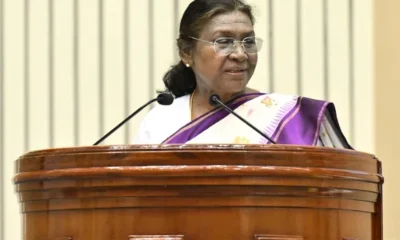
Droupadi Murmu sworn in as India’s first tribal President

Presidential candidate Yashwant Sinha received 3,80,177 votes while Murmu received 6,76,803 votes.

Published

on

Droupadi Murmu sworn in as India's first tribal President

Droupadi Murmu scripted history by becoming the first-ever tribal woman to hold the highest constitutional post. The NDA’s Droupadi Murmu was sworn in as the 15th President of India today at the Central Hall of the Parliament at 10:15 am. President Murmu was administered an oath by the Chief Justice of India, NV Ramana.

She is the second woman President of the country after Pratibha Patil. Murmu, 64, has become the youngest President ever to hold office and the first born after independence. A 21-gun salute was also fired in honour of the new president. An overwhelming majority of MPs and MLAs elected Droupadi Murmu against Yashwant Sinha.

President Droupadi Murmu began the day with a visit to Rajghat to pay homage to Mahatma Gandhi before heading to Rashtrapati Bhavan where she was received by former President Ram Nath Kovind.

Droupadi Murmu addressed the nation after taking office as India’s 15th President and said it was an honour to take charge at a time when India is completing 75 years of Independence.

The oath ceremony was attended by a host of VVIPs, including outgoing President Ram Nath Kovind, Vice-President and Chairman of the Rajya Sabha M Venkaiah Naidu, Prime Minister Narendra Modi, Lok Sabha Speaker Om Birla, Members of the Council of Ministers, Governors, Chief Ministers, heads of diplomatic missions, Members of Parliament, and principal civil and military officers of the government.

Read Also: 6 die in explosion in firecracker businessman house in Bihar, rescue operation underway

Addressing the nation, Murmu said we will have to speed up our efforts to meet the expectations that our freedom fighters had for the citizens of Independent India.

On becoming the first indigenous woman to hold the highest Constitutional post, she said reaching the Presidential post is not her personal achievement, it is the achievement of every poor in India. “My nomination is evidence that the poor in India can not only dream but also fulfill those dreams”, she added.

President Murmu further said she hails from a tribal society, and the Ward Councilor gave her the chance to become President of India. “This is India’s greatness as the origin country of democracy”, she added.

Presidential candidate Yashwant Sinha received 3,80,177 votes while Murmu received 6,76,803 votes. The third round of counting saw the BJP-led NDA candidate acquire a significant lead and surpass the 50 percent threshold.

Born in 1958, President Droupadi has served as the Governor of Jharkhand from 2015 to 2021. In the years 2000 and 2009, she was elected twice as an Odisha MLA from Rairangpur in Mayurbhanj on a BJP ticket.

AAP claims BJP hijacked Delhi government event, Arvind Kejriwal won’t attend the programme

Delhi reports first and India’s fourth monkeypox case, WHO declares global health emergency

India News

 Akhilesh Yadav launches SP’s 2027 UP poll campaign from Rahul Gandhi’s seat

Akhilesh Yadav launched the Samajwadi Party’s 2027 Uttar Pradesh Assembly election campaign from Rae Bareli, represented by Rahul Gandhi in the Lok Sabha.

Published

on

Akhilesh Yadav

Samajwadi Party chief Akhilesh Yadav has formally begun the party’s campaign for the 2027 Uttar Pradesh Assembly elections, launching the outreach from Rae Bareli, the Lok Sabha constituency represented by Congress leader Rahul Gandhi.

Yadav travelled through the area on the party’s newly launched PDA Rath before addressing a public meeting. The campaign vehicle carries the Samajwadi Party’s PDA messaging, referring to its focus on backward classes, Dalits and minorities.

Akhilesh Yadav discusses alliance with Congress

During his Rae Bareli visit, Yadav said the Samajwadi Party would contest the 2027 election as part of an alliance and indicated that seat-sharing would be decided on the basis of winnability.

He said the party would give a seat to whichever alliance partner is considered capable of winning it. The remarks come against the backdrop of the SP and Congress having contested the 2024 Lok Sabha election together in Uttar Pradesh.

Rae Bareli has particular political significance for the Congress as Rahul Gandhi is its sitting Lok Sabha MP. Yadav’s decision to begin the campaign from the constituency therefore placed the SP’s alliance with the Congress in focus.

PDA Rath becomes centrepiece of campaign

The PDA Rath was rolled out as part of the SP’s mobilisation ahead of the 2027 Assembly election. The vehicle prominently carries the party’s PDA messaging, with PDA standing for Pichhde, Dalit and Alpsankhyak.

The campaign is aimed at taking the SP’s social-justice messaging to voters across Uttar Pradesh as the party prepares for the Assembly election.

During the programme, Yadav also attacked the BJP and raised issues including the Election Commission and what he described as the alleged misuse of election machinery. These are political allegations made by the SP chief and should be understood as such.

BJP reacts to Akhilesh Yadav’s campaign

The launch of the PDA Rath comes as political activity intensifies in Uttar Pradesh ahead of the 2027 Assembly election.

The BJP has responded to Yadav’s campaign and his political messaging, while the SP has continued to focus its outreach on the PDA social coalition and its alliance strategy with the Congress.

The 2027 contest is still ahead, with parties using the period before the election to strengthen their organisational networks, public outreach and alliance arrangements.

Continue Reading

India News

Rahul Gandhi attacks CEC Gyanesh Kumar, says vote chori leads to kanoon chori

Rahul Gandhi accused the Election Commission of failing to protect voters and linked his “vote chori” allegation to what he called “kanoon chori”.

Published

on

Congress leader and Leader of Opposition in the Lok Sabha Rahul Gandhi on Thursday launched a fresh attack on Chief Election Commissioner Gyanesh Kumar and the Narendra Modi government, alleging irregularities in India’s electoral process.

Addressing a press conference in Delhi, Mr Gandhi linked his earlier allegations of “vote chori” with what he described as “kanoon chori”, arguing that alleged manipulation of votes would have consequences for the country’s law-making and institutional systems.

“From vote chori comes kanoon chori,” Mr Gandhi said, arguing that if votes had been stolen, laws and institutional changes made by lawmakers elected through those votes would also be affected.

Rahul Gandhi attacks Gyanesh Kumar

Mr Gandhi specifically targeted Chief Election Commissioner Gyanesh Kumar and questioned the Election Commission’s handling of the electoral process.

His remarks came amid reports of differences within the poll body over the Special Intensive Revision (SIR) exercise. Mr Gandhi referred to reported concerns involving the Election Commission and alleged that questions raised about the functioning of the poll panel had not been adequately addressed.

He also alleged that the Election Commission had failed in its responsibility to protect the vote, which he described as the foundation of India’s democratic and constitutional system.

‘Vote chori’ claim

Mr Gandhi reiterated his allegations of irregularities in elections and said the issue went beyond individual voters.

He argued that the vote gives power to the Constitution, while the Constitution provides the basis for laws and institutions. On that basis, he said alleged destruction of the voting process would have wider consequences for the country’s constitutional system.

Mr Gandhi also questioned what he described as the disappearance of anti-incumbency in elections involving the BJP, comparing recent electoral outcomes with earlier political trends.

He alleged that the 2024 Lok Sabha and Assembly elections had been manipulated. These remain allegations made by Mr Gandhi and should not be presented as established facts.

Attack on Modi and Amit Shah

During the press conference, Mr Gandhi also targeted Prime Minister Narendra Modi and Union Home Minister Amit Shah while making his allegations about the electoral process.

He questioned the role of the Election Commission and its leadership, and called for accountability over what he described as irregularities affecting India’s voting system.

Mr Gandhi said he was presenting evidence for his allegations and maintained that the issue concerned not only elections but also the functioning of democratic institutions.

The Election Commission’s reported internal differences over the SIR exercise formed part of the backdrop to his remarks. The claims made by Mr Gandhi concern his interpretation of those developments and are distinct from established findings about election manipulation.

Continue Reading

India News

BJP hits back at opposition over EC row, says disagreement is democracy

The BJP has defended reported differences among Election Commissioners, saying internal deliberations are part of a healthy democratic process.

Published

on

The BJP has defended the Election Commission amid a political row over reported differences among Election Commissioners concerning decisions linked to the Special Intensive Revision (SIR) of electoral rolls.

BJP MP Sambit Patra said discussions and exchanges of views within the poll panel should be seen as part of the democratic process rather than as evidence of institutional dysfunction.

According to the BJP’s position, disagreement during official deliberations reflects the fact that members of an institution are able to put forward their views before decisions are taken.

BJP defends EC deliberations

Patra said that if the three Election Commissioners discuss and debate issues among themselves, such exchanges should not be characterised as dictatorship. He described such deliberations as a sign of a healthy democracy.

The BJP’s response came amid reports that Election Commissioners Sukhbir Singh Sandhu and Vivek Joshi had raised objections on multiple occasions over decisions and orders associated with the SIR exercise and electoral rolls.

The Election Commission has said that differences in views and observations are a normal part of deliberations within an institution. It has maintained that decisions, including those related to SIR, were taken unanimously.

Row centres on SIR process

The controversy comes against the backdrop of the ongoing political debate over the Special Intensive Revision of electoral rolls.

Opposition parties have raised concerns over the reported differences within the poll panel, while the BJP has sought to counter those arguments by pointing to the role of discussion and deliberation in institutional decision-making.

Patra also said the BJP’s understanding of the matter was based on media reports rather than access to the Election Commission’s internal documents. He said the documents, as reported, indicated that the SIR process was finalised after democratic deliberations and consensus.

What the Election Commission has said

The Election Commission has rejected the suggestion that the reported objections indicate a breakdown in its functioning.

It has maintained that differing opinions during deliberations are part of normal institutional functioning and that the decisions eventually taken by the commission were unanimous.

Continue Reading

Trending

© Copyright 2022 APNLIVE.com