
India News
Khurram Parvez arrest: Rights bodies protest Kashmiri activist’s detention, call for immediate release

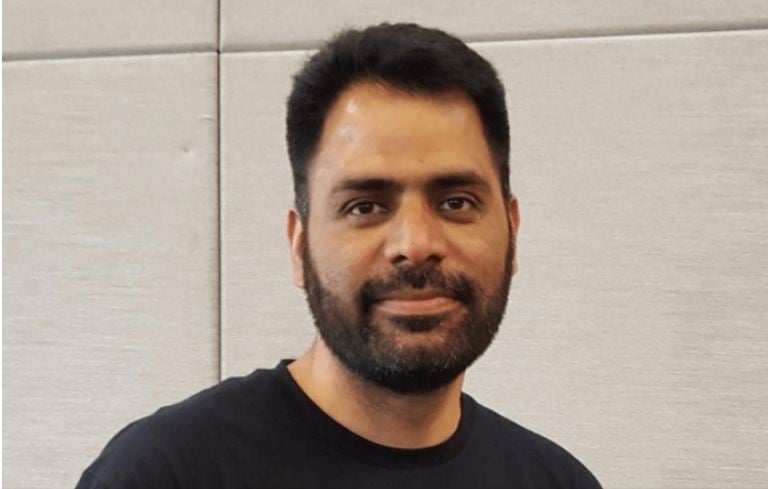
The National Investigation Agency (NIA) on Monday evening arrested prominent Kashmiri rights activist Khurram Parvez from Srinagar in connection with a terror funding case. The agency, however, did not confirm the reason for his arrest but family sources said he was taken for questioning by officials who claimed to be from the NIA.
Parvez was arrested after an hours-long raid at his residence in Srinagar, his wife Samina said. They also seized Parvez’s mobile, laptop, some books, along with her cell phone, Samina said.
The family said the NIA had also raided Khurram’s residence during the intervening night of October 28 and 29 last year in cases where they claimed his involvement in separatist activities.
NIA’s move to arrest Parvez elicited sharp reactions from rights bodies and activists, including the United Nations Special Rapporteur.
The United Nations said it was disturbed by the reports of Khurram’s arrest. Mary Lawlor, UN Special Rapporteur on Human Rights Defenders, tweeted that he is not a terrorist, he’s a Human Rights Defender.
David Kaye, a former UN Special Rapporteur, said Khurram’s arrest under terrorism charges was yet another extraordinary abuse in Kashmir.
The World Organisation Against Torture (OMCT), a Geneva-based non-profit organization that works with groups across the world to fight for human rights, said it is deeply concerned about the high risk of torture while in custody. In its tweet, the organization called for his immediate release.
What are the charges against Parvez?
Parvez has been booked under the Unlawful Activities Prevention Act (UAPA) and other multiple charges. The Indian Penal Code sections 120B (criminal conspiracy), 121 (attempt to wage war) and 121A (conspiracy to commit offenses) have been invoked against Parvez.
He was also charged under Section 17 (funding a terrorist act), Section 18 (conspiracy), Section 18B (recruitment for the commission of a terrorist act), Section 30 (membership of a terrorist organization) and Section 40 (offences for raising funds for a terrorist organization) of the Unlawful Activities (Prevention) Act (UAPA).
The arrest has been made under the supervision of G. Siva Vikram, Superintendent of Police (SP) NIA. The witnesses during the arrest include Suhail Ahmad Mir, Patwari Assistant Commissioner Nazool and Patwari Deputy Commissioner Nazool office.
Who is Khurram Parvez?
Parvez, 42, is the program coordinator of the widely respected rights group of the Jammu Kashmir Coalition of Civil Society (JKCCS), and chairperson of the Asian Federation Against Involuntary Disappearances (AFAD).
Khurram is one of the most well-known rights defenders from the Valley who lost his leg to a militant IED in the early 2000s. He is a recipient of the Reebok Human Rights Award 2006. He is a vocal critic of the government and was arrested for two and a half months in 2016 by the Mehbooba Mufti-led government.
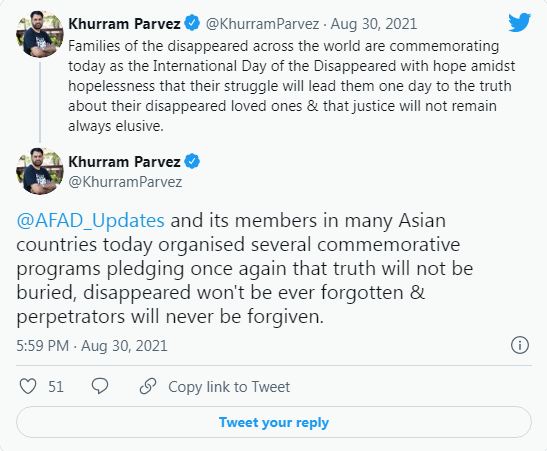
Two days before his arrest, the immigration authorities in the country had refused to let him board a flight to Geneva where he was scheduled to address the United Nations Human Rights Council about India’s human rights record.
Read Also: Salman Khan says will not hand over stardom to next generation, suggests mehnat karo bhai
JKCCS has published some of the most damning reports on human rights violations in Kashmir, the latest titled “Kashmir’s Internet Siege” on mass detentions and the justice system amid Internet restrictions following the abrogation of the state’s special status on August 5, 2019.





India News
Supreme Court questions EC over missing records in Sringeri election dispute
The Supreme Court questioned the Election Commission over missing video footage of the 2023 counting in Karnataka’s Sringeri constituency. The case involves a revised result following a recount of postal ballots.

India News
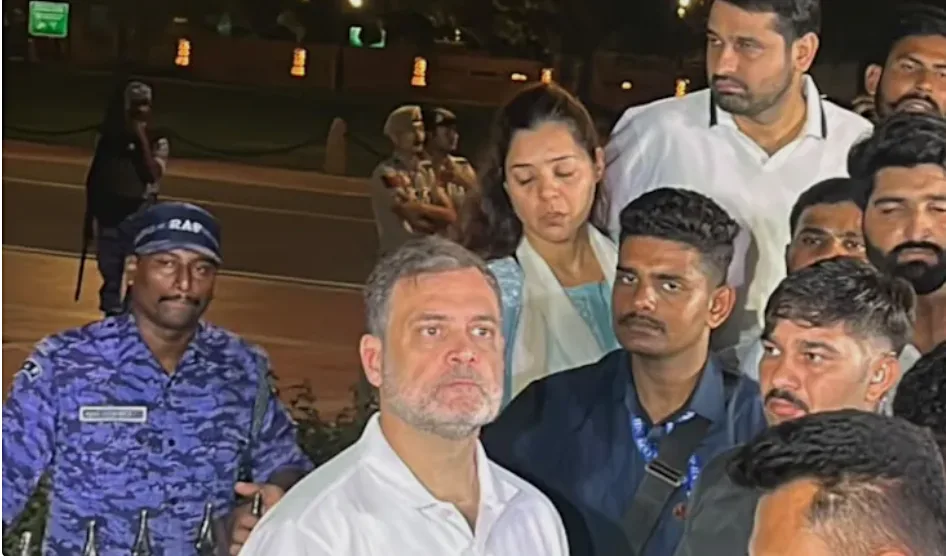
Rahul Gandhi joins India Gate protest by Ankita Bhandari’s parents
Rahul Gandhi joined the protest by Ankita Bhandari’s parents at India Gate in New Delhi on October 14. The demonstration has brought renewed attention to the 2022 murder case and the family’s concerns following Dushyant Gautam’s appointment as Sikkim Governor.
India News
Meerut murder: Muskaan Rastogi and Sahil Shukla get death sentence
A Meerut court has sentenced Muskaan Rastogi and Sahil Shukla to death in the blue drum murder case involving the killing of merchant navy officer Saurabh Rajput in March 2025.

CJP leaders Saurav Das, Ashutosh Ranka, Ajinkya Shinde sent to 5-day judicial custody

PM Modi speaks to Mark Carney as India and Canada push to strengthen ties

S Jaishankar says India is a natural option for Russia amid Europe tensions

Meerut murder: Muskaan Rastogi and Sahil Shukla get death sentence

Rahul Gandhi joins India Gate protest by Ankita Bhandari’s parents

Supreme Court questions EC over missing records in Sringeri election dispute
Rahul Gandhi joins India Gate protest by Ankita Bhandari’s parents
Meerut murder: Muskaan Rastogi and Sahil Shukla get death sentence
PM Modi speaks to Mark Carney as India and Canada push to strengthen ties
S Jaishankar says India is a natural option for Russia amid Europe tensions

Afghan Men Try To Hang With The Jet Engine Of The Aircraft in Kabul- Afghanistan News – Kabul News
Trending Top 10 News: 10000 Crore Fine on Flipkart, Apple to Launch Unique Feature, Hdfc Bank Job Ad

Trending Top 10 News: Nokia 6310, Apple sales, Bachpan ka Pyar Video Kid, Dainik Bhaskar IT Raid

Trending Top 10 News: Canada bans Indian flights, Rain in Delhi NCR, AIMIM Twitter hacked, Raj Kundra case

Trending Top 10 News: Shein India, Apple New Service, Pocket Oxygen, Oppo Launched New Phone
-
 India News21 hours ago
CJP leaders Saurav Das, Ashutosh Ranka, Ajinkya Shinde sent to 5-day judicial custody
-
 India News20 hours ago
PM Modi speaks to Mark Carney as India and Canada push to strengthen ties
-
 Latest world news21 hours ago
S Jaishankar says India is a natural option for Russia amid Europe tensions
-
 India News10 hours ago
Meerut murder: Muskaan Rastogi and Sahil Shukla get death sentence
-
 India News9 hours ago
Rahul Gandhi joins India Gate protest by Ankita Bhandari’s parents
-
 India News9 hours ago
Supreme Court questions EC over missing records in Sringeri election dispute
