English हिन्दी
Connect with us

India News

Mallikarjun Kharge warns action against workers over DK Shivakumar slogans

Congress president Mallikarjun Kharge warned party workers of disciplinary action after pro-DK Shivakumar slogans disrupted a Congress programme in Bengaluru.

Published

on

mallikarjun-kharge

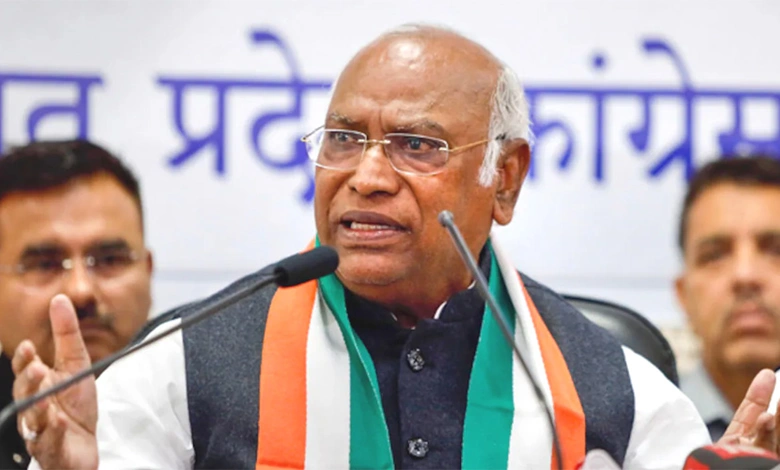
Congress president Mallikarjun Kharge on Sunday strongly reprimanded party workers after a section of the audience raised slogans in support of DK Shivakumar during a party programme in Bengaluru. Kharge also warned that disciplinary action could be taken against those responsible for disrupting the event.

The incident took place during the ‘Sankalpa Samavesha’ programme, where party leaders had gathered for an organisational event. According to reports, some workers repeatedly chanted “DK-DK” slogans, prompting Kharge to intervene and ask them to maintain discipline.

Visibly upset by the sloganeering, Kharge reminded workers that the gathering was meant for the party and not for promoting individual leaders.

“This is not an individual’s programme, it is a party programme,” Kharge said while stressing that Congress functions as an organisation rather than around personalities.

The veteran leader also expressed displeasure over the disruption, questioning why a few people should dominate proceedings when many others had attended the programme. Referring to his long political career, Kharge said the party had contributed significantly to the rise of many leaders and emphasised the need to uphold organisational discipline.

Warning the workers against similar behaviour in the future, Kharge said footage from the event would be examined and action would be taken if necessary.

“Discipline is always necessary for the party. Whoever is shouting here, there will be footage. I will take disciplinary action after reviewing the footage,” he said.

The episode once again highlighted the importance the Congress leadership places on party discipline during organisational events in Karnataka.

India News

Delhi Police lathicharge ahead of CJP’s march to Parliament triggers chaos

Published

on

By

Delhi Police personnel on Monday lathicharged supporters of the Cockroach Janta Party (CJP) from marching towards Parliament, which began its sitting for the Monsoon Session today, triggering mayhem and chaos.

The protest, Chalo Sansad, was organized by CJP founder Abhijeet Dipke to demand accountability over alleged irregularities in national entrance examinations and the resignation of Union Education Minister Dharmendra Pradhan.

Thousands of protesters gathered at Jantar Mantar despite the police refusing permission for the march. As demonstrators attempted to move towards Parliament, security personnel, including the Rapid Action Force (RAF), stopped them using barricades. Then clashes broke out between protesters and police. Visuals from the protest showed police using batons to disperse the crowd and restore order.

Ahead of the protest, Abhijeet Dipke had appealed to supporters to remain peaceful and carry a rose and a copy of the Indian Constitution as symbols of non-violence. Despite this appeal, the march was not allowed because Delhi Police said no permission had been sought or granted. Authorities also imposed Section 163 of the Bharatiya Nagarik Suraksha Sanhita (BNSS) in the New Delhi district, prohibiting large gatherings due to the beginning of the Monsoon Session.

Ladakh climate activist Sonam Wangchuk, who has been now moved to Safdarjung Hospital, had been on a hungerstrike demanding accountability for alleged failures in the education system and examination paper leaks. Wangchuk was shifted to the hospital after his health deteriorated, the move has further intensified public support for the protest.

The police action caused traffic disruptions around Jantar Mantar, Parliament Street, and nearby areas, while security was significantly tightened across central Delhi. Additional police personnel, barricades, and surveillance teams were deployed to prevent protesters from entering the high-security Parliament zone.

Several Metro stations around the Jantar Mantar protest site and Parliament were shuttered. Delhi Police have warned that legal action will be taken against anyone violating prohibitory orders. Meanwhile, CJP leaders have said their movement will continue until their demands are addressed.

Continue Reading

India News

Parliament’s Monsoon Session begins today amid political clashes over key bills

Parliament’s Monsoon Session starts today with 19 sittings scheduled until August 13. Political clashes over the NCPI, key bills, NEET-UG and other national issues are expected to dominate proceedings.

Published

on

Parliament

The Monsoon Session of Parliament is set to begin on Monday with the Centre and the Opposition preparing for sharp confrontations over several political and legislative issues. The session will have 19 sittings and is scheduled to continue until August 13.

Several controversial bills, political developments and national issues are expected to dominate proceedings. Prime Minister Narendra Modi is also expected to address the media before Parliament convenes.

Opposition targets NCPI over recognition issue

One of the major flashpoints is the recognition of the Nationalist Citizens Party of India (NCPI), which has drawn criticism from Opposition parties.

The Opposition staged a symbolic walkout during an all-party meeting after Parliamentary Affairs Minister Kiren Rijiju invited NCPI representatives. Opposition leaders alleged the party is acting as a platform for 20 rebel Trinamool Congress MPs, arguing that the Lok Sabha Speaker has not yet formally approved their merger with the NCPI.

Congress leader Jairam Ramesh and Trinamool Congress MP Mahua Moitra questioned the legitimacy of the group’s recognition, while Speaker Om Birla has allowed the rebel MPs to sit separately until a decision on the merger is taken.

Responding to the criticism, Kiren Rijiju described the walkout as symbolic and said no Member of Parliament could be denied participation based on numerical strength. NCPI chief Sudip Bandyopadhyay defended the party, describing it as a secular organisation committed to communal harmony.

NDA numbers under focus

The political significance of the merger also extends to the strength of the National Democratic Alliance (NDA) in the Lok Sabha.

The NDA currently has 298 members in the 540-member House, where three seats remain vacant. If the Speaker approves the merger of the 20 rebel MPs with the NCPI, the alliance’s tally would increase to 318, bringing it closer to the two-thirds majority mark of 360 seats.

Key bills likely to dominate the session

The government is expected to introduce and debate several important bills during the session.

Among them is the Constitution (131st Amendment) Bill, which proposes increasing the strength of the Lok Sabha to 850 seats while implementing 33 per cent reservation for women. The proposal was defeated earlier this year after Opposition parties raised concerns over the delimitation process, with parties such as the DMK arguing it could reduce the political representation of southern states.

Law Minister Arjun Ram Meghwal is also expected to introduce the Supreme Court (Number of Judges) Amendment Bill, 2026. The legislation seeks to replace an ordinance and increase the sanctioned strength of Supreme Court judges from 33 to 37.

Another closely watched proposal is the Foreign Contribution (Regulation) Amendment Bill, which aims to establish a designated authority to manage and dispose of foreign assets. The bill also proposes stricter provisions for cancelling the FCRA registrations of NGOs after expiry of their certificates.

Opposition plans to raise NEET and Ayodhya issues

Apart from legislative business, the Opposition is expected to raise several national issues during the session.

Aam Aadmi Party MP Sanjay Singh has submitted a notice in the Rajya Sabha seeking a discussion on the NEET-UG paper leak. Opposition parties are also expected to raise allegations related to the reported theft of offerings from the Ayodhya Ram Temple.

Ahead of the session, Speaker Om Birla urged all political parties to ensure that debates remain constructive throughout the proceedings.

Continue Reading

India News

Sonam Wangchuk sets three conditions to end hunger strike after hospitalisation

Sonam Wangchuk has said he will end his hunger strike only if three conditions related to the alleged NEET paper leak issue and Parliament assurances are fulfilled while he remains admitted to Safdarjung Hospital.

Published

on

Sonam Wangchuk

Activist and educator Sonam Wangchuk has said he will end his hunger strike only if three conditions are fulfilled, days after being shifted to Delhi’s Safdarjung Hospital following concerns over his deteriorating health.

In a handwritten letter shared from the hospital, where he alleged he was being kept under “illegal detention”, Wangchuk outlined three demands that he said must be met before he agrees to end his fast.

Wangchuk lists three conditions

According to the letter, Wangchuk’s first condition is that the government should accept responsibility for what he described as failures in the education system, particularly the alleged NEET question paper leaks.

His second demand is for political leaders to assure him that the paper leak issue will be raised in Parliament.

As his third condition, Wangchuk said senior political leaders should visit him at Safdarjung Hospital and personally assure him regarding the first two demands if his health does not permit him to participate in the planned Parliament march.

The activist also wrote that his “freedom of movement, speech, and all communication are restricted” during what he described as his “illegal detention”.

Hunger strike began over education issues

Wangchuk, who has frequently campaigned on issues concerning Ladakh and education reforms, joined a protest at Delhi’s Jantar Mantar on June 28 seeking the resignation of Union Education Minister Dharmendra Pradhan over the alleged NEET paper leak issue.

He has remained on a hunger strike for more than 20 days as part of the protest.

On the morning of July 18, the 21st day of his fast, Delhi Police shifted him from the protest site to Safdarjung Hospital after doctors reportedly warned that his condition had become critical, with concerns about possible organ failure. The move also came after the Delhi High Court directed authorities to take all necessary steps to protect his life.

Delhi High Court declines interim relief

Meanwhile, Wangchuk’s wife, Gitanjali Angmo, approached the Delhi High Court seeking permission to shift him to a private hospital.

However, Justice Mini Pushkarna declined to grant interim relief, observing that the authorities were within their rights to move Wangchuk to Safdarjung Hospital since he had not admitted himself despite his worsening health.

The court also noted that doctors were closely monitoring his condition and administering oral medication with his consent, adding that there was no evidence of force or violation of his autonomy at this stage.

Senior advocate Vivek Tankha said Angmo is expected to challenge the order before a division bench of the Delhi High Court and seek an urgent hearing.

Continue Reading

Trending

© Copyright 2022 APNLIVE.com